By Stephanie Orr
Copy Editor
Photos by Stephanie Orr
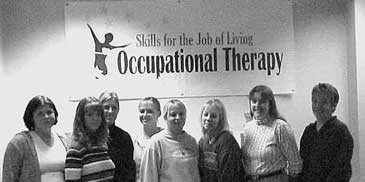
Presenting the OTA class of 2003. From left to right, Beth
Kaufman, Melissa Batchelor, Laurie Haselhorst, Sarah Feldman, Jessica Sams,
Christine Wilkerson, Nora Laird and Instructor Kim Keubrich.
Introducing OT, OTA and OTR
Jim has played football since
high school, and he has hopes of being drafted into the NFL. He played for his
college team, and his last game was being watched by several NFL scouts.
Jim played exceptionally well. During the last play, Jim went for a final
touchdown. He caught the ball and headed for the end zone. He was almost there
when something went terribly wrong, and he was tackled. Jim had been tackled
hundreds of times before, but this time he could not get up. His legs were
totally numb.
He woke up in the hospital to the news that he was paralyzed from the chest
down. What is next for Jim? How is he going to bathe or dress himself? Will he
be able to finish school or live alone?
Jim is facing a tough rehab program including physical therapy, psychological
counseling and Occupational Therapy (OT). Hopefully, when all is said and done,
Jim will be able to lead a satisfying and independent life.
OT is a health and rehabilitation discipline that focuses on restoring function
and increasing functional independence. Using purposeful activities, an OT helps
a person relearn how to do every day occupations, such as bathing, working,
eating, playing or dressing. OTs help people get around their physical or
psychological hurtles and regain their independence.
OTs and Certified Occupational Therapy Assistants (COTA) work in a number of
areas. People young and old, mentally disabled or physically ailing may need OT.
The field of occupational therapy has a bright future. According to the US
Department of Labor there is expected to be a 30 percent increase in jobs
available between now and 2008. This includes both Registered Occupational
Therapists (OTR) and COTAs.
Jim’s story is totally hypothetical, but LC has offered an A.A.S. in OTA since
January of 1999.
 |
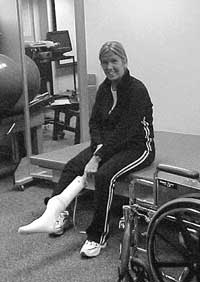 |
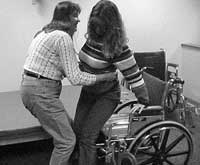
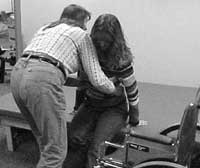
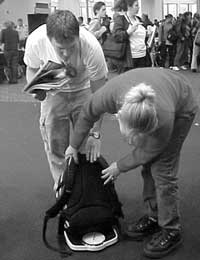
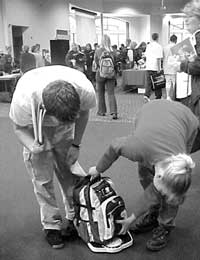
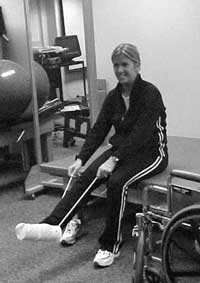
| Laurie Haselhorst, an LC student enrolled in the OTA program, demonstrated using a sock-aid. A piece of adaptive equipment, sock-aids are used by people who are not able to bend over safely due to balance disorders, healing hip fractures or other reasons. This tool increases independence while dressing. | |
| Student | Instructor |
 |
|
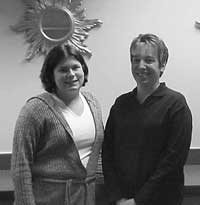
| Beth Kaufman is a 20-year-old LC
student in the OTA program. She graduated from Edwardsville High School and
knew she wanted to go into some type of therapy. An Internet search led her
to OTA. LC was her first choice because it was the closest school that offered an OTA program. Before applying to the program, Kaufman went to St. Clair’s Hospital to observe an OTA at work and liked what she saw. “Helping someone get back independence, so they can do something for themselves,” said Kaufman, attracted her to OTA. “I’d like to see me make a difference in someone.” Kaufman described the program as fast-paced, but said that students get personalized attention from the instructors, and that makes it easier to handle. “Linda Orr (coordinator of the program) made a big difference,” said Kaufman. “I recommend [the program] to anyone with the drive to help someone out.” She also suggests that anyone interested in OTA visit the program. “I’m ready to get out and apply what I am learning,” Kaufman said. She hopes to get a job at Christian Northeast Hospital, or somewhere comparable, but has no preference as to what age group she works with. “I didn’t realize [upon entering the program] all the different people and conditions we get to work with,” Kaufman said. |
Kim Kuebrich started working at LC
this semester as an Instructor for the OTA program. She teaches Physical
Components I and Adaptations to Daily Living (ADL). Kuebrich has been an OTR
for eight years, and also works at St. Anthony’s Hospital. Kuebrich believes that people generally do not have a good understanding of what OT is or does. “You have to look at an ‘occupation’ as a daily event,” said Kuebrich, “[for example] a child’s occupation is play.” When an OT works with a child it looks like they are simply playing with them, but Kuebrich points out that they are doing purposeful activities. “We have goals,” she says. Kuebrich thinks that one of the best things about OT is the diversity. OTAs work with people of all ages. They work in schools, nursing homes, psychiatric units or hospitals. “It’s hard to get burnt out because there are so many different areas,” Kuebrich said. “If you get tired of one you can move to another with the same skills.” OT is a very rewarding career. Kuebrich said, “How many people can say, ‘my job is to maximize function and independence’?”
|
If you or someone you know is interested in perusing a career in OTA, contact Linda Orr at (618) 468-4416, or stop by the LC OTA facilities on the first floor of the Math Building.