|
More books for the RML
By Stephanie Orr
Copy Editor
Over the summer, 8,000 new books were added to the Reid
Memorial Library (RML) collection. Additions cover topics across the
colleges’ curriculum, with a number of the volumes relating to career
programs on campus. The LC Foundation provided most of the funding for the
purchase.
At present, about 2,500 of the books have been added to
the online catalog and put on the shelves. The remaining titles are expected
to be available to the student body by the end of the year. The library
usually gets between 1,000 and 1,500 new volumes annually.
Another new addition to RML is the Special Collections
room. Located in the former juvenile reading room, this cozy alcove is
adjacent to the main reading area and houses the colleges’ impressive Local
History and Lewis and Clark collections. According to RML director Dennis
Krieb, “it’s a nice little room to sit and read the paper.”
The expansion was initiated to prepare for academic
accreditation for 2003. During the previous accreditation in 1992 it was
briefly mentioned that the RML had inadequate holdings for a community
college of its size. In theory, a population the size of LC’s should have
access to a library with approximately 60,000 volumes, according to Krieb.
Physically, RML can hold a maximum of 45,000 books. “But that doesn’t mean
we’re below par,” states Krieb, “…it means we have a lot of room to grow.”
And grow it will, if recent events are any
indication. According to Krieb the library is seeing a boost in traffic; the
number of people checking out books is up roughly 44 percent, and the
library’s academic search databases, which can be accessed from home, are
seeing 300-400 hits per day. The inter-library loan service offered by RML
is also popular.
Top |
Student Profile:
Layla Clark
By Julia Batty-Photographer
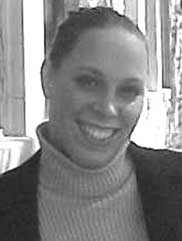
Layla CLark is a twenty-eight year old student, who is back
on campus after a ten year hiatus.
She was born an raised in Godfrey, but has spent the last ten
years living in St. Louis and San Diego working in various jobs and enjoying
life. She Feels the time off was of enormous help to her as a student.
She says her mind is really present now on schoolwork and career motivation,
more so then it could ever have been at eighteen, or even twenty.
Layla has been at LC for three consecutive semesters and plans to transfer
to SIUE next year. She plans to major in education with an emphasis on
English and Literature.
Place an add with

|
Simple Tips For
Reducing Backpack Injury
-
Choose a pack that is appropriate for your size and age.
-
Load the heaviest items closest to the back of the pack.
-
Do not carry more than 15% of your body wieght in the
pack.
-
Wear both shoulder straps for an even load.
-
Adjust the pack so that it fits snugly against your back.
Place an add with
|
|
Backpack Awareness Day
By
Stephanie Orr
Copy Editor
The American Occupational Therapy Association (AOTA) and L.L. Bean are
identifying backpacks as a health issue.
“Students are risking back pain and injury by carrying backpacks
that are too heavy or packed improperly,” says Linda Orr, coordinator of
LC’s Occupational Therapy Assistant (OTA) program.
According to AOTA students should carry no more than 15 percent of
their total body weight in a school backpack.
According to the US Consumer Product Safety Commission’s National
Electronic Injury Surveillance System database, 2001, more than 7,000
emergency room visits were related to improper backpack use.
“Students who are experiencing an aching back and shoulders,
weakened muscles, tingling arms, or a stooped posture may be carrying
too much weight on their back, packing their bag improperly, or wearing
their bag incorrectly,” says Orr.
During Transfer Day on Oct. 23 in the Commons from 11 am to 1, the
OTA club will be manning a “Backpack Awareness” booth where students
will be able to find out if their school bags are too heavy.
The OTA club members will be available to assess students’ backpack
health, and offer tips and suggestions on how students can guard
themselves against backpack related injury. |
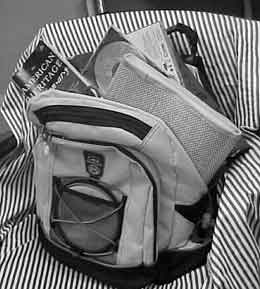
This is not the proper way to pack a backpack.
PHOTO BY STEPHANIE ORR |
|