Vulnerabilities in Firewalls
Vincent Law 014-68-0083
Courtesy of UC Davis Computer Science Department ECS 289M Spring 2002
Abstracts
Nowadays businesses,
as many of 80 percent of all the sites, have been employing firewalls as the
means of protection for themselves against potential attacks. They see
firewalls as entrance guards for any incoming traffic. Therefore, it makes
firewall as the only entrance. However, misusing firewall can still be
dangerous to a network and the consequence can also be very disastrous. Therefore,
good configuration and effective security testing are necessary in order to
ensure the security policies are properly implemented in the firewall. This
article describes some effective steps in testing the firewall and outlines the
vulnerabilities currently discovered in firewalls by systematically classifying
them based on Aslam’s vulnerability taxonomy scheme.
Introduction
Before Internet’s emergence, blocking network traffic is a
totally ridiculous idea. Network interoperability, efficiency and traffic
transparency are what everybody wants. This all changed once Internet became
its dominant usage for general public use. Internet was no longer an
internetworking medium only for the researchers and academic personnel, but to
everyone in public. This means that researchers can no longer use the Internet
as a “playground” to freely include any untested feature that can potentially
harm not only the network itself but also its users. This started the firewall
concept.
Firewall Controversies
Firewall security is a very
controversial Internet topic. While some feel the firewall is very secure
because it aggregates security functions in a single place, thus simplifying
management, installation, and configuration. On the other hand, others feel
that firewall can cause damages for the same reason simply because it provides
"a hard, crunchy outside with a soft chewy center", which means
firewall can give users a false sense of security, leading to lax security
within the firewall perimeter. They observe that most of the “computer crime”
in corporate environments is actually perpetrated by insiders who are immune to
the perimeter defense strategy. Firewall advocates counter that firewall is so
important that it can still act as an additional safeguard instead of as a
substitute for careful security management within the perimeter. Yet, firewall
detractors are also concerned about the difficulty of using firewalls,
requiring multiple logins and other out-of-band mechanisms, and their
interference with the usability and vitality of the Internet.
Firewall concepts and classification
The general firewall architectural
model should separate policy, which is determining whether to grant service
access to service requester or not, from control, i.e., limiting resource access
to the service users. Earlier firewalls were router-based, using the routers to filter out unwanted packets
based on the header information and the access control list rules inside the
routers, by means of association,
which matches a combination of fields such as source and destination addresses,
protocols used, other source and destination information etc with the policy
rules in the router. Based on the TCP/IP level (OSI layer 3), if the
destination address is permitted by the rules, then the packet can go through,
otherwise the packet is dropped and the router will also notify the sending
system not to send any more related packets. This is why it is also called packet filtering. However, this handling
scheme was so inefficient because of the filtering and the maintenance and
updating of the rules within the routers, and it did not have memory to store
past events in order to act as an influence of future events, i.e. stateless
and no detailed logging. Worst of all, since it does not prevent any direct
connections to internal hosts by external clients without authentications, it
remains vulnerable to attacks such as source address spoofing. As a result, the
concept of TCP/IP security approach, a.k.a. application
gateways or proxy servers, began
to emerge. The application gateway itself, operating at OSI layer 7
(application layer), serves as the “server” to the client user, and the
“client” to the remote server. Therefore, it can control over what a client can
do and cannot do, not only based on service but also on time-of-day controls. Authentication
therefore is supported at the user-level. It also has an advantage in which the
gateway becomes an excellent location for comprehensive logging because it can
recognize, capture and interpret the client commands and activities in great
details, thus making the gateway itself the “representative” of all the
internal clients. However, application gateways suffer the overhead whenever
every incoming data packet is checked. One other concern is the lack of instant
allowance of any packet from a completely new application even though that
application is not expected to pose any harm, but this concern has been
somewhat addressed by the introduction of tools enabling the creation of
“generic” proxies that are application-aware. Still, gateways themselves are
application programs, thus they have to suffer the overhead of swapping memory
between the program and the OS. Fortunately most industry products are capable
enough to handle this problem through hardware, plus they provide prevention of
the support of dangerous protocols. A newer technique was later derived from
the original router filtering concept, and is called stateful inspection (or sometimes referred to stateful packet filtering, an enhancement to dynamic packet filtering as opposed to static packet filtering mentioned earlier), and it is installed and
running as part of the OS. Like packet filtering (also at OSI layer 3), it
loads the stateful inspection module just as the packet enters the router and
before the OS begins processing the packet in the higher layers, thus
eliminating the need of copying the data from the OS into the user space.
Instead of examining each packet independently of previous traffic, it keeps
track of the past history by treating the first packet of the new transaction
the “representative” of the whole stream, and the decision, no matter whether
the packet is permitted or not, will be stored as the more current state
information or the current session. Subsequent packets will then be handled the
same way as the first packet, thus eliminating the overhead of per-packet
checking. A various, and more flexible, version developed by Check Point even
enhanced it by allowing the peeking of each packet only at the application
protocol, simply because of the fact that one transaction may lead to dynamic
changes to this or other transaction’s state. Both static router-filtering and
stateful inspection can be fooled by protocol
tunneling, especially for the case of stateful packet filtering because it
does not examine the data which may be dangerous. Protocol tunneling is the
cooperation of data exchange through the use of one permitted protocol to
transmit another protocol which is prohibited, and sometimes it can be disastrous
if the application poses any threat to the network. One example is that the DNS
port could be used to transfer file data. Another is the sendmail attack. So it is vulnerable to packet-based attacks given
the fact that the packet will be allowed to pass or be forwarded as long as the
first packet satisfies the security rules. Application gateways also cannot
prevent this from happening, but at least they can log and authenticate (at OSI
layer 7), allowing the inspectors to locate the abused protocol. Yet its
flexibility allows the dynamic configurations, such as using the INSPECT
language to add new services, of which applications to support provided careful
configurations, and most of these applications involve in communicating with
the OS module to modify the rule base and control operation, logging, and
authentication if supported via application gateway. Based on the tradeoffs on
both packet filtering scheme and application gateway model, hybrid firewalls
are available in the market currently as a compromise of both advantages. Since
firewall represents what kind of data and traffic inspections the network is
employing, it can be viewed as a representation, or implementation, of the
network’s security policies, and therefore the selection and comparison of both
firewall schemes will continue to be an ongoing issue.
Common attacks
against, as well as attack precautions for, firewalls
There are always methods to attack a firewall. Here are some
of the popular ones
- Normally,
both the source and the destination determine the packet route. The packet
itself only stores the destination address, but nothing about how it
expects to get there. Sender has an option to include information in the
packet that tells the route the packet should take to get to its destination.
There comes the name source routing.
For a firewall, source routing is noteworthy, since an attacker can claim
his/her own generated traffic to be from a host “inside” the firewall. In
general, such traffic wouldn't route to the firewall properly, but with
the source routing option, all the routers between the attacker's machine
and the targeted host will return traffic along the reverse path of the
source route. On the other hand, in practice, source routing is very
little used. In fact, generally the main legitimate use is in debugging
network problems or routing traffic over specific congestion control links
for specialized situations. When building a firewall, source routing
should be either disabled or blocked at some point. Besides faked traffic,
attacks can also be directed to a wrong router.
- In
ICMP, an ICMP Redirect tells the recipient system to override something in
its routing table. Routers use it to tell hosts that the host about the
use of a non-optimal or defunct route to a particular destination, i.e.
the host is sending it to the wrong router. The wrong router sends feedback
to the host by an ICMP Redirect packet telling the host what the correct
route should be. Forging ICMP
Redirect packets to a host that pays attention to them can alter the
routing tables on the host and possibly subvert the security of the host
by causing traffic to flow via an unintended path or even causing denial
of service attacks.
- DoS
attacks happen simply because of the distributed nature of the network, in
which every network node is connected via other networks which in turn
connect to other networks etc. Only a few of local elements within reach
are under the control by a firewall administrator or ISP. An attacker then
can always disrupt an upstream connection from where the victim controls
it. In other words, if someone wanted to take a network off the air, they
could do it either by taking that network off the air, or by taking the
subsequent networks it connects to off the air.
- SMTP
server hijack happens when a spammer takes many thousands of a message
copies and sends it to a huge email address list. As these lists are often
already so bad, and in order to increase the speed of spam operation, many
have resorted to simply sending all of their mails to an SMTP server that
will take care of actual mail delivery. All of the bounces, spam
complaints, hate mail, and bad PR come for the site that was used as a
relay.
- Any application
software cannot avoid the existence of bugs. There are bugs allowing
remote users to do things ranging from gaining unauthorized machine control
and even making that application crash. This risk exposure can be reduced
by running only necessary services, keeping up to date on patches, and
using products that have been around a while.
- Besides
application bugs, OS also has bugs. These are also typically initiated by
users remotely. OSs relatively new to IP networking tend to be more vulnerable
and problematic, because most mature operating systems have had enough time
to locate and eliminate these bugs. An attacker can often cause the target
equipment to continuously reboot, crash, lose the ability to talk to the
network, or replace with harmful files on the machine. In this regard,
running as few OS services as possible can help and having a packet filter
in front of the OS can reduce the exposure to a large number of these
types of attacks.
Auditing is necessary
because firewalls are still vulnerable
Approach for the early days of firewalls is more
conservative and more for rigorous defenses, and that is why these firewalls
are more difficult to install, configure, and use. On the other hand, contemporary
firewalls, while more user-friendly and easier to use, are generally considered
as more susceptible to vulnerabilities. Survey by the Computer Security
Institute at the end of 1997 indicated that about 30 percent of security breaches happened in places with firewalls
installed. Among them, over half of them
(about 51 percent) reported firewall
mis-configuration and as high as 41
percent cited product weakness.
Some of these firewalls even allow users to make them less secure. The
inclusion of GUI to the firewalls no doubt increases the user-friendliness of
the firewalls, but the main approach of firewalls is not the ease-of-use but
security. In fact, the introduction of GUI is one of the reasons firewalls may
not seem as secure as before, simply because GUI has integrated a lot of
insecure options into the products, and most of them should not even be
included for considerations. These inclusions make the firewall administrators
think that these are designed as part of the safety features. In additions,
because of this misunderstanding, auditors will usually skip detailed investigations
as long as the firewalls exist (“Does firewall exist? Yes. Next item”), as a
result ignoring the potential loopholes undetected assuming firewalls to be
safely-configured enough to catch and handle them. As for protection, firewalls
cannot prevent any attack by tunneling over most application protocols. For
example, tunneling ``bad'' and offensive things over HTTP, SMTP, and other
protocols is quite simple and trivially demonstrated. There are also some other
known backdoors allowing an attacker to get past the firewall without being
noticed. Examples include:
- using
remote administration tools which can effectively become backdoor access
tools if used maliciously
- prompting
email recipients to run a test program provided by the sender where the
test program is indeed an installation program for perhaps a virus
- executing
a rootkit to gain root access under a magic password or a discard port
- running
LOKI through the use of ICMP Echo Response packets, which normally are
simply response packets as a reply to, for example, ping, to bypass the
firewall checking freely, but in LOKI these packets may include illegal
piggyback commands
- emulating
a remote web server so that it can gain access behind a targeted firewall,
and
- converting
or encoding a malicious request to a usually firewall-permitted request,
such as web browser request.
Hence, in order to use firewalls properly and safely,
correct firewall auditing procedures should be regularly conducted. These
auditing steps are as follows:
- requiring
and acquiring a hard copy of security policies, because without a written
policy, it means there are no clear goals in mind and firewalls are
relegated to be just another network-based devices which are not only
costly but also hindering network traffic performance
- listing
of permitted services based on the policies
- checking,
comparing and correcting the compliance of the firewall with the service
list, including the handling of accesses and interactions with untrusted
sources
- checking
the patches
- investigating
the necessities and risks of the existence of the excessive services not
included in the list, and ensuring the shut-down of these services, which
may include negotiations with involved department or personnel, if found
unnecessary
- scanning
of the firewall upon the service appearances
- probing
the hosts protected behind the firewall
- examining
the log maintenance, and
- paying
attentions on who check(s) the daily reports.
Documenting the firewall configurations is recommended,
because it will be easier to perform some of the above steps such as the
compliance checking to find out why unlisted services are included, and it is
also easier to identify who may need these unlisted services according to the
information revealed in the logs. One more important practice to ensure
security is to frequently check to see if the firewall is functioning. Crashing
the firewall software is one of the most traditional methods to break into the
firewall. Without periodic monitoring, there is no guarantee that the firewall
is present for defense against any sudden attack.
Testing Firewall
Although the firewalls currently available in the market are
very advanced in designs and implementations, their vendors have not been able
to provide as advanced firewall testings. Some of the firewall testing teams
have some knowledge on the technology of firewall testing, yet few of them
genuinely understand the whole firewall testing process. After all, firewall
testing is not like other security testing such as penetration testing. Knowing
the technology well is not good enough to provide adequate firewall tests.
Therefore, Dr. E. Eugene Schultz proposed a scheme to effectively test the
firewalls. The scheme includes the followings:
- covering
the nature of firewall testing
- the
goals of firewall testing
- proper
firewall testing procedures
- proper
persons to perform the testing
Nature of Firewall Testing
Firewall test is first and foremost viewed as a kind of
penetration test, which uses techniques designed to attempt to defeat and
bypass current security settings, in order to figure out how effective of the
current security mechanisms. The test team members act as intruders to try to
simulate a real-life attack to the targeted system, which in turns exploit any
security breach and security inadequacies. The tests have to be performed
properly so that no catastrophic consequence will result. To meet this
requirement, planning is necessary and it is in fact the most basic step to
effectively test the firewalls. First, ground rules for testing have to be
established in much the same way as developing firewall policy before
developing the firewall. Issues to be considered include:
- rationale:
proper testing is necessary to determine, through empirical methods, the
firewall’s ability to prevent likely attacks by intruders
- management
cognizance and approval: without management approval, the test, like
obtaining password files from a corporate machine, can be both
catastrophic to the company and may result in felony charges against the
testers
- disruption:
test script may be able to attack the network to halt any network service
if planning is mishandled
- pre-notification:
large amount of time may be wasted if the test is not noticed and the test
attack can lead to timely investigations, not to mention the absence of
preparations to possible damage to the targeted network’s utilities
- supervision:
an advantage of supervising testing activity is to learn how it is done
and how the firewall withstands attacks, and to ensure that the person
conducting the test does not do anything unethical, as long as the
supervising does not slow down the testing considerably or cause any
misleading to the tester.
- use of
results: before testing begins, management and technical personnel should
determine how to learn from and use the test result in deciding whether to
continue using or replacing the firewall or not.
- safeguarding
results: careful planning has to be made on protecting and keeping the
test results long before the test commences, so that the results will not
end up in the hands of a malicious person who can use it as the leverage
against the organization.
Firewall Test Goals
After deciding to test the firewalls and setting up the
ground rules for the tests, specific goals for the tests have to be determined.
The highest level of the goal is to observe whether the firewall is secure enough
to withstand attack situations under current configurations. However, specific
goals have to be made because these specific goals will be used as the
functional guidelines for the tests and how to interpret the results. Specific
goals are usually formulated from these questions:
- Is the
firewall implementation and configuration reflecting the security policy?
- How
well can the firewall resist and withstand particular types of attacks,
especially those new ones?
- Does
the leakage or bypass occur in the security perimeter created by the
firewall and how does it occur?
- How
adequate is the logging capability and can the log help effectively in
discovering and locating attacks?
- Can
the firewall trigger and send an alarm after penetration test commences?
- How well
can the firewall hide information and addresses from the protected network
so that potential attackers cannot retrieve them?
Proper Firewall Test
Procedures
Security testing will not be effective and efficient without
clearly-stated, detailed, written procedures that can be easily followed.
Firewall security testing is no exception. In order to ensure proper firewall
security testing, no prevention omission, and replicability of the test
procedures and findings, the following steps are encouraged to perform:
- Create
a test plan, including test scope specifications, targeted firewall(s) and
host(s), test goals, required steps to achieve the goal.
- Develop
specific procedures used for the test, like what traceroute commands to
use, the steps needed for interactive tests, and the attack scripts for automated
tests.
- Carefully
determine which parts require interactive tests due to possible
out-of-control situations or necessity of step-by-step observations, and
which parts need automated tests due to time-saving reasons. Besides, the
tests have to be made sure to be conducted in a non-production because any
failure will not cause damage or disruption.
- A
decision has to be made on how thorough and deep the tests should be
performed before a proof of protection or penetration is achieved. The
decision has to be rule-based and depend on the goals, as long as no
significant disruption or damage will be resulted in the network
operations.
- Exact
and proper firewall security test documentations not only helps the record-keeping
of every action taken, results, location of the source and targeted host,
and other critical information on the data and observations, but also
ensure that no planned steps will be missed. This requirement also allows
the addition of any missing details and actions if they are found to be
missing during the tests.
- Careful
documentations also produce conclusions and recommendations for future
improvements on the firewalls, even though some details or vulnerabilities
may seem insignificant because they may turn out to be significant
themselves or lead to other significant details. A good report reflects
the value of a well-planned and well-executed test. The report should have
these criteria included:
- Objectivity
in methodology and findings helps avoid any confusion or speculation.
- Thoroughness
helps its usefulness in archiving the report for targeted reviewers who
will refer to the report later for decision-making.
- Clarity
enables the report easy enough to understand by those who are not
technically proficient enough. Using footnotes on some technical terms is
also helpful.
- A
well-organized report is more understandable and easier to keep the
readers’ interest in continuing the reading, and as a result increase the
usefulness of the report. Also avoid any tedious descriptions so that the
reviewers can locate sections such as backgrounds, methodology, findings,
conclusions, and recommendations, from the report.
- A
solution-oriented report possibly with priority for each found security
weakness helps the administrators in looking for solution(s) because some
solutions for certain vulnerabilities may already be suggested in the
report.
- Credits
are provided so that no matter whether the test is successful or not
those who review the report may turn to those credited people for
references.
Firewall Tester
Selection Criteria
Many people incline to turn to the original firewall vendors
for firewall security test. However, the vendors often only test the firewalls
they have recently installed, thus making the test not quite complete. For
example, running a port scanning tool to determine whether traffic to certain
ports is blocked or not can provide useful information, but is lacking feedback
concerning how the allowed connections are security-wise managed. Besides, they
are frequently not aware of their products’ vulnerabilities, and even if they
know about some vulnerabilities, they may not be motivated enough to reveal
that to the public. Firewall developers are also not a good choice either,
simply because they are usually not the ones who use the firewalls, as well as
the fact that they are in most cases not the most expert users. In additions,
sometimes their tests are also biased because they may test the firewalls in a
way such that they want the firewalls to work on the basis of their own
creations but not on the basis of public interests, and the biases can result
in the tests being conducted in limited scope only and steps that the intruders
may take in breaking in the firewall may be overlooked. Hiring a network
attacker, an ex-network attacker, or a close associate to a network attacker
may seem tempting, but the personal integrity and trustworthiness to the person
becomes questionable, and an institute hiring this kind of person as tester is
possible to cause a lot of damages, and sometimes financial losses, to the
institute. On the other hand, hiring a “cybercop” as a tester is also not good
enough as the person may still not be able to provide guaranteed expertise in
firewall testing. Therefore, to carefully select the right person(s) for
firewall testing, there are also some consideration criteria:
- The
first and foremost thing is to make sure the tester(s) are honest and
trustworthy enough.
- The
reason why vendors and their internal employees are not good candidates
for firewall testing is that they are not motivated enough to prove how
adequate the security is for the firewall.
- Experience
is very important as the tests are very rigorous and involves a lot of
plans, procedures, and knowledge that only known from experienced
personnel knows.
- The
tester also should have adequate knowledge on how to attack the targeted
firewall in order to make the test credible and useful.
- Those
who can demonstrate strong firewall security test planning and
preparations should be considered as the front-runners for the tester
works.
- Testers’
communication skill is also an important criterion, especially in terms of
inter-personal communication skill and presentation skill. Otherwise the
test may not be going smoothly, and the test result may not be clearly
presented, and suggestions may not be precisely brought up, and thus
making the test ineffective and less valuable, and may even lower the
motivations for further testing in the future.
- Cost
is always a factor in making tester selection to avoid over-the-budget
firewall security testing.
Archiving
vulnerabilities
There are currently several websites that actively archive
the reported vulnerabilities once they are confirmed by the board advisors.
Most of them are for distributions for researchers and developers, and are CVE
(Common Vulnerabilities and Exposures)-compatible. CVE (Common Vulnerabilities and Exposures) from MITRE (http://www.cve.mitre.org) is defined as a
list or dictionary of common names for publicly known information security
vulnerabilities and exposures. They believe that it is easier to use a common
name to share data across separate databases and tools that until now were not
easily integrated. This makes CVE the key to information sharing. They feel
that the term vulnerability can be
interpreted differently, for example, it can refer to causes for security
breaches, but it can also refer to a program behaving not as properly as it is
designed, and merely these two requirements can contradict to each other. One
example is the finger command in
UNIX. It can be viewed as a vulnerability because it reveals other users’
information, which is supposingly a secret according to some systems’ security
policies. On the other hand, it can also be regarded not as a vulnerability
because it is exactly designed the way it is required to do. Therefore, CVE
introduces the term exposure, and
regards it as an exposure if the scenario is not considered as a vulnerability
by everyone. An advantage for the CVE list is that it is well established and
referenced by a lot of research and industry people. If the security tool
incorporates according to CVE format to produce reports, it can fix the faults more
easily, more quickly, and more accurately by obtaining the vulnerability
information from one or more separate CVE-compatible databases. Being
CVE-compatible also allows interoperability and cross-references with other
CVE-based security tools. Here are some popular CVE-compatible archived
vulnerability sites:
- MITRE’s
own CVE site is already having an archive.
- CERT
(Computer Emergency Response Team)
- SecurityFocus
Online (http://online.securityfocus.com)
is another popular site which stores vulnerability data according to
vendor, product or technology name, keyword, impact, Bugtraq ID number,
and CVE number. It also offers discussion forums, other users’
suggestions, and solutions if available, for the reported vulnerabilities.
- National
Institute of Standards and Technology’s ICAT metabase (http://icat.nist.gov) also keeps a
searchable index of information on CVE-compatible vulnerabilities.
- CERIAS
from
Classifying Firewall
vulnerabilities
Vulnerabilities are mathematically expressed in terms of
security states, which are comprised of multiple authorization levels. In one
definition, a state is considered to be vulnerable if this authorized state can
be accessed by an unauthorized user due to possible bugs in the security
policies. To classify vulnerabilities found in the firewalls, like for other
kinds of security vulnerabilities, an easy-to-comprehend, systematic, and
scalable scheme is essential for the purposes of efficiency, helpfulness and manipulations
and analyses, and manageability. An additional factor is to have at least a
majority of related people agree on and adopt the scheme, so that the scheme
can be effectively used and vulnerability information can be practically shared
among each other, and sometimes can even learn and derive a behavioral pattern
which causes the faults as a result of the vulnerabilities. Aslam’s model, one
of the most sophisticated models adopted for the vulnerability database, bases
on factors like coding, environment, and configuration. Meanwhile, Krsul’s
model develops further by referencing from a multi-dimensional state-space set,
where each dimension in the set represents a feature, including such obvious
ones like impact, threat, system vendor, application,
detection, patches, and even Aslam
classification etc. However, since Krsul’s model can be situationally
complex and even Krsul himself could not provide any guarantee the usefulness for
the analysis of a particular feature, which itself can also be too abstract and
subjective, in the state space, Aslam’s model became a preferred model to use
here for the classification of firewall vulnerabilities.
Overview of Aslam’s
model of vulnerability taxonomy
In 1995, Taimur Aslam proposed a model to classify UNIX
vulnerabilities due to the existences of common various drawbacks, such as
inconsistencies in complications, identification troubles, non-systematic
natures, and ambiguities, in previous attempts of the formalizations of
vulnerability classifications. In his scheme, Aslam defined three main classes
of vulnerabilities, namely coding, operational, and environment, and related the vulnerabilities using entity relation model. Coding
vulnerabilities are those that can introduce faults because of making certain
calls in a program, such as race conditions happening between the UNIX system
calls access() and write(). Operational vulnerabilities
emerge when configuration errors, for example, lead to possible faults, and one
good example is the permission to root access to the machine running tftp. An example of environmental
vulnerabilities is the ability to create an interactive shell by running “exec –i” with a setuid shell script file. Figure 1 shows a flow chart on how a
vulnerability can be classified based on Aslam’s scheme. There are two unclassified error nodes, indicating the
purpose of scalability. The flow chart approach uses pure iteration method, in
which a question with answers of either Yes
or No is asked, and given an answer
the flow will move to either the next question or a leaf is reached, in which
case a vulnerability is successfully classified. Even though this model is for
UNIX vulnerabilities at the time proposed the scheme, it can be generalized to
be applied to classify other vulnerabilities, including those for the
firewalls.
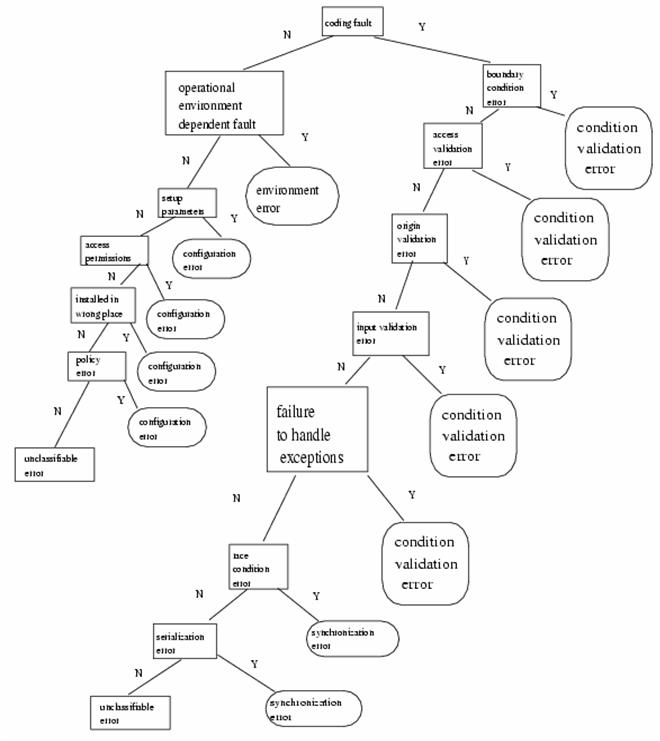
Fig 1: A flow chart
illustrating how a vulnerability is classified under Aslam scheme
Firewall
vulnerabilities based on Aslam’s model of vulnerability taxonomy
As of June 19, 2002, there are 90 known firewall
vulnerabilities, mostly vendor-specific and a few are actually replicated.
Below is the Aslam classification of these vulnerabilities, sorted with most
recent finding first in each vulnerability class:
- Coding:
- Boundary
conditions (11)
- June
18, 2002: Heap overflow in the KTH Kerberos 4 FTP client 4-1.1.1 allows
remote malicious servers to execute arbitrary code on the client via a
long response to a passive (PASV) mode request.
- June
18, 2002: Buffer overflow in OpenSSH before 2.9.9, and 3.x before 3.2.1,
with Kerberos/AFS support and KerberosTgtPassing or AFSTokenPassing
enabled, allows remote and local authenticated users to gain privileges.
- June
18, 2002: Buffer overflow in tcpdump 3.6.2 and earlier allows remote
attackers to cause a denial of service and possibly execute arbitrary
code via an NFS packet.
- May
16, 2002: Heap overflow in sudo before 1.6.6 may allow local users to
gain root privileges via special characters in the -p (prompt) argument,
which are not properly expanded.
- March
15, 2002: Off-by-one error in the channel code of OpenSSH 2.0 through
3.0.2 allows local users or remote malicious servers to gain privileges.
- December
6, 2001: Buffer overflow in internal string handling routines of xinetd
before 2.3.1 allows remote attackers to execute arbitrary commands via a
length argument of zero or less, which disables the length check.
- November
18, 2001: Buffer overflows in gzip 1.3x, 1.2.4, and other versions might
allow attackers to execute code via a long file name, possibly remotely
if gzip is run on an FTP server. This vulnerability can also be treated
as an environmental
vulnerability because the involved program, gzip, is a third-party
program which technically does not belong to the firewall itself.
- September
21, 2001: Buffer overflow in the GUI authentication code of Check Point
VPN-1/FireWall-1 Management Server 4.0 and 4.1 allows remote attackers
to execute arbitrary code via a long user name.
- February
12, 2001: Buffer overflow in NetScreen Firewall WebUI allows remote
attackers to cause a denial of service via a long URL request to the web
administration interface.
- November
14, 2000: Buffer overflow in Getkey in the protocol checker in the
inter-module communication mechanism in Check Point VPN-1/FireWall-1 4.1
and earlier allows remote attackers to cause a denial of service.
- May
18, 2000: Buffer overflow in the CyberPatrol daemon
"cyberdaemon" used in gauntlet and WebShield allows remote
attackers to cause a denial of service or execute arbitrary commands.
- Access
validations (14)
- March
15, 2002: The decompression algorithm in zlib 1.1.3 and earlier, as used
in many different utilities and packages, causes inflateEnd to release
certain memory more than once (a "double free"), which may
allow local and remote attackers to execute arbitrary code via a block
of malformed compression data.
- September
8, 2001: The Log Viewer function in the Check Point FireWall-1 GUI for
Solaris 3.0b through 4.1 SP2 does not check for the existence of '.log'
files when saving files, which allows (1) remote authenticated users to
overwrite arbitrary files ending in '.log', or (2) local users to
overwrite arbitrary files via a symlink attack.
- July
30, 2001: IRC DCC helper in the ip_masq_irc IP masquerading module 2.2
allows remote attackers to bypass intended firewall restrictions by causing
the target system to send a "DCC SEND" request to a malicious
server which listens on port 6667, which may cause the module to believe
that the traffic is a valid request and allow the connection to the port
specified in the DCC SEND request.
- July
2, 2001: ip_conntrack_ftp in the IPTables firewall for Linux 2.4 allows
remote attackers to bypass access restrictions for an FTP server via a
PORT command that lists an arbitrary IP address and port number, which
is added to the RELATED table and allowed by the firewall.
- March
26, 2001: Firewall-1 4.1 with a limited-IP license allows remote
attackers to cause a denial of service by sending a large number of
spoofed IP packets with various source addresses to the inside
interface, which floods the console with warning messages and consumes
CPU resources.
- December
11, 2000: The client authentication interface for Check Point Firewall-1
4.0 and earlier generates different error messages for invalid usernames
versus invalid passwords, which allows remote attackers to identify
valid usernames on the firewall.
- December
11, 2000: The mailguard feature in Cisco Secure PIX Firewall 5.2(2) and
earlier does not properly restrict access to SMTP commands, which allows
remote attackers to execute restricted commands by sending a DATA
command before sending the restricted commands.
- November
14, 2000: The OPSEC communications authentication mechanism (fwn1) in
Check Point VPN-1/FireWall-1 4.1 and earlier allows remote attackers to
spoof connections, aka the "OPSEC Authentication
Vulnerability."
- November
14, 2000: The inter-module authentication mechanism (fwa1) in Check
Point VPN-1/FireWall-1 4.1 and earlier may allow remote attackers to
conduct a denial of service, aka "Inter-module Communications
Bypass."
- March
11, 2000: Firewall-1 3.0 and 4.0 leaks packets with private IP address
information, which could allow remote attackers to determine the real IP
address of the host that is making the connection.
- February
12, 2000: Firewall-1 allows remote attackers to bypass port access restrictions
on an FTP server by forcing it to send malicious packets which
Firewall-1 misinterprets as a valid 227 response to a client's PASV
attempt.
- August
31, 1998: Cisco PIX firewall manager (PFM) on Windows NT allows
attackers to connect to port 8080 on the PFM server and retrieve any
file whose name and location is known.
- June
1, 1998: An account on a router, firewall, or other network device has a
default, null, blank, or missing password.
- May
11, 1998: Check Point Firewall-1 does not properly handle certain
restricted keywords (e.g., Mail, auth, time) in user-defined objects,
which could produce a rule with a default "ANY" address and
result in access to more systems than intended by the administrator.
- Origin
validations (8)
- November
28, 2001: Cisco IOS Firewall Feature set, aka Context Based Access
Control (CBAC) or Cisco Secure Integrated Software, for IOS 11.2P
through 12.2T does not properly check the IP protocol type, which could
allow remote attackers to bypass access control lists.
- February
16, 2001: WatchGuard SOHO FireWall 2.2.1 and earlier allows remote
attackers to cause a denial of service via a large number of GET
requests.
- December
11, 2000: The web administration interface for IBM AS/400 Firewall
allows remote attackers to cause a denial of service via an empty GET
request.
- November
14, 2000: Check Point VPN-1/FireWall-1 4.1 and earlier improperly
retransmits encapsulated FWS packets, even if they do not come from a
valid FWZ client, aka "Retransmission of Encapsulated
Packets."
- April
24, 2000: ZoneAlarm 2.1.10 and earlier does not filter UDP packets with
a source port of 67, which allows remote attackers to bypass the
firewall rules.
- January
1, 1999: A router or firewall forwards packets that claim to come from
IANA reserved or private addresses, e.g. 10.x.x.x, 127.x.x.x, 217.x.x.x,
etc.
- January
1, 1999: A router or firewall forwards external packets that claim to
come from inside the network that the router/firewall is in front of.
- January
1, 1997: A router or firewall allows source routed packets from
arbitrary hosts.
- Input
validations (14)
- April
22, 2002: The printf wrappers in libsafe 2.0-11 and earlier do not
properly handle argument indexing specifiers, which could allow
attackers to exploit certain function calls through arguments that are
not verified by libsafe.
- April
22, 2002: libsafe 2.0-11 and earlier allows attackers to bypass
protection against format string vulnerabilities via format strings that
use the "'" and "I" characters, which are
implemented in libc but not libsafe.
- July
16, 2001: slapd in OpenLDAP 1.x before 1.2.12, and 2.x before 2.0.8,
allows remote attackers to cause a denial of service (crash) via an
invalid Basic Encoding Rules (BER) length field.
- July
12, 2001: Format string vulnerability in Check Point VPN-1/FireWall-1
4.1 allows a remote authenticated firewall administrator to execute
arbitrary code via format strings in the control connection.
- July
9, 2001: Check Point VPN-1/FireWall-1 4.1 base.def contains a default
macro, accept_fw1_rdp, which can allow remote attackers to bypass
intended restrictions with forged RDP (internal protocol) headers to UDP
port 259 of arbitrary hosts.
- December
19, 2000: Format string vulnerability in x-gw in TIS Firewall Toolkit
(FWTK) allows local users to execute arbitrary commands via a malformed
display name.
- November
14, 2000: The seed generation mechanism in the inter-module S/Key
authentication mechanism in Check Point VPN-1/FireWall-1 4.1 and earlier
allows remote attackers to bypass authentication via a brute force
attack, aka "One-time (s/key) Password Authentication."
- June
6, 2000: Check Point Firewall-1 allows remote attackers to cause a
denial of service by sending a large number of malformed fragmented IP
packets.
- March
20, 2000: Cisco Secure PIX Firewall does not properly identify forged
TCP Reset (RST) packets, which allows remote attackers to force the
firewall to close legitimate connections.
- January
29, 2000: Firewall-1 does not properly filter script tags, which allows
remote attackers to bypass the "Strip Script Tags" restriction
by including an extra < in front of the SCRIPT tag.
- August
9, 1999: Firewall-1 can be subjected to a denial of service via UDP
packets that are sent through VPN-1 to port 0 of a host.
- January
1, 1999: A filter in a router or firewall allows unusual fragmented
packets.
- January
1, 1999: Some filters or firewalls allow fragmented SYN packets with IP
reserved bits in violation of their implemented policy.
- August
18, 1998: Cisco PIX firewall and CBAC IP fragmentation attack results in
a denial of service.
- Race
conditions (1)
- May
26, 2000: Race condition in IPFilter firewall 3.4.3 and earlier, when
configured with overlapping "return-rst" and "keep
state" rules, allows remote attackers to bypass access
restrictions.
- Operational:
- Setup
parameters (10)
- June
18, 2002: Snapgear Lite+ firewall 1.5.3 and 1.5.4 allows remote
attackers to cause a denial of service (crash) via a large number of
packets with malformed IP options for connections to either the HTTP web
management port or the PPTP port.
- April
1, 2002: Check Point Firewall-1 3.0b through 4.0 SP1 follows symlinks
and creates a world-writable temporary .cpp file when compiling Policy
rules, which could allow local users to gain privileges or modify the
firewall policy.
- November
11, 2001: Vulnerability in Postfix SMTP server before 20010228-pl07,
when configured to email the postmaster when SMTP errors cause the
session to terminate, allows remote attackers to cause a denial of
service (memory exhaustion) by generating a large number of SMTP errors,
which forces the SMTP session log to grow too large.
- Access
permissions (10)
- November
14, 2000: Check Point VPN-1/FireWall-1 4.1 and earlier allows remote
attackers to redirect FTP connections to other servers ("FTP
Bounce") via invalid FTP commands that are processed improperly by
FireWall-1, aka "FTP Connection Enforcement Bypass."
- November
14, 2000: Check Point VPN-1/FireWall-1 4.1 and earlier allows remote
attackers to bypass the directionality check via fragmented TCP
connection requests or reopening closed TCP connection requests, aka
"One-way Connection Enforcement Bypass."
- Policy
(1)
- Installation
ordering (1)
- Environmental:
- Proxy
(3)
- September
20, 2001: SMTP proxy in WatchGuard Firebox (2500 and 4500) 4.5 and 4.6
allows a remote attacker to bypass firewall filtering via a base64 MIME
encoded email attachment whose boundary name ends in two dashes.
- Daemon
(1)
- OS
or Kernel (3)
- June
2, 2001: Borderware Firewall Server 6.1.2 allows remote attackers to
cause a denial of service via a ping to the broadcast address of the
public network on which the server is placed, which causes the server to
continuously send pings (echo requests) to the network.
- July
10, 1997: Windows NT 4.0 before SP3 allows remote attackers to bypass
firewall restrictions or cause a denial of service (crash) by sending
improperly fragmented IP packets without the first fragment, which the
TCP/IP stack incorrectly reassembles into a valid session.
- Encryption
and authentication (3)
Conclusions
As shown in the list above, most firewall vulnerabilities
belong to buffer size handlings, access controls on both implementation and
operational levels, the nature of the input packets, and the settings and
handlings of the setup parameters. Some of these vulnerabilities can actually
be easily classified in more than one classes, which is a big reason why
Aslam’s model itself needs further enhancements. The majority of the
vulnerabilities found in firewalls proved that both proper software
design/development and installation are very important to ensure security for
the network intended to be protected by the firewall or otherwise disadvantages
will outweigh the advantages.
References
- Rik
Farrow, Richard Power, “History of Firewall Technologies”, http://www.spirit.com/Network/net0597.txt
- RFC-1636,
http://zvon.org/tmRFC/RFC1636/Output/chapter3.html,
Chapter 3
- Matt
Curtin, Marcus J. Ranum, “Internet Firewalls: Frequently Asked Questions”,
http://pubweb.nfr.net/~mjr/pubs/fwfaq
- Rik
Farrow, “CSI 1997 Firewall Matrix -- An Analysis of Current Firewall
Technologies”, http://www.spirit.com/CSI/Papers/farrowpa.htm,
CSI 1997 Firewalls Matrix
- Avolio
and Blask, “Application Gateways and Stateful Inspection: A Brief Note
Comparing and Contrasting”, http://www.spirit.com/CSI/Papers/apgw+spf.html,
Trusted Information System, Inc.
- Rik
Farrow, “Network Defense: Your firewall may be doing you more harm than
good”, http://www.spirit.com/Network/net1098.txt
- Rik
Farrow, “Network Defense: There are holes in your firewall, and there is
little you can do about them”, http://www.spirit.com/Network/net0699.txt
- Eugene
E. Schultz, Ph.D., “How to Perform Effective Firewall Testing”, http://www.spirit.com/CSI/Papers/how2test.htm
- Taimur
Aslam, “A Taxonomy of Security Faults in the UNIX Operating System”, ftp://ftp.cerias.purdue.edu/pub/papers/taimur-aslam/aslam-taxonomy-msthesis.ps.Z
- Ivan
Krsul, “Computer Vulnerability Analysis”, https://www.cerias.purdue.edu/techreports-ssl/public/97-05.pdf
- ICAT
Metabase, “A CVE Based Vulnerability Database”, http://icat.nist.gov/icat.cfm
- MITRE
Common Vulnerabilities and Exposures (CVE) Search Results for Firewall, http://www.cve.mitre.org/cgi-bin/cvekey.cgi?keyword=Firewall
- CERT/CC
Vulnerability Notes, http://www.kb.cert.org/vuls
- SecurityFocus Vulnerabilities
Archive, http://online.securityfocus.com/cgi-bin/vulns.pl