Zakaria Zubeida
With effect from 25 August 2008, this Web site has migrated to a new location.
From this date, biographies at this site will no longer be updated.
To view the current version of this biography, follow the link to the new
Palestinian Biographies Web site.
This article was first posted as a summary of the movie, Arna�s
Children, on the Lawrence
of Cyberia weblog.
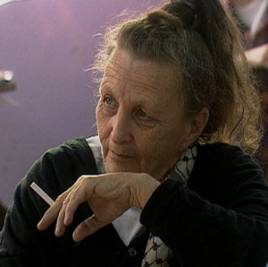
Arna Mer (below,
left) was a Zionist pioneer in 1930's Palestine under the British Mandate. From
the founding of the Jewish state in 1948, she campaigned for human rights in
Israel, which for the most part meant speaking out for the rights of the
Palestinian population. She became Arna Mer-Khamis when she married Saliba
Khamis, a Palestinian Arab and leader of the Israeli Communist party. After the
Arab-Israeli war of 1967, she was imprisoned several times for protests and
demonstrations against the Israeli occupation of the West Bank.
During the first
Palestinian intifada, when Israel closed all Palestinian schools, Arna
Mer-Khamis opened a series of Care and Learning Centres in the Occupied
Palestinian Territories, to meet the needs of the Palestinian children most
affected by the daily unrest. She explained: "I have not come here because
of philanthropic reasons. I have not come here in order to show that there are
nice Jews that help the Arabs. I came to struggle against the Israeli
occupation". At one of her Learning Centres, in the squalid refugee camp
in Jenin, she opened a theatre - "Arna's House" - on the top floor of
a building donated by a local widow, Samira Zubeida. The theatre troupe
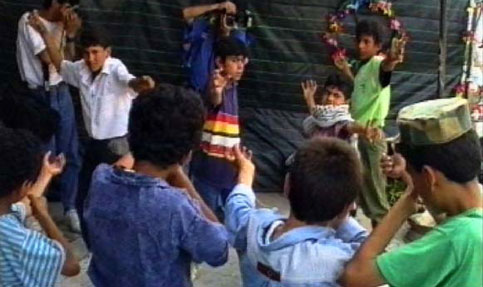
comprised a dozen local nine- and ten-year-olds, and the purpose of Arna's
House was to give them a place where they could express creatively their
everyday frustrations, anger and fear.
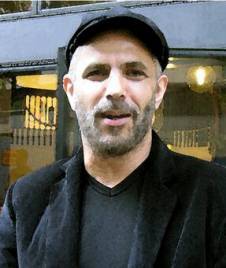
Arna's son, Israeli
actor Juliano Mer-Khamis (below, right), helped select members for the troupe,
filmed their earliest rehearsals and performances in 1987, and interviewed the
child actors. "It was very easy to attract the children", he recalls.
"The only option they had for playing was to beat the swamps with a stick.
Anything would amuse them. Anyone who performed pantomimes for them would win
them. You did not need much".
 ��
�� 
Juliano returned to the theatre group in 1995 on his mother's final visit to Jenin (Arna was in the final stages of terminal illness at that time), and recorded on film how the now-teenage actors were progressing under Oslo. Juliano returned with his video camera for a final visit in May 2002, immediately after the IDF's reinvasion of Jenin, to find out how the (now) young men who had once performed at Arna's House had fared in the battle, which had decimated the center of Jenin refugee camp where their family homes were located and where the theatre stood.
From his 15-years'
worth of video footage, Juliano created a movie - Arna's Children - that
described what became of the children in the Jenin theatre group through years
of occupation, "peace process" and military invasion. The film
follows in particular the progress of five leading members of the troupe -
Ashraf, Nidal, Yusuf, Ala'a and Zakaria - and through their desperate lives,
shows us what makes a "terrorist".
Arna's Children won the Best Film
award at Prague's One
World Film Festival in April 2004. Days later, it received the Best First
Documentary award at the Canadian International
Documentary Festival. The following month, it was named Best Documentary at
New York's Tribeca
Film Festival. Sadly, by the time Arna's Children received this
international recognition, all but one of the movie's leading characters were
already dead.
When the theatre
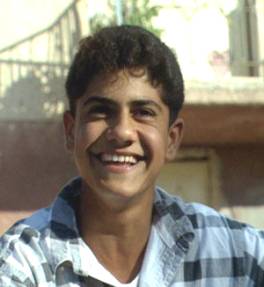
was first established, Ashraf Abu el-Haje (below, left) was one of the
smallest members of the troupe, though he quickly emerged as the star. Ashraf
was a smiling, enthusiastic and outgoing child, who won a place in the troupe
by sheer persistence. He loved to paint, and loved to act, because being on
stage gave him a freedom to express himself that life under occupation did not:
"I give my entire self on the stage. I try to forget the audience in front
of me, so I can attract them. I will not let the occupation leave us in the
sewage and garbage. When I am on stage, I feel as though I throw a Molotov and
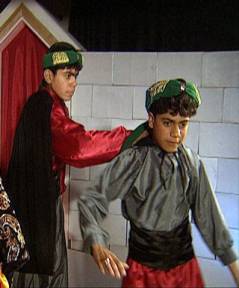
stones at the occupation." He is pictured (below,right), with his best
friend Yusuf, performing in Ghassan Kanafani's The Fairy Girl.
 ��
�� 
Ashraf had only ever seen one play - it was at An Najah National University in Nablus, about wanted activists who hide from the Israeli army - but he already knew he wanted to be a director and playwrite. And he wanted to be a great actor, who would take on great roles. He tells the camera that one day he would like like to act in Romeo and Juliet: he will be "the Palestinian Romeo", and perhaps one of his cousins from the refugee camp will be Juliet.
Ashraf's father
worked in Israel, but was fired from his job when the spiralling violence and
closure made it impossible to reach work on a regular basis. So instead of
studying to become an actor, Ashraf left school to support his family. He
worked as a plumber, then opened a stand in Jenin market. He still drew for
pleasure, producing large and beautiful pictures of landscapes and, later, of
the Palestinian martyrs; but he no longer had time for rehearsals with the
other children. When his older brother was arrested and sentenced to eight
years in jail by an Israeli military court, the IDF demolished the family home
as a collective punishment. Ashraf and his baby sister were deeply affected by
the loss of their home: thirteen-year-old Ashraf declared to the cameraman that
he wanted to become a shahid, announcing, "I am not ready to live on my
knees. I prefer to die while standing on my feet." His sister stopped
speaking altogether.
In the Oslo years,
Ashraf was initially optimistic that things would get better. When he was old
enough, he joined the Palestinian police, but he was quickly disillusioned as
he found himself providing security for an Israeli occupation that was not
ending, but deepening. Land belonging to Ashraf's grandfather was confiscated
by Israel for settlement expansion. As a Palestinian policeman, Ashraf was
required to provide protection for the Israeli settlers living on the land
expropriated from his grandfather. "We have become subcontractors of
Israel", he said. "They expropriated land from my grandfather to expand
the settlement above Jenin� and as Palestinian police we are supposed to guard
the settlers against harm...There is a border barrier every meter: I work in
Area C, secretly move through Area B, and sleep in Area A like a cow who goes
back to her enclosure after pasture." He was furious that the Israelis
were "working over" the Palestinians by using the peace process to
entrench the Occupation, and resigned in disgust from the police force.
In early 2002,
Ashraf joined the al-Aqsa Martyrs' Brigades in Jenin. When Israeli tanks and
armored bulldozers reinvaded the camp on 3 April, Ashraf and another of Arna's
children, Nidal Sweitat (by then an Islamic Jihad member), took up positions in
the rehearsal room where they once laughed and joked as Arna dressed them in
fancy robes for their performances. They stocked the room with grenades and
homemade bombs, hacked firing holes in the walls, and waited for the advancing
Israeli soldiers. Ten days later, after one of the most intense and deadly
battles of the intifada, Ashraf was dead, killed by an Israeli helicopter
missile. "[A]fter conducting a hopeless gunfight through a hole he made in
the wall of a building, [he] fired and fired and fired until he was pulverized
and died", as Ha'aretz put it. He was 22, and is still recalled as a hero and martyr for the manner of his death, by the people of the refugee camp.
Nidal Sweitat was also killed in the same battle; Arna's theatre was flattened,
along with the entire heart of the refugee camp.
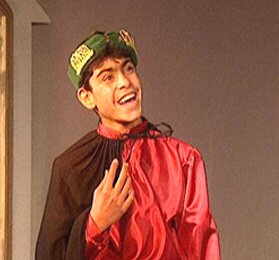
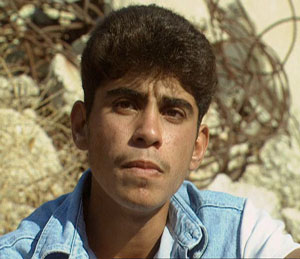
Ashraf's best
friend was Yusuf Sweitat (below, l & r), older brother of Nidal. In
the 1995 interviews, Yusuf is more serious and pensive than Ashraf. He says
that he likes acting because on stage he can tell people what he feels, what he
wants or doesn't want, and whether he loves life or not. Zakaria, another of
Arna's children, describes Yusuf as "the most romantic, the most
sentimental of all of us." Yusuf's mother, Sukina, saw how he performed
the role of the king in "The Little Oil Lamp", and it gave her hope
that "maybe they'd receive a scholarship and study outside and be
prominent citizens."
 ��
�� 
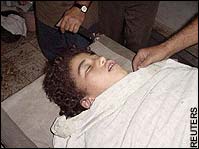 Yusuf graduated
high school, and joined the Palestinian police as a homicide investigator. On
October 18, 2001, an Israeli tank shell hit the Ibrahimiya Elementary School,
near Yusuf's police station in Jenin. He raced to the scene and found
12-year-old Riham Ward (left) haemorrhaging from shrapnel wounds. He tried to
carry her to hospital, but she died en route.�
Yusuf graduated
high school, and joined the Palestinian police as a homicide investigator. On
October 18, 2001, an Israeli tank shell hit the Ibrahimiya Elementary School,
near Yusuf's police station in Jenin. He raced to the scene and found
12-year-old Riham Ward (left) haemorrhaging from shrapnel wounds. He tried to
carry her to hospital, but she died en route.�
Yusuf talked
obsessively to his friends about Riham's death. "The girl changed his
life," one recalled. And Yusuf's father, Hamad, also noticed an immediate
change in his son, who became more placid, more resigned, and more prayerful.
Zakaria explained that witnessing the death of Riham Ward brought home to Yusuf
the fact that the new horizons the theatre opened up for him had all been an
illusion. It made him realise that he lived instead in a real world where a
foreign army could randomly kill a child, and no-one be held accountable.
"He was the most romantic, the most sentimental of all of us. In the play,
the whole world opened before his eyes, because he was the king. Now he sees a
child torn to pieces before his eyes. A person feels all his childhood was a
lie, all his life was a lie."
In the days
immediately following Riham's death, Yusuf asked friends to help him get a gun.
He assured them it was just for target practice, but none of them would help
him. So he quietly spread the word among Jenin's militant organisations that he
needed a gun to carry out an attack on behalf of the dead girl, and that he
would allow any group that would arm him to claim responsibility for his
actions. A local member of Islamic Jihad took Yusuf up on his offer. In return
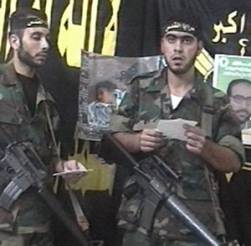
for weapons, Yusuf and his next-door-neighbor, Nidal al-Jibali, taped a
farewell message (below, left) for Islamic Jihad. The videotape shows a visibly
uncomfortable Yusuf stiffly reading a farewell message: "To my brothers,
my family and all my loved ones, don't be sad. It is a sacrifice." The
child pictured in the poster on the wall behind his right shoulder is Riham
Ward, whose life he had been unable to save.
 ��
�� 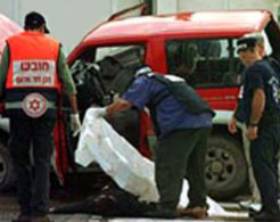
On 28 October 2001,
Yusuf and Nidal drove a red Mitsubishi into the center of the Israeli town of
Hadera, and opened fire on a group of Israeli women waiting at a bus stop. They
murdered four people before they were themselves shot dead by Israeli police.
Yusuf was 22, and Nidal 23. The photo (above, right) shows Israeli police
covering their bodies in Hanassi Street, Hadera.
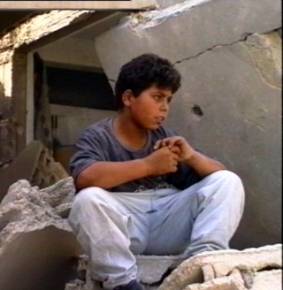
Ala'a Sabagh (below, left) is
12 years old when he first appears in Arna's Children. It is 1992, and
he is sitting silent and nervous and uncomprehending in the rubble of his home,
destroyed earlier that day by the IDF, in an act of collective punishment for
the actions of his jailed older brother.
Ala'a was the most
unresponsive and withdrawn of the boys in the theatre. At first, he wouldn't
join at all, but Yusuf Sweitat made a particular effort to draw him into the
group, by encouraging his talent for painting and drawing. Ala'a began going to
Arna's House to paint pictures of the tanks and soldiers and planes that were
part of his everyday life, and eventually became part of the group and helped
in the production of the plays.
When the theatre
group disbanded after Arna's death, however, Ala'a quickly dropped out of
school. His father tried to interest Ala'a in the family refrigerator repair
service, but he said Ala'a preferred to make money in the stolen car trade that
flourished between Israel and the West Bank. At the outbreak of the second
intifada, Ala'a was an early recruit for the newly-formed al-Aqsa Martyrs'
Brigades, despite his family's disapproval. His friends recalled that, eight
years after the event, Ala'a was still resentful at the imprisonment of his
brother and the destruction of his home. A year into the intifada, Ala'a drove
to an Israeli checkpoint on the edge of Jenin in a car he had repaired for an
Arab friend living in Israel. When he arrived at the checkpoint, he pulled out
a rifle and shot an Israeli guard at his post. He escaped, and went
underground. Despite being on Israel's wanted list, he got married at the
urging of his family.
�By the beginning of 2002, Ala'a had risen to
become a senior member of the local al-Aqsa Martyrs' Brigades. As Israeli
troops and tanks made repeated incursions into Jenin, Ala'a assembled new
recruits to prepare the camp for more clashes. He turned to his friends from
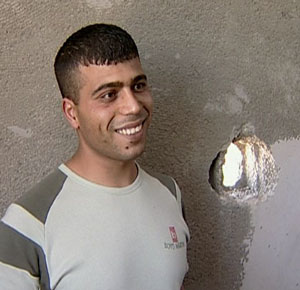
the theatre, recruiting Ashraf Abu el-Haje. Ala'a led the defence of Jenin
Refugee Camp through the massive destruction and intense fighting of the
invasion that began on 3 April 2002. He is shown (below, right) in a stairway
of a house at the Jenin refugee camp from which he carried on a shootout with
the Israeli army during the battle.
 ��
�� 
Ala'a survived the
fighting. He was captured by the IDF, but gave a false name so he would not be
recognised as a wanted man. Believing that Ala'a Sabagh had been killed in the
battle, the Israelis released him after 55 days in custody. His father, who
feared that imprisonment was the only way that Ala'a would stay alive, was
disappointed when his son was released.
 When he returned to
Jenin, Ala'a became the new commander of the al-Aqsa Martyrs' Brigades in the
city, replacing a senior commander killed in the Israeli incursion. He lived in
hiding, mostly among the rubble of the destroyed houses in the refugee camp,
and survived an Israeli assassination attempt. In the second week of November
2002, his wife - whom he had seen only sporadically since their marriage - gave
birth to their son. Through friends, Ala'a dispatched secret messages to his
wife to set up clandestine meetings, and over the next two weeks, he stole two
brief visits with his wife and baby.
When he returned to
Jenin, Ala'a became the new commander of the al-Aqsa Martyrs' Brigades in the
city, replacing a senior commander killed in the Israeli incursion. He lived in
hiding, mostly among the rubble of the destroyed houses in the refugee camp,
and survived an Israeli assassination attempt. In the second week of November
2002, his wife - whom he had seen only sporadically since their marriage - gave
birth to their son. Through friends, Ala'a dispatched secret messages to his
wife to set up clandestine meetings, and over the next two weeks, he stole two
brief visits with his wife and baby.
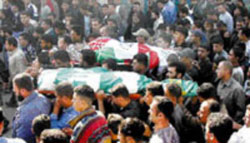
At about 11:20 p.m.
on 26 November 2002, Israeli aircraft fired a missile into a house on the
southwestern side of the Jenin refugee camp, where Ala'a Sabagh was in hiding
with Immad Nasharti, the local leader of Islamic Jihad. Both were killed
instantly: their funeral is pictured (left).
So, by the time the
movie Arna's Children was completed, four of the five leading characters
were dead. And, in the days immediately following the invasion of Jenin refugee
camp, Juliano Mer-Khamis found that the children and adults who had played a
more ancillary role in the theatre's story had fared little better than the
principals.
Samira Zubeida, who had donated
one floor of her home to house the theatre, and whose sons Zakaria and Daoud
had been part of the troupe, had been killed in an Israeli incursion on 3 March
2002, one month before the main assault on the refugee camp. She was shot by an
IDF sniper who targetted her as she stood near a window in her home, and bled
to death. Her son Daoud was alive, but had been detained without trial for a
year by the Israelis. Among the other children, Haifa, a little girl who
was so shy when she joined the troupe that she hardly dared speak, was dead
under the rubble of her destroyed home. The badly disfigured body of Jamal,
who had fought against the Israeli invasion, was also found in the rubble. Mahmoud
Kaneri, another child who was terribly shy when Juliano first filmed him in
1987, was missing after the invasion. His family feared him dead, but held out
hope when witnesses reported him arrested by the IDF instead. Mahmoud was
indeed a prisoner, and upon his release he returned to his job as a stonemason
in Jenin. Mahmoud has carved the gravestones of each member of the theatre
killed over the past three years. He described last month in the Washington
Post what it feels like to be 25 years old and to know that just about every
childhood friend you had is dead:
...While you are
making the headstone, you are crying. You never thought you'd design the tomb
for a friend, or a brother. The theatre was a base for us to become
distinguished people. They were all distinguished in the theatre. They were
distinguished here. Their tombs should be distinguished. That is my job.
Sometimes you sit
by yourself and think it over. You think you're living in a dream. It's next to
impossible to believe what happened. We were so happy. We fell in love with
acting. We thought we'd continue and become something. The sky was the limit...
It was an illusion.
We were struck by reality.
So, if Ashraf,
Nidal, Yusuf and Ala'a are accounted for, what happened to Zakaria, the fifth
(and last) of Arna's children? Zakaria is still in Jenin, which is currently
racked by lawlessness and an internal Palestinian power struggle, typified by
last week's torching of the city Governor's headquarters:
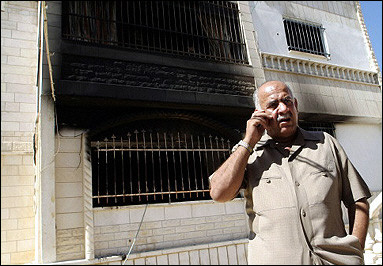
Palestinian governor of the West Bank city of
Jenin, Qaddura Mussa, stands outside his office building after it was set on
fire by members of the Al-Aqsa Martyr Brigades overnight, Saturday July 31,
2004. (AFP/Saif Dahlah)
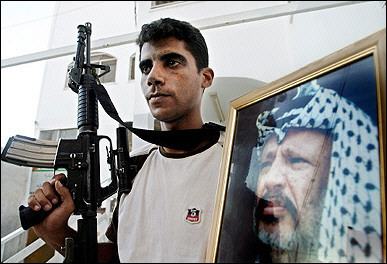
A Palestinian local leader of the al-Aqsa
Martyrs' Brigades holds up his M-16 rifle and picture of Yasser Arafat in the
northern West Bank city of Jenin, after members of the group set ablaze the
Governor's building. Palestinian leaders warned the West Bank was on the verge
of unprecedented chaos as thousands of demonstrators showed their support for
militants who attacked the offices here of the security services and local
governor. (AFP/Saif Dahlah)
That
"Palestinian local leader of the al-Aqsa Martyrs' Brigades" is Zakaria
Zubeida, the son of the late Samira Zubeida in whose home "Arna's
House" was based, the friend who recalled Yusuf Sweitat as "the most
romantic, the most sentimental of all of us", and the last survivor of
Arna's children.
When the theatre
was founded on the top floor of the Zubeida house, Zakaria was 12 years old.
His recently-deceased father, Mohammed, had been an English teacher, but was
prevented from teaching by the Israelis after he was convicted of Fatah
membership in the late 1960's. He worked instead as a labourer in an Israeli
iron foundry, did some private teaching on the side, and became a peace
activist. The first Israeli Zakaria ever met was the soldier who came to take
away his father for alleged membership of Fatah.
Zakaria attended
the UNRWA school in Jenin Refugee Camp, and was a good student. When he was a
ninth grader, he was shot in the leg as he threw stones at Israeli soldiers
during the first intifada. He was hospitalised for six months, and underwent a
series of operations on his leg, which was left permanently shortened. He never
returned to school. Instead, his life alternated between the theatre that was
his home, and the Israeli military prison system. At age 15, he was arrested
for the first time (for throwing stones) and jailed for six months. After his
release, Zakaria graduated to Molotov cocktails and was jailed again, this time
for four years. In prison, he learned Hebrew, and became politically active,
joining Fatah.
The Oslo accords
led to his release and exile to Jericho, from where he surreptitiously made his
way back to Jenin, and joined the PA police. He became a sergeant, but left,
disillusioned, after a year, complaining: "There were colleagues whom I
had taught to read who were promoted to senior positions because of nepotism
and corruption." He went to work illegally in Israel, and for two years
earned a good living as a contractor for home renovations in Tel Aviv and
Haifa. He was eventually apprehended in Afula and after a brief incarceration
for working in Israel without a permit, deported back to Jenin. With his path
to work in Israel blocked, Zakaria turned to auto theft. In 1997, he was caught
with a stolen car, and was given a fifteen-month sentence. He served the time,
was released and returned to the camp. He became a truck driver in Jenin,
transporting flour and olive oil, but lost his job in the violence and closures
that marked the beginning of the second intifada.
Zakaria himself
traces his entry into armed militancy back to late 2001 when, after the killing
of a close friend, he learned to become a bombmaker. (One of his crude,
home-made devices blew up in his face in February 2003, leaving him with
damaged eyesight and a permanently pock-marked appearance). It was the death of
his mother (Samira), and brother (Taha), however, that left Zakaria most
embittered and unable to personally countenance peace with Israel. Both were
killed in Jenin by the IDF in the spring of 2002. Israeli journalist Gideon
Levy noted that it was not so much their deaths that embittered Zakaria, as the
resounding silence that followed from the people they had once thought their
friends in the Israeli peace camp:
He wasn�t always
like this. The late peace activist Orna Mer�mother of the actor Juliano
Mer�founded a theatre group that met at his parents� home in the Jenin refugee
camp. In the mid-�90s, Israeli peace activists used to come to this house.
The disappointment
and anger he feels toward the Israeli peaceniks are incomparably greater than
his anger at Prime Minister Ariel Sharon. He mentions this over and over.
Sharon is a military man and so he doesn�t expect anything different from him.
Not so with the Israeli peace camp. Not one of them called him after his mother
was killed by an IDF sniper�s bullet over a year ago, while she was standing by
the window of her home, and no one came when his brother was killed a few hours
later. The house was also demolished�and no one came.
�You took our house
and our mother and you killed our brother,� Zebeida says angrily as soon as he
sits down. �We gave you everything and what did we get in return? A bullet in
my mother�s chest. We opened our home�and you demolished it. Every week, 20-30
Israelis would come to do theatre there. We fed them. And afterward, not one of
them picked up the phone.�
The Al-Aqsa
Martyrs� Brigades may reach peace with Israel, he says, but he won�t
personally. He won�t forgive the killing of his mother and brother and the
razing of his house.
Zakaria fought in
Jenin refugee camp all through the battle of April 2002. He managed to evade
capture, escaping room by room as the soldiers moved systematically through
what remained of the houses. He recalls: �That was a real war, a terrific war.�
Zakaria became head of the Jenin al-Aqsa Martyrs' Brigades in November 2002, on
the assassination of Ala'a Sabagh. He has given the Brigades a higher profile
than his predecessors, by being publicly interviewed and filmed, and by
actively seeking a political role for the group within the PA.
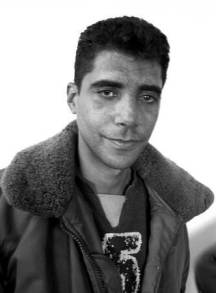
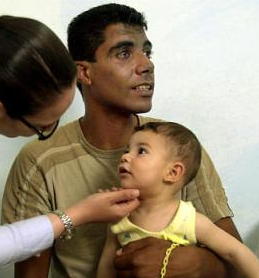
Zakaria, his wife
and young son Mohammed (a.k.a. Hamoudi, below, right) live underground in
Jenin, rotating where they live and sleep: "I am a different person. I
have weapons, guards, my finger on the trigger all night. I sleep with one eye
closed and the other open." He acknowledges that, especially since the
birth of his son in December 2003, he would like to have a settled life, but
has got too deeply mired in the struggle to get out. Besides, he insists,
"Without a state, my son has no future."
 ��
�� 
He is probably
Israel's most wanted man in the West Bank, and has survived five attempted
assassinations. He was shot three times by the IDF in the third attempt, in
February 2004, and five Palestinians were mistakenly killed when Israeli Border
Police botched the fourth attempt less than two months later. Following the
fifth attempt on his life, on 13 June 2004, he acknowledged that the Israelis
would eventually succeed in killing him:
I'm dead. I know
that I'm dead....[but] I've gotten out of a lot of things, and I think that maybe
we'll succeed in the end. Another Zakariya will come. I'm not the first and not
the last. There was Ziad - and they succeeded. And Zuheir came - and they
succeeded with Zuheir. And Alaa came - and they succeeded with Alaa. And
Zakariya came. Maybe they'll succeed with Zakariya. Then came Hamoudi. My
son.... And they'll succeed with Hamoudi. Then will came Zakariya, the son of
Hamoudi ... if they want to continue with this cycle. But if they continue with
the cycle of peace, maybe Zakariya will die and Hamoudi will live in peace.
And that is the
last of the boys who, way back in 1987, became Arna's Children.
SOURCES
Biographical
information:
�
In Jenin,
Seven Shattered Dreams; Washington Post, 19 July 2004
�
A Short
Story Of Suicide; by Juliano Mer-Khamis
�
A
Chronicle Of Empty Graves; by Juliano Mer-Khamis
�
The
Use Of Fiction (fotolog), 13 May 2004
�
Zacharia
Zubeidi: The Marked Man; The Independent (subscription), 28 May 2004
�
Wanted Man
by Gideon Levy; Socialist Viewpoint, July-August 2003
�
A
Dead Man Walking by Gideon Levy; Ha'aretz, 25 March 2004
�
Israel
Tries To Kill Resistance Leader; al-Jazeera, 13 June 2004
�
On
The Turning Away (fotolog), 14 April 2004
Film Reviews:
�
The
Palestinian Romeo by Uri Avnery
�
Weep
For This Drama Club (Ha'aretz), by Yitzhak Laor
�
Arna's
Children by Avraham Oz
�
Children
Of The Homeland (Ha'aretz), by Uri Klein
�
Review:
Arna's Children (EI), by Arjan El Fassed
�
The
Show Is Over (Yediot Ahronot), by Meiron Rappoport and Faiz Abbas
�
We
Must All Be Arna's Children, by James Wagner
News reports:
�
Al-Aqsa
Martyrs Chief Says Will Halt Attacks; Ha'aretz, 14 June 2004
�
Fatah
Wing Wants Arafat To Cede Power; Washington Post, 8 July 2004
�
Arafat
Faces Generational Crisis; Christian Science Monitor, 21 July 2004
�
Palestinian
Authority Buildings Set Afire; Washington Post, 1 August 2004
�
Palestinian
Fighter Blames U.S. For Unrest; Washington Times, 6 August 2004
Return to Palestinian
Biographies Home Page.
Last Update:
9 August� 2004
Zakariya Zubeida
biography Zakariya Zbeide biography Zakariya Zbeidi biography Zakariya Zubeidi
biography Zakariya Zbeida biography Zacharia Zubeida biography Zacharia Zbeide
biography Zacharia Zbeidi biography Zacharia Zubeidi biography Zacharia Zbeida
biographyZachariya Zubeida biography Zachariya Zbeide biography Zachariya
Zbeidi biography Zachariya Zubeidi biography Zachariya Zbeida biography