Shotokan Stances
Shotokan is the oldest "style" of Japanese Karate, founded by Gichin Funakoshi. He is also credited as being the founder of Karate-Do "The way of the Empty Hand" which was developed by adding DO to Karate, and changing the meaning of Kara-Te ("Chinese or China Hand") It had formerly been refered to as Karate-Jutsu (pronounced "jItsu" not "jUtsu") Tode-Jutsu ("Chinese Hand Technique") or Ryukuan Kempo ("Fist of the Ruyuku Kingdom")
Shotokan is often considered a Karate style for athletic people, but this is misleading. Shotokan, I believe, is designed to DEVELOP athleticism in the Ka (praticioner). This idea is partially due to the influence of the Okinawan style Naha-Te (which was an internal training school), which emphasizes physical development over anything else. Modern Karate styles derived from this are Okinawan Goju-Ryu, Uechi-Ryu, and Japanese Shotokan, Shito-Ryu, and Wado-Ryu are also derived in part from this school
As such, Shotokan-Ka should not think of the stances themselves as effective. The 3 stances of Shotokan (Zenkutsu-, Kokutsu-, and Kiba-Dachi) as such should be practiced to develop your athleticism. Instead of thinking about developing a strong stance, think about developing strong legs, and developing fast legs. Hold the stance as low as you can, until you start crying. Then release (if you're on carpet, fall down instead of getting up, using your arms to support you)
If you are not willing to do this, and you still wish to learn Karate for self-defense, you are better off learning stances such as Sanchin-, Neko-Ashi-, and Naihanchi-Dachi, which are effectively are used for the same reasons. As well, advanced Shotokan students [Black belt's or Yudansha ("Person of Grade")] should learn these stances, as, while less useful for physical education, are superior for mobility and self-defense.
Front Stance

Figure 1: Zenkutsu Dachi (The Front Stance)
The Front Stance is designed to got deliver maximum stability and power towards the front. The hips are used as measument for this stance. The length should be twice the length of your hips if measured along a straight line from the front of the stance to its rear (not along the line of your legs, which would be diagonal because they are not on the same line)
The knee of the front leg should be pressed forward enough that the big toe disappears, but no farther, which would decrease both stability -by shifting the center of gravity- and mobility
Back Stance

Figure 2: Kokutsu Dachi (The Back Stance)
The Back Stance is designed to deliver maximum length between you and your opponent, and to increase mobility of the front leg, if kizami-geri is to be used. The most common use of backstance, however, is to block and attack from the front. The heels of the feet should like up on a straight line if viewed from the front. The length is the same as the front stance, but because it is on a straight line (not diagonal) the legs will actually feel closer together.
As with the Front Stance, the knee of the front leg should be pressed forward enough that the big toe disappears, but no farther.
Side Stance
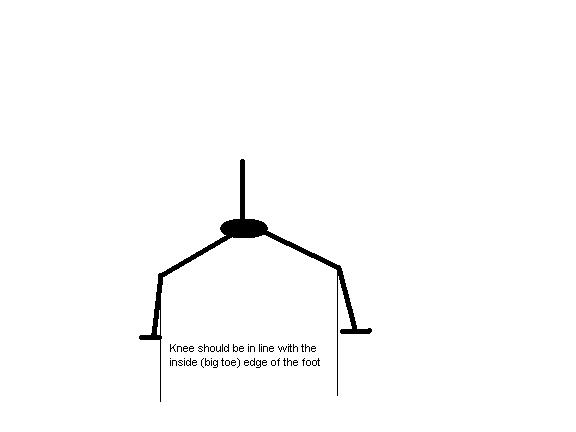
Figure 3: Kiba Dachi (Horse Stance)
The Horse stance is designed to deliver maximum stability to attacks from both sides, although attacks to the sides will require significant practice to become effective. The distance between the heels is the same as the Back stance, so it is the shortest stance, although often is incorrectly practiced as the longest.
The big toe is significant in this stance as well. However, you will need a mirror to check this. The inside edge of the foot should be directly under the knee.