|
|||||||||||||||
CONTENTS
(The compiler acknowledges the help he received in constructing this page from the Ramakrishna Vedanta Society, the Ramakrishna Mission and Shri Rajan Khurana.) Background About Swami Vivekananda
The first of them was Sri Krishna who told us in the Bhagvad Geeta: Yada yada, hee dharmasya, glanir bhavati Bharata, (Whenever in the land of India religion is in danger, i.e. in today's context whenever on our Globe the right thinking of humankind is in danger) Abhyuthanam adharmasya, tadatmaanam srujamyaham, (To eradicate ignoble thoughts and to save religion) Paritrananya sadhunaam, vinashayacha dushkrutaam (To vanquish the evil-doers and to aid the noble) Dharma-sanstapanarthaya, sambhavami yugey yugey. (To re-establish religion, I come forth over and over again) In keeping with this message of Sri Krishna who was one of the few greatest sons of humankind - a noble son of humankind came forth time and again. They included Gautama Buddha, Jesus Christ, Zarathusthtra, Moses, and many others. Swami Vivekananda was one such noble son of humankind. In India there came after Sri Krishna, at critical junctures of Indian history, personalities like, Chanakya who guided Chandragupta Maurya (the founder of the Maurya Empire), Madhavacharya who guided Harihara Raya (the founder of the Vijaynagar Empire) , Swami Samartha Ramdas who guided Chattrapati Shivaji Maharaj (founder of the Maratha Empire) and last of them all Swami Vivekananda who lit amongst us the flame of self-confidence to exercise ourselves once again for the benefit of humankind. Swami Vivekananda's compellingly inspiring words, ring again and again in one's ears motivating us to "Arise Awake and Stop not till the Goal is reached." "O man, be not weak. Everything that can weaken us as a race we have had for the last thousand years. It seems as if during that period the national life had this one end in view, viz., how to make us weaker and weaker, till we have become real earthworms crawling at the feet of every one who dares to put his foot on us." We may note that none of these personalities
spoke of hatred or revenge, they all stood for justice.
There is no last messiah in the Hindu world view. That is why Hinduism is called a Living Idea, guided by the sum total of human wisdom that is not considered to be embodied in one person, or one book, or one period of human history. Hence the term "Living". Many personalities contributed to the march of ideas that we call Hinduism. Swami Vivekananda was one such person. Swami Ji was the first person in recent history to reveal the treasures of Hindu knowledge to the west. From a complete unknown in the west, he attended the first Parliament of Religions, held in Chicago in 1893, to become a hero of that parliament and subsequent lecture tours of the west. To the Hindu faith he created the spark that started the light that shines all round the world today. Swami Ji was a scientific thinker, he knew that modern science and the Hindu faith were convergent. This was so as the Hindu faith gives every person the complete freedom of how to co-relate with the universe - as a deity or as a frontier of human consciousness. The words Swami Ji spoke were simple yet contained power to penetrate the heart. He spoke plainly and clearly about his beliefs without any ambiguity. He was fearless and through actions and words he tried to put fearlessness in others also. He believed in the empowerment of the individual. He revealed the power each person possesses to change the world. His teachings show that man posseses great power, his teachings are aimed not only for the Hindus but for whole of humanity. A Brief Life-Sketch of Swami Vivekananda We cannot think of Sri Rama without thinking of Hanuman, or remember Sri Krishna without remembering Arjuna. In the same way do Buddha and Ananda go together, as do Christ and St. Paul.Even such is the link between Sri- Ramakrishna and Swami Vivekananda. For, the one was the spring and the other was the stream conveying the spring's waters.Swami Vivekananda was born in Calcutta on-January 14, 1863 on the holy day of Makara Sankranti. His father was Viswanatha Datta, a prominent lawyer of Calcutta and his mother was Bhuvaneswari Devi, a very cultured woman of aristocratic upbringing. The Dattas named the child Narendranath. He was as good at studies as at play. He was a student with superlative talents both innate and acquired. His range of reading was wide, his powers of understanding were keen. He had a very retentive , memory and in discriminative faculty he was very much above the rest. He grew into an athlete and was proficient in all kinds of games of his age. Even as a boy he was highly soulful and deeply meditative; there were deeper powers in his young being than are usually found in youths. He was challenging and knew no fear. A hundred graces and excellences marked him out as a genius even at school and college. Narendranath was a thinker. His intellect was too robust to take things on feeble faith and customary belief. He demanded verification, proof, before he would consider believing in anything. The doubting youth went here and there in quest of God for long but in vain. And when he almost despaired of discovering God and almost concluded that God was a mad man's idea, chance, took him to Sri Ramakrishna. (Compiler's Note: Here the compiler wishes to humbly reiterate that Swami Vivekananda's ideas deal overwhelmingly with issues like character-building, self-confidence, self-empowerment and a compelling sense of commitment to nation-building (global-building and global integration in today's context). Despite being a theist, Swamiji was no obscurantist and rejected rituals altogether. And although as a Rationalist, I reject theism, I find Swamji's ideas on all other aspects same as mine. If we remove the subsidiary grain of theism in Swamiji's thought, he is no different from a Rationalist. And in my personal view Swamiji's ideas about character-building, self-confidence, self-empowerment and a compelling sense of commitment to nation-building (global-building and global integration in today's context) are the core of his message to us - which we should take and carry forward - Sudheer Birodkar.) Vivekananda and Ramakrishna Paramhansa For nearly five years Narendranath stayed with Sri Ramakrishna and was taught and trained by him. At the end of this short period of utmost intensity Narendranath had imbibed the superhuman wisdom of the Paramahamsa and had become his alter ego. In 1886, when Narendranath was not even twenty-three years old, Sri Ramakrishna passed away. On Naren's very-young shoulders fell the gigantic burden of executing Sri Ramakrishna's mission.-lt.was not an easy task, but if anyone was capable of performing it, it was Narendranath, who had the brain and the brawn for it. He renounced home; he became Swami Vivekananda; he established a Math (a monastery) where he and his co-disciples could carry on austerities. - He then wandered over India as a parivrajaka sadhu. From the northern Himalayan extremity to the southern land's end of Kanya Kumari did he travel, studying the Motherland, understanding her problems at first hand and forming solutions for her regeneration. This pilgrimage was one of the landmarks of his life and the very many occurrences and incidents relating to his wanderings are fascinating peeps into the rich variety and compelling charm of his personality. Sojourn to the USA
'Sisters and Brothers of America' But then it was a case of conquest at first speech. When his turn to address the august assembly came, he rose like the morning sun and spoke to the 'Sisters and Brothers of America'. That hearty call fascinated the Parliament and the western world. Rising above cramping creeds and dwarfing dogmas he spoke of harmony and universalism; his message came like the breath of life to a suffocated people. As soon as he spoke the words 'Sisters and Brothers of America' the crowd rose in cheer and everyday of the conference there was one man they came to hear. The conference organisers, made Swami Ji's talk the last of each day to ensure the crowd stayed to the end of each day. He stayed many months in America lecturing and teaching and helping Westerners to study Indian philosophy. Then he went to England and Europe. He had become a bridge of understanding between the Orient and the Occident. Return to India In 1897 the Swami returned to India. The nation rose like one man to honour him. The people saw in him a new Sankara who had risen to bring life and vigour to the motherland. The Swami reminded his countrymen of the Indian national ideal of renunciation, roused them to a sense of privilege in being Indians and showed them how spiritual culture was the secret of India's immortal existence. He made Bharata a Prabuddha Bharata. Your country requires heros; be heroes. Stand firm like a rock. Truth always triumphs. What India wants is a new electric fire to stir up a fresh vigour in the national veins. Be brave, be brave; man dies but once. A New Adi Sankara But he did not stop with advising and preaching. He was a capable organiser and desired to set up an organisation which could ensure the continuance of his Master's mission. So he founded the Ramakrishna Math and Mission (with its Headquarters at Belur Math near Calcutta) which is a body to the service of humanity. This Sangha is his lasting legacy to mankind. Swami Vivekananda's Mahasamadhi Swami Vivekananda was not forty, when he entered into Mahasamadhi. But his age is not to be calculated in solar years. For, in just one decade of public work he had implanted into human consciousness ideas which may need one thousand and five hundred years to get worked out in full. There is an Indian side to his life-work and there is an international aspect to it, In both the fields his contribution has been unique. STRENGTH Strength, manhood, Kshatra-virya, Brahma-teja. All power is within you; you can do anything and everything. Believe in that; do not believe that you are weak; do not believe that you are half-crazy lunatics, as most of us believe now-a-days. You can do anything and everything, without even the guidance of any one. Strength is what the Upanishads speak to me from every page. This is the one great thing to remember, it has been the one great lesson I have been taught in my life; strength, it says, strength, O man, be not weak. ~ Everything that can weaken us as a race we have had for the last thousand years. It seems as if during that period the national life had this one end in view, viz., how to make us weaker and weaker, till we have become real earthworms crawling at the feet of every one who dares to put his foot on us. Therefore, my friends, as one of
your blood, as one that lives and dies with you, let me tell you that we
want strength, strength and every time strength. And the Upanishads are
the great mine of strength. Therein lies strength enough to invigorate
the whole world; the whole world can be vivified, made strong energised
through them.
They will call with trumpet voice upon the weak, the miserable, and the downtrodden of all races, all creeds and all sects to stand on their feet and be free. Freedom, physical freedom, mental freedom, and spiritual freedom are the watchwords of the Upanishads.What I want is muscles of iron and nerves of steel, inside which dwells a mind of the same material as that of which the thunderbolt is made. Strength, manhood, Kshatra-virya, Brahma-teja. All power is within you; you can do anything and everything. Believe in that; do not believe that you are weak; do not believe that you are half-crazy lunatics, as most of us believe now-a-days. You can do anything and everything, without even the guidance of any one. All power is there. Stand up and express the divinity within you. What puerile creatures may be saying against you. Indifference! Indifference! Indifference! Bear in mind the eyes are two in number, and so the ears, but the mouth man of action, the lion-heart, that the goddess of wealth resorts. No need of looking behind. Forward! We want infinite energy, infinite zeal; infinite courage, and infinite patience; then only will great things be achieved. Vedanta recognizes no sin, it only recognizes error; and the greatest error, says the Vedanta, is to say that you are weak, that you are a sinner, a miserable creature and that you have no power and you cannot do this or that. Weakness is the one cause of suffering. We become miserable, because we are weak. We lie, steal, kill and commit other crimes, because we are weak. We suffer, because we are weak. We die, because we are weak. Where there is nothing to weaken us, there is no death, no sorrow. Weakness is the one cause of suffering Strength does not come by thinking of weakness all the time. The remedy for weakness is not brooding over weakness, but thinking of strength. Either in this world or in the world of religion, it is true that fear is the sure cause of degradation and sin. It is fear that brings misery, fear that brings death, fear that breeds evil. And what causes fear? Ignorance of our own nature. Each of us is heir-apparent to the Emperor of Emperors. Know that all sins and all evils can be summed up in that one word - weakness. It is weakness that is the motive power in all evil-doing. It is weakness that is the source of all selfishness. It is weakness that makes men injure others. It is weakness that makes them manifest what they are not in reality What our country now wants are muscles of iron and nerves of steel-gigantic wills which nothing can resist, which can penetrate into the mysteries and secrets of the universe and will accomplish their purpose in any fashion even if it meant going to the bottom of the ocean and meeting Death face to face. We have wept long enough; no more weeping, but stand on your feet and be men. It is a man-making religion that we want. It is man-making theories that we want. It is man-making education all round that we want. And here is the test of truth-anything that makes you weak physically, intellectually and spiritually, reject as poison; there is no life in it, it cannot be true. Truth is strengthening. Truth is purity, Truth is all knowledge. Truth must be strengthening, must be enlightening, must be invigorating. We speak of many things parrot-like, but never do them; speaking and not doing has become a habit with us. What is the cause of that? Physical weakness. This sort of weak brain is not able to do anything. We must strengthen it. First of all our young men must be strong. Religion will come afterwards. You will be nearer to Heaven through football than through a study of the Gita. You will understand Gita better with your biceps, your muscles, a little stronger. You will understand the mighty genius and the mighty strength of Krishna better with a little of strong blood in you. You will understand the Upanishads better and the glory Of the Atman when your body stands firm upon your feet and you feel yourselves as men. What we want is vigour in the blood, strength in the nerves, iron muscles and nerves of steel, not softening namby-pamby ideas. Be moral, be brave, be stridently moral and brave. Don't bother your head with religious theories; cowards only sin, brave men never. Try to love anybody and everybody. I have never spoken of revenge,
I have always spoken of strength.
Be bold! My children should be brave, above all. Not the least compromise on any account. Preach the highest truths broadcast. Do not fear of losing your respect or of causing unhappy friction. Rest assured that if you serve truth in spite of temptations to forsake it, you will attain, a heavenly strength, in the face of which men will quail ro speak before you things which you do not believe to be true. People would be convinced of what you would say for them, if you can strict serve truth for fourteen years continually, without swerving from it. We are all the sparks of the infinite. How can we be nothing? We are everything, ready to do everything, we can do everything and man must do everything, Therefore, my brethren, teach this life- saving, great, ennobling, grand doctrine to your children, even from their very birth. This marvellous doctrine of the soul, the perfection of the soul, is This faith in themselves was in the hearts of our ancestors, this faith in themselves was the motive power that pushed them forward and forward in the march of civilisation; and if there has been degeneration and if there has been defeat, mark my words. You will find degradation to have started on the day our people lost this faith in themselves. What did I learn in the West? There I saw that inside the national hearts of both Europe and America resides the tremendous power of the men's faith in themselves. An English boy will tell you, '1 am an Englishman, and I can do anything". The American boy will tell you the same thing, and so will any European boy. Can our boys say the same thing here? No, nor even the boys' fathers. We have lost faith in ourselves. There is not one system in India, which does not hold the doctrine that God is within, that Divinity reside within all things. Every one our Vedantic systems admit that all purity and perfection and strength are in the soul already. The ideal of faith in ourselves is of the greatest help to us. If faith in ourselves had been more extensively taught and practised, I am sure a very large portion of the evils and miseries that we have, would have vanished. Throughout the history of mankind, if any motive power has been more potent than another in the lives of all great men and women, it is that of faith in themselves. Born with the consciousness that they were of to be great, they became great. Never quarrel about religion. All quarrels and disputations concerning religion simply show that spirituality is not present. Religious quarrels are always over the husks. When purity, when spirituality goes, leaving the soul dry, quarrels begin, and not before. Do not care for doctrines, do not care for dogmas, or sects, or churches or temples; they count for little compared with the essence of existence in each man which is spirituality and the more this is developed in a man, the more powerful is he for good. Earn that first, acquire that and cnticise no one. Show by your lives that religion does not mean words or names, or sects, but that it means spiritual realization. - Sincerity of conviction and punty of motive will surely gain the day, and even a small minority, armed with these is surely destined to prevail against all odds. - Truth, purity and unselfishness - wherever these are present, there is no power below or above the sun to crush the possessor thereof. Equipped with these, one individual is able to face the whole universe in opposition. It is only in our scriptures that this
adjective is given to The Lord-Abhih, Abhih. We have to become Abhih, fearless
and our task will be done. Arise! Awake! and stop not till the goal is
reached!
"Sudheer, Lavlesh and the Hindu History team would be happy to receive your valued feedback on this site.We invite you to Sign and Read our Guest book. We also invite you to use our Message Board on Hinduism and Hindu History to start a discussion on any relevant topic".For comments on site mail to [email protected] 
|
|||||||||||||||
 |
 |
 |
|||||||||||||

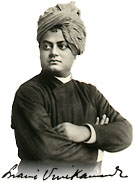 Swami
Vivekananda alongwith Adi Sankara and Chanakya have been the fountainheads
of my inspiration to dive deep into the universal and timeless wisdom they
have given to humankind. This website on Swami Vivekananda is a small way
of repaying the debt I owe to these Personalities - who have been my impersonal
Gurus in my effort over the last 20 years to rediscover the immense strength
of character which the thoughts of these three titans embody.
Swami
Vivekananda alongwith Adi Sankara and Chanakya have been the fountainheads
of my inspiration to dive deep into the universal and timeless wisdom they
have given to humankind. This website on Swami Vivekananda is a small way
of repaying the debt I owe to these Personalities - who have been my impersonal
Gurus in my effort over the last 20 years to rediscover the immense strength
of character which the thoughts of these three titans embody.