 |
|||||||||||||||||
CONTENTS
VEDANTA Vedanta is the only philosophical tradition that remains alive today. The reason is that unlike any other philosophical school. Vedanta has been fully integrated into the Hindu religion. Vedanta literally means 'end of the Vedas' but it is interpreted as 'culmination of the Vedas'. The founder of Vedanta tradition is said to be the Vedic Seer Vyasa, but its most well known exponent was Adi Shankaracharya. There were others too like Sayanacharya, Madhavacharya and many others. The Vedanta system virtually represents Shankaracharya's interpretation of the Sutras. The Sutras are a collection of rituals and practices that have been sanctioned in Vedic literature. The essence of Vedanta philosophy is that all human beings have souls (Atman). And although physically all beings have a separate existence, their souls are actually not separate. They are merged into one supreme soul (Param-Atmah) or the absolute soul (Brahman). This unity of different souls is called Advaita or non-dualism (also called Monism). The doctrine of Advaita is central to Vedanta philosophy. The visible and palpable universe around us is considered to be unreal (Mithya) which is but an illusion i.e. Maya), while that which is tbe supreme reality the absolute soul (Brahman) cannot be perceived by our normal senses of sight, smell, hearing or touch. (The Vedanta philosophy continues to
be very popular among Hindu philosophers and is a subject at many discourses
at temples. There are many contemporary names associated with this philosophy.
It is not possible to recollect all, but some of those who have based their
principles on Vedanta Philosophy include A. Parthasarthy, Swami Chinmayananda,
Maharshi Mahesh Yogi, among many others.)
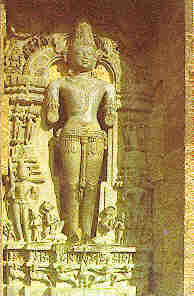
Vishnu - the Preserver. Vishnu is one of the three deities of the Hindu Trimurti (Triad or Trinity). The other two are Brahma - the Creator and Mahesh - the Destroyer. Thus there is a combination of three opposite tendencies of Creation, Preservation and Destruction in this concept. This was supposed to reflect the cosmic law of the working of the universe. SANKHYA The Sankhya school is relatively materialistic as compared to Vedanta. The founder of the Sankhya school is considered to be a philosopher named Kapila. The term Sankhya could be derived from Sankhyaa meaning 'numbers'. This could be so as Sankhya philosophy divides the universe into 25 principles (tattvas). The first 8 tattvas comprise of the material universe and are termed as Prakriti. One tattva (principle) is the motive power of the universe which is looked upon as the soul or spirit and is termed Purusha. The remaining 16 tattvas are the result of Purusha acting upon Prakriti and they constitute the material universe with all its movements of rotation, revolution, gravitation. Thus everything begins with matter
(Prakriti) but this matter in itself is inert or dead, it is activated
by the stimulus provided to it by the motive power(Purusha) and the result
of this is the active universe with its twinkling stars and rotating planets
of which we are a part. The Sankhya system of ideas is thus not entirely
theistic as it assumes the existence of both matter and motive power to
begin with. The universe is not looked upon as the creation of a supreme
creator. But the Sankhya doctrine is neither entirely materialistic. According
to Sankhya, matter (Prakriti) which exists without any creator having created
it, but is inert until it is activated by the motive power (Purusha).
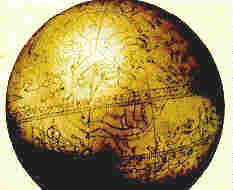
Sankhya philosophy divides the universe into 25 principles (tattvas). The first 8 tattvas comprise of the material universe and are termed as Prakriti. One tattva (principle) is the motive power of the universe which is looked upon as the soul or spirit and is termed Purusha. The remaining 16 tattvas are the result of Purusha acting upon Prakriti and they constitute the material universe with all its movements of rotation, revolution, gravitation. Seen here is an Astrolabe from the mediaeval India. An Astrolabe was used to measure the position of stars and planets for navigational purposes. Evidently the Sankhya doctrine tried to explain the existence (or creation) of the universe by extending the idea of sexual procreation to the entire universe. Incidentally, Purusha literally means "man" or male and Prakriti is one of the names of the Mother-Goddess. Unlike Vedanta, the Sankhya doctrine was not incorporated into any religion. It never obtained wide acceptability among Hindu philosophers as did Vedanta. The most popular philosopher who is said to have propounded the Sankhya philosophy was Kapila. From the name it is uncertain whether this philosopher was a man or a woman. (Modern Indian philosophers like Rahul Sankrutyan and Devi Prasad Chattopadhyay have referred to the specualtions of Kapila.) But Buddhism seems to have borrowed ideas from the Sankhya School. Thus this school appears to be of considerable antiquity and must have existed since before the 6th century B.C.E. when Gautama Buddha lived. But the Sankhya doctrine displays a dual character which arises from the attempts made to reconcile materialistic logic with the gaps in knowledge (perception)about the nature of the universe. In this sense the Sankhya doctrine proves inadequate as an intellectual doctrine as compared to another philosophical tradition or doctrine which was known as Lokayata (Derived from "Loka" meaning lay people) and which was thoroughly materialistic. LOKAYATA The Lokayata doctrine tried to explain the nature of the universe without the intervention of either God or devil.
"Truth" for the exponents of this tradition was that which could be perceived by human senses of sight, hearing, smell, taste or touch. This kind of a down-to-earth approach necessitated recognition of the limits to human knowledge and capacity. But it also tethered the exponents of Lokayata to a realistic and convincing approach. Nothing was accepted as a matter of faith and the quest to know more about the unknown was the driving force of this school. According to the Lokayata doctrine, the universe was made up of active physical forces (like gravitation) which activated and stimulated each other. But these physical forces although active were not alive as they did not move about consciously towards any set purpose. This is where the Lokayata school differed from other philosophies which interpreted the "active" quality of these forces as proof of their being "alive". The idea that the active powers of the physical universe like thunder, lightning, rain and storms were alive and moved about consciously to achieve a set purpose was the foundation of most philosophies. The exponents of Lokayata did not believe in concepts such as life after death or rebirth. A charge that was made against adherents of this philosophy was that they emphasized only the material aspects while disregarding spiritual ones. But this was natural in a school which looked upon only the perceptible as real.
Lokayata looked upon Man and his psyche a result of the material conditions around him. In this respect this school came close to modern interpretations which look upon man to be ultimately a result of physical evolution of the universe, and religion together with all aspects of the human psyche a result of Man's intellectual and emotional evolution. Thus the Lokayata philosophy which seems closest to the modern Rationalism, seems to have been popular at some stage in history in ancient India. The term Lokayata itself can be translated as 'widespread among the people'. Its principle exponent is considered to be a philosopher named Charavaka who is said to be a contemporary of Sri Krishna and if legend is to be believed, he was burned at the orders of Yudhisthira after the Mahabharat war. His crime was apostasy in declaring that the Vedas are not the ultimate in human knowledge. Modern philosophers who have propounded this philosophy include like Dharmanand Kosambi, Rahul Sankrutyan and Devi Prasad Chattopadhyay. There existed other philosophical schools like Nyaya, Vaisheshika, Yoga and Mimansa, but the three schools discussed here represented the major under-currents of Indian philosophical thought. As mentioned earlier, philosophies interacted closely with religions and Hinduism, Buddhism, Jainism all show traces of ideas borrowed from the different philosophical schools which strictly speaking were part of no religion. All the religions and philosophies we have
so far discussed originated in ancient times, but among the religions that
originated in India there is a mediaeval one without the mention of which
our discussion would be incomplete. This religion is that of the Gurus
of Punjab - Sikhism.
"Sudheer, Lavlesh and the Hindu History team would be happy to receive your valued feedback on this site.We invite you to Sign and Read our Guest book. We also invite you to use our Message Board on Hinduism and Hindu History to start a discussion on any relevant topic".For comments on site mail to [email protected] 
|
|||||||||||||||||
 |
 |
 |
|||||||||||||||

 In
the history of religious beliefs in
In
the history of religious beliefs in 
 "Truth"
for Lokayata Philosophers was that which could be perceived by human senses
of sight, hearing, smell, taste or touch. The Hathayoga discipline which
lays emphasis of making the body the first object of duty (Shariram Aadyam
Khalu Dharam-Saadhanam )has many parallels with the Lokayata outlook.
"Truth"
for Lokayata Philosophers was that which could be perceived by human senses
of sight, hearing, smell, taste or touch. The Hathayoga discipline which
lays emphasis of making the body the first object of duty (Shariram Aadyam
Khalu Dharam-Saadhanam )has many parallels with the Lokayata outlook.
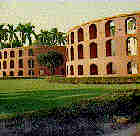
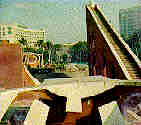 According
to the Lokayata doctrine, the universe was made up of active physical forces
(like gravitation) which activated and stimulated each other. But these
physical forces although active were not alive as they did not move about
consciously towards any set purpose. This is where the Lokayata school
differed from other philosophies which interpreted the "active" quality
of these forces as proof of their being "alive". The idea that the active
powers of the physical universe like thunder, lightning, rain and storms
were alive and moved about consciously to achieve a set purpose was the
foundation of most other philosophies. But it was the Lokayata outlook
that was reflected in the advances made by ancient Indian Astronomers like
Aryabhatta and Varahamihira who tried to understand and interpret the physical
universe around them in physical terms. Seen here are views of the Jantar-Mantar
(Yantra-Mantra) which are astronomical observatories built by Raja Jai
Singh of Jaipur. This observatory at Delhi, built in the 18th century on
principles of creating tools for astronomical observations and measurements
is based on the techniques enunciated in ancient Hindu astronomical texts
like the Aryabhattiya and Pancha-siddhanka which date back to the 5th century
C.E.
According
to the Lokayata doctrine, the universe was made up of active physical forces
(like gravitation) which activated and stimulated each other. But these
physical forces although active were not alive as they did not move about
consciously towards any set purpose. This is where the Lokayata school
differed from other philosophies which interpreted the "active" quality
of these forces as proof of their being "alive". The idea that the active
powers of the physical universe like thunder, lightning, rain and storms
were alive and moved about consciously to achieve a set purpose was the
foundation of most other philosophies. But it was the Lokayata outlook
that was reflected in the advances made by ancient Indian Astronomers like
Aryabhatta and Varahamihira who tried to understand and interpret the physical
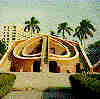
universe around them in physical terms. Seen here are views of the Jantar-Mantar
(Yantra-Mantra) which are astronomical observatories built by Raja Jai
Singh of Jaipur. This observatory at Delhi, built in the 18th century on
principles of creating tools for astronomical observations and measurements
is based on the techniques enunciated in ancient Hindu astronomical texts
like the Aryabhattiya and Pancha-siddhanka which date back to the 5th century
C.E.


