|
||||||||||||||||||
CONTENTS
Query 2. What sort of Jewellery, cosmetics, clothes did they wear? Answer: Ancient Indians wore lot of jewellery.
It was used both by men and women as crowns, armbands (baju-bandha) {Baju
= side, bandh = belt}, Waist belt (Kaya-bandh) Kaya = waist, Bangles for
both sexes (choodi), Leg bangles or anklets (Painjan), ear rings (Jhumka),
nose rings (nath), rings on fingers (Anguthi) and toes (Jodavi) as well,
hair odornments in case there was no crown.
Answer: The concept of breakfast did not exist. The meals were both vegetarian and non-vegetarian in earlier days (before the 6th century B.C.E.). After the coming of Buddhism, Jainism and other pacifist religion and reforms in Hindusim, vegetarian food (i.e. strictly excluding animal and fish meat) became the norm for as much as 50% of the population. However milk and milk products are not considered non-veg. Only where the killing of a living being (animal and fish) is concerned, the non-veg tag is applicable. Query 4. What did they do? Jobs, school ? Answer: Education was given in a sort of
hostel located deep inside forests. These hostels were called Ashramas
or Guru-kula.(Guru = teacher)
In ancient India, education was given in a sort of hostel located deep inside forests. These hostels were called Ashramas or Guru-kula.(Guru = teacher) Query 5. When and what did they worship? Religious beliefs Answer: Hinduism is polytheistic. The dictum
is "God is one, people call him by many names". Hence many (innumerable)
deities exist. When monotheistic religions came into India, they were welcomed
and their deities absorbed into hinduism. Today also many Hindus worship
at Mohammedan and Christian shrines and keep images of Christ as a part
of the Hindu altar where images of many Hindu deities are kept.
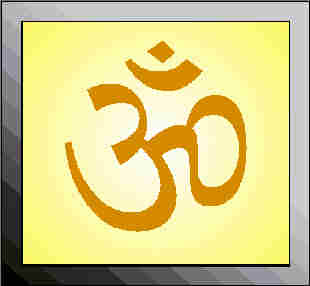
Hindiusm is polytheistic. The dictum is "God is one, people call him by many names". Seen here is the symbol Omkar which is a representation of God. It is considered to have some hoary link with terms like Omnipotent and OMnipresent in the English language as also with the term "Amen" in Christianity and "Amin" in Islam. In Hinduism, Omkar is a representation of God but there are many (innumerable) deities which are recognised and worshipped. When monotheistic religions like Christianity and Islam, came into India, they were welcomed and their deities were recognized by Hindus. Even today many Hindus worship at Muslim and Christian shrines and keep images of Christ as a part of the Hindu altar where images of many Hindu deities are also kept. Query 6. Entertainment. What did they do for fun? Ancient Indians has many games like Chess,
polo, cards (which are said to have gone from India to the other parts
of our globe). There were martial arts like wrestling, fencing, etc. Hunting
was also a favourite pastime of the nobility.
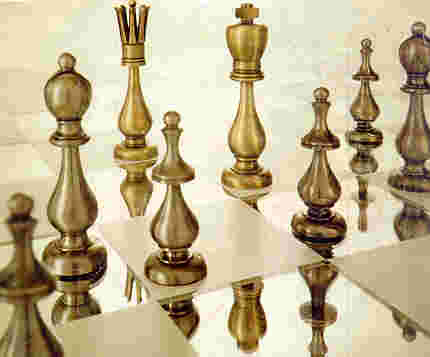
Ancient Indians had many games like Chess, polo, cards (which are said to have been transmitted from India to the other parts of our globe). There were martial arts like wrestling, fencing, etc. Hunting was also a favourite pastime of the nobility. Query 7. How were they governed? They were governed by monarchs (Rajan), although in earlier times (before the 6th centuyr B.C.E.) there were democratic institutions like the Sabha and the Samiti (Assemblage). Query 8. What kind of pets did they have? The pets were mainly birds like parrots. The royals had peacocks. Query 9. Odds and ends, if possible. The odd and unusual, to catch their interest Their interests were mostly philosphical
speculation. All Indian sciences are intertwined with philosophy and theology.
Now we move on to examine the roots of
Ahimsa
(Non-Violence
) - A Noble Humanist Concept
"Sudheer,
Lavlesh
and the Hindu History team would be happy to receive your valued feedback
on this site.We invite you to Sign
and Read our
Guest book. We also invite you to use our Message
Board on Hinduism and Hindu History to start a discussion on any relevant
topic".For comments on site mail to [email protected]
|
||||||||||||||||||
 |
 |
 |
||||||||||||||||

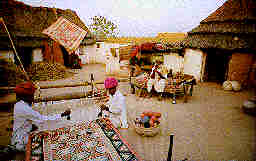
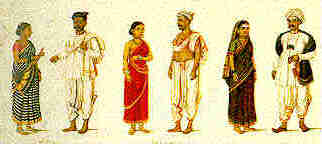 Ancient
Indians wore (some still wear) an unstiched garment called dhoti. This
was a 9 meter long cloth that was draped around the legs and tied at the
abdomen. Both sexes wear it the same way. That of ladies is coloured in
bright colours. And that of men is either white or in sober colours.
Ancient
Indians wore (some still wear) an unstiched garment called dhoti. This
was a 9 meter long cloth that was draped around the legs and tied at the
abdomen. Both sexes wear it the same way. That of ladies is coloured in
bright colours. And that of men is either white or in sober colours.