|
||||||||||||||||||||||||||
CONTENTSThe British Come to Rule India and the Return of Indian Sovereignty
But the decline of feudalism was facilitated by the general confusion that prevailed in the country after the eclipse of the Mughal empire as the executive authority of the country.
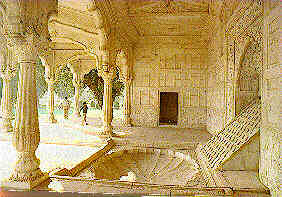
The interior of the Govind palace at Datia. The opulence and grandeur of the medieval palaces was unparalleled. The reason for this was that there manor was a status symbol for the feudal lords. Though the Mughal empire did survive till 1857, its heyday can be considered to have come to an end in 1707, with the death of Aurangzeb. The Marathas could not rise to the status of being the central authority for the entire country though at one time their armies had marched upto Attock beyond Peshawar near today's Afghanistan-Pakistan border.
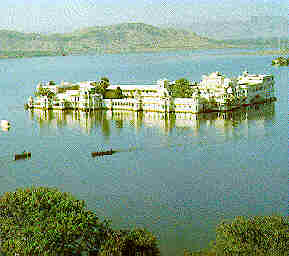
Like a flower blossoming from the water, the Palace at Udaipur sits aesthetically on the Lake For a brief period of 3 years from 1756 to 1759, the Marathas ruled Punjab and the Mughal emperor was a pensioner of the Marathas recelving an annual pension of as. 60,000 from Mahadji Shinde, the Maratha Sardar of Gwalior . The rebellious Governors of the Mughals and Marathas But the seeds of disintegration of feudalism
had been sown during the reign of Aurangzeb itself, the sudden increase
in tax incidence by re-imposition of the hated Jazia penalty (abolished
by Emperor Akbar) on the majority of the subjects of the Mughal empire
who were Hindus along with the general tendency of Nawabs (provincial governors)
to delink their provinces, notably Bengal, Hyderabad and Oudh from the
Mughal emperor's control, who increasingly became powerless to resist this
tendency of his provincial governors.
The Ghungat (veil) along with child-marriage is a gift of Muslim Rule to India.During Muslim Rule, the modesty of any lady was fair game for the Muslim chieftains. The example of Rani Padmani is well known. But there are innumerable unnammed Hindu women, whose modesty was violated during those dark days of the arbitrary Muslim rule. This tendency acted as a drain on the Mughal treasury; primarily due to the expenditure of the efforts to regain effective control over these rebellious Nawabs - and secondly by the loss of revenue from these lost provinces. Such distintegration of the Mughal empire also made it easier for the British to grab one province after another.
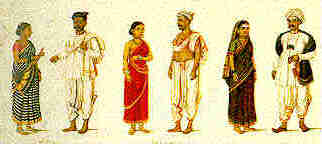
Traditional dresses of India. Indian garments are traditionally unstiched. Men use the Dhoti and the Angavastra The Dhoti is draped over the legs and the Angavastra is thrown across the shoulders. Except that a part of the saree is pulled across the shoulders. Both Men and Women wear colourful garments The East India Company On behalf of the Brtish East India Company, the resourceful British Governor-General Robert Clive grabbed Bengal in 1757 from its governor Siraj-ud-doulah, Oudh fell from the hands of Wajid Ali Shah and the titular Mughal Emperor Bahadur Shah Zafar was himself packed off in 1857 after the abortive Sepoy Mutiny. Among the Marathas also this tendency towards disintegration due to rebellious governors like the Bhosales of Nagpur - who never accepted the authority of the Peshwa, the Holkars of Indore, the Gaikwads of Baroda and the Scindias of Gwalior distancing themselves from the authority of the Peshwa at Poona, ultimately caused the downfall of the Maratha empire.
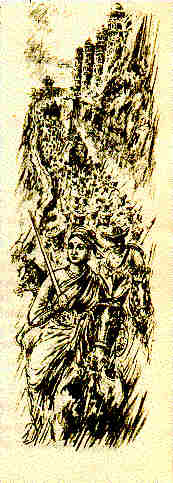
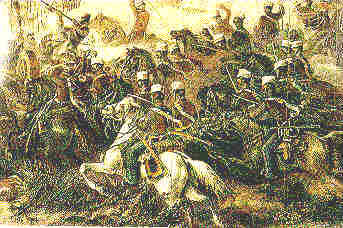
Rani Laxmibai of Jhansi was one of the important leaders of the uprising of 1857 against the British. The uprising, despite its nationalistic overtones, was in its essence, a fight of the Indian feudal classes of kings and princes, against the new incoming imperial power of the British. The mass participation that characterised the freedom movement was to come in much later with Lokmanya Tilak and Mahatma Gandhi. The general increase in defence expenditure
which started with Aurangzeb's Deccan campaign against Shivaji, the firebrand
Maratha leader; was kept up later by the numerous battles of Indian monarchs
against each other and later against the East India Company. This was an
important reason for commercial stagnation. This commercial stagnation
of trade within the country was partly responsible for the absence of the
rise of a significant merchant capital and its transformation into industrial
capital in the 17th and 18th centuries when Indian merchants had established
contacts with their European counterparts at Surat, Mumbai (Bombay), Chandranagore,
Chennai (Madras), etc. As Indian chieftains and kings badly needed resources
to finance their campaigns they levied arbitrary taxes and declared state
monopolies over the trade in profitable commodities. Provincial governors
often abused their positions to participate in trade either by directly
starting trading ventures or by thrusting themselves as partners upon one
or more Of the prospering merchants, and grabbing fat shares of their profits.
These resources were used for financing military campaigns and also for
the unproductive squander by the feudal princelings.
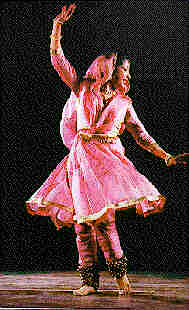
The Lucknavai Gharana (Style) of the Kathak dance style is an amalgam of the Indian and Central Asian Dance styles. The Jaipuri Gharana represents more closely the original dance style based on Bharatmuni's Natyashatra. Exclusive monopolies for the resale of superior foreign goods were declared much to the detriment of the Indian trading community and the profits were siphoned off to finance a lavish court and feudal lifestyle. The losses due to the imposition of such feudal privileges acted as a dead-weight on the nascent merchant capital, making it increasingly difficult for the emergence of a strong Indian manufacturing industry which required capital formation for its establishment. Had this been allowed an Indian industrial base could have been formed around the year 1800 itself as happened in Japan. But this was not to be and the task was left to the British. In the early days of British rule, the British Viceroys and other colonial administrators collaborated with the Indian feudal nobility to usurp this country. Unlike the fierce struggle between the Muslim monarchy and the Hindu landed nobility in the initial days of Muslim Occupation, the coming of the British power saw a smooth adjustment between the pre-British landed aristocracy and the colonial power. The Jagirdars and Inamdars generally became the Zamindars in the new set-up. The Zamindari System The reason why only the aristocracy rebelled in the Sepoy mutiny against the colonial power lies in the absence of religious fanaticism in the British colonialists like that in the early Muslim Sultans of Delhi. When British rule was established in Bengal and Oudh in the latter part of the 18th century, the colonial administration formed a class of intermediary revenue collectors who were drawn from the native landed nobility itself. These revenue collectors called Zamindars were basically different from the Jaqirdars and Subahdars of the Mughal period in that they did not have the admnistrative powers of the feudal lords of the Mughal period. True, the Zamindars had many arbitrary powers but this was never formally recognised and the British administration did not interfere with the zamindars till as.long as their arbitrary powers did not create a rival centre of power. To begin with no Zamindar had a private army, he could not dispense justice and he could levy no tax which was not sanctioned by the colonial administration . This prevented a Zamindar from becoming mini or a semi-independent ruler which the Jagirdars and Mansabdars could easily become under the Mughals. But it was not from these collaborators of British colonialism that the first Indian capitalists were to emerge. The Zamindars were the rural lackeys of the British colonialists who due to the rights of revenue collection conferred on them by the British, developed a vested interest in supporting the British colonial rule.
The Sepoy Mutiny The Sepoy Mutiny can be called the last upsurge of Indian Feudalism. It was those princelings who were deprived of their kingdoms due to the many ploys of the British Colonial expansionist policy like "The Doctrine of Lapse" that activly participated in the Mutiny. The feudal counterparts of the Zamindars who participated in the last upsurge of Indian feudalism the mutiny in 1857 were wiped out by the colonial power between 1857 and 1860. Those of the princelings who did not support the mutiny and threw in their lot with the British, continued to hold nominal favour of the colonial power in the form of privy purses and princely titles. The development of Indian capitalism took place as an totally distinct process with its roots in the new cities like Bombay, Calcutta and Madras established by the British. The traditional merchants under Mughal and Maratha rule had not been in a position to accumulate capital - and establish manufacturing industries for various reasons like the unfavourable political conditions, the Islamic ban on usury and also lack of foresight.
The pierced marble work that the artisans of medieval India created was unmatched across the globe. But this tradition acted as a drain on our economy and prevented the emergence of the culture of thrift, savings and productive investment that we saw at work in London, Manchester and in Europe in general in the 19th century. This heralded the modern age in Europe, while India under colonial rule remained in the middle ages. Gujaratis and Marwaris - The Nascent Indian Capitalist Merchant Class The Indian industrial capitalist class thus came from a totally different background. Almost none of the Indian industry houses of the late 18th and early 19th centuries had the background of being feudal nobles, like Jagirdars or Inamdars. The Parsi merchants in western India were the first community from whom developed Indian industrialists, they were followed by the Hindu communities like the Gujaratis and Marwaris. But during the l9th century and first half of the 20th century it was overwhelmingly in England and not in India that industrial development received a boost. Hence in India the transition from a feudal land based agrarian economy to a modem industrial economy was brought about with a deformity due to the imperialist subjugation to boot.
The policy of 'Great' Britain was of a systematic annihilation of Indian handicraft industries by exposing them to the ruinous competition from the cheap machine products coming from UK. The supply of cheap Indian raw materials and the dumping of finished products made from those raw materials filled the coffers of British industrialists while it drained India. Thus India was made to push from behind and pull from ahead the Chariot of Britain's industrial revolution. Even agriculture was drained off by the rapacious Zamindari system. In the Zamindari system the obscurantism and arbitrary privileges of India's feudal past were combined with the cold calculating rapacity o£ British imperialism. India' s subjugation under the most advanced capitalist country of that age unleashed the wholesale pauperization of rural artisans and peasants and yet there was not accumulation of capital. The accumulation took place in Manchester and London. Thus after nearly two centuries of living
through the twilight of two ages of the dying feudalism and the deformed
nascent newborn Capitalism, we inherited an economy which bore the worst
features of both feudalism and colonial capitallsm at the dawn of our independence.
The Mutiny of 1857 created
the first stirrings of a national movement for securing Independence from
the British. But in its essence, the Sepoy mutiny was a war fought by the
Indian kings and princes to preserve their privileges and rights of succession,
which were being threatened by the British policy of the "Doctrine of Lapse".
The Sepoy Mutiny was a war of the feudal princes against a new incoming
imperialist power of the British. The freedom movement that came later
under Tilak and Gandhi was a mass struggle in its real sense.
THE RETURN OF INDIAN SOVEREIGNTY On the midnight between August 14th and 15th, 1947 came to an end not just British rule of two centuries but alien domination which had begun nearly 750 years back when Indians had started losing their sovereignty to the Sultans of Delhi. The coming of independence after seven
centuries of alien rule had been generally preceded by a brutal tyranny,
where Indians had been made to pay a penal tax if they were not ready to
disown their country, its culture and their ancestral faith: their places
of worship had been arbitrarily desecrated and destroyed; their life and
security and the honour of their womenfolk had been at the mercy of rulers
who had contempt for everything Indian. (This was the general situation
during Muslim rule} except during the reigns of Akbar and Jehangir and
in the period after the death of Aurangzeb when Mughal power was on the
decline and hence was not in a position to tyrannize its Hindu subjects.
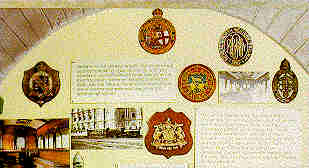
Royal Insignia of the British. Up to the Sepoy Mutiny of 1857, the British Rule in India was in the hands of the British East India Company. After the Mutiny, the British Government directly handled the administration of British Rule. A Pauperized Class of Landless Peasants This period was followed by subjugation under a European power that aimed at a systematic economic exploitation of this country. The only positive aspect of this passing of sovereignty from one alien ruler to another was the end of the arbitrary humiliation and the beginning of an orderly economic plunder! British economic imperialism created a pauperized artisan class and peasantry who formed into the proletariat employed in British owned and later Indian owned factories in the urban areas. The migration of the pauperised artisans and peasant was a phenomenon that occurred for the first time in Indian history. Many of these pauperised artisans and peasants had no land or profitable occupation left in the rural areas thus they migrated to the cities with empty hands. Even those who remained back in the
villages had to cope up with the demands of the Zamindar representatives
of British colonialism for revenue. Even the worst famines in the country's
history that occured during British rule could not bring about even a temporary
suspension of revenue collection. The colonial administration thus wanted
its pound of flesh whether its victims were living or dying. Even in the
best of times the lot of rural peasants was far from enviable and during
such famines its misery was compounded manifold. This led to other problems
of perpetual indebtedness, small size of individual holdings by sale of
a part of land to the Zamindars and moneylenders, fragmentation of land,
etc.
Abolition of Zamindari and Tax on Agricultural Income After the end of British rule, the Indian
National Government not only formally abolished Zamindari but also the
income tax on agricultural produce and thus removed necessity for having
any institution of intermediary revenue collectors between the farmers
and the state that had existed from the post-Mauryan times till the British
period. The situation today has some elements in common with that existing
under the Mauryans. Only that the problems of over-population , disguised
unemployment, rural indebtedness, smallness and fragmentation of holdings,
etc., have been added.
The ills of Indian agriculture are reflected in the mass movement of the rural poor to the cities. Those of us whose families had migrated from the villages two or three generations back have today established themselves in the cities and some of us can be said to be prospering. In most cases our rural roots are forgotten, only to be remembered on the occasion of a wedding in the family during which religious convention requires that we go to our family Gods located in our ancestral villages, for getting the wedding or other ceremonies like thread ceremony, naming ceremony solemnized. Other occasions when rural India captures our attention is during farmers agitations, rasta rokos which block rail and road links between cities. The farmers demands for higher procurement prices and support prices catch a city dweller's attention as these prices ultimately hurt his pocket. But nevertheless it goes to establish that Indian urbanities are bound to have links with rural India and be affected by developments in rural India. Thus it would pay for an average Indian to be informed about the rural setting, its history and its problems which in other words is our own past as we all have sometime or the other moved from our rural ancestral homes to the urban areas. By doing this we would not only understand better our rural brethren, but would also understand ourselves better.
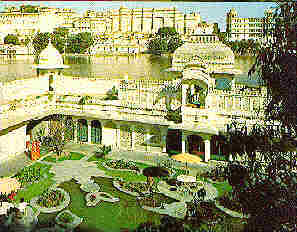
Royal Gardens such as this one generously used marble, gold and precious stone for inlay work. Such works of art that the artisans of medieval India created was unmatched across the globe. But overindulgence of the princelings with such opulence led to the frittering away of wealth of the nation. Now we move on to examine the essence of
India - Hinduism
and the influence it has had on other religious communities in India. We
shall also examine how this influence has played an important role in shaping
India's society for the past 3000 years from 1000 B.C.E. up to the present.
"Sudheer, Lavlesh and the Hindu History team would be happy to receive your valued feedback on this site.We invite you to Sign and Read our Guest book. We also invite you to use our Message Board on Hinduism and Hindu History to start a discussion on any relevant topic".For comments on site mail to [email protected]
|
||||||||||||||||||||||||||
 |
 |
 |
||||||||||||||||||||||||

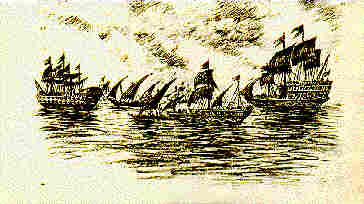 From
the 15th century onwards the first European colonists had started visiting
the shores of India
From
the 15th century onwards the first European colonists had started visiting
the shores of India




 While
such fine skilled craftsmanship was much relevant in the middle ages. With
the coming of mechanization, and mass production, craftsmanship became
irrelevant and a waste of manpower. Whenever the British saw competition
from craftsmen, it suppressed their arts as in the case of the cutting
off the thumbs of the skilled superfine saree weavers of Bengal.
While
such fine skilled craftsmanship was much relevant in the middle ages. With
the coming of mechanization, and mass production, craftsmanship became
irrelevant and a waste of manpower. Whenever the British saw competition
from craftsmen, it suppressed their arts as in the case of the cutting
off the thumbs of the skilled superfine saree weavers of Bengal.
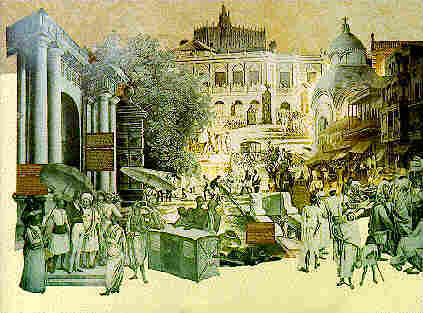 The
progress made in India under British Rule like the coming of railways,
Postal System, Telegraphic communications, etc., were all undertaken by
the British Administration to facilitate their rule. The aim of British
policy was to integrate the Indian economy with that of the British in
way such that India supplied Great Britain with cheap raw material
for being manufactured into valued-added (costly) finished products. India
again was to provide a ready captive market for British goods made from
Indian raw materials. The resultant enrichment and industrial development
was to take place in Britian and not in India. Thus at the dawn of independence,India
inherited an economy that had the worst features of both the feudal and
the industrial ages without the advantages of either. Looking Forward
The
progress made in India under British Rule like the coming of railways,
Postal System, Telegraphic communications, etc., were all undertaken by
the British Administration to facilitate their rule. The aim of British
policy was to integrate the Indian economy with that of the British in
way such that India supplied Great Britain with cheap raw material
for being manufactured into valued-added (costly) finished products. India
again was to provide a ready captive market for British goods made from
Indian raw materials. The resultant enrichment and industrial development
was to take place in Britian and not in India. Thus at the dawn of independence,India
inherited an economy that had the worst features of both the feudal and
the industrial ages without the advantages of either. Looking Forward