Passover and Easter, Part Four

Hosted by www.Geocities.ws

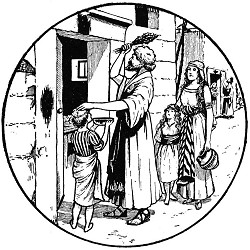
"Now the Lord spoke to Moses and Aaron in the land of Egypt saying, 'This month shall be your beginning of months, it shall be the first month of the year to you (yes, the Hebrew calendar was changed, and this will be addressed in another section on my web site). Speak to every congregation of Israel, saying 'On the tenth of this month, every man shall take for himself a lamb, according to the house of his father, a lamb for a household. And if the household is too small for the lamb, let him and his neighbor next to his house take it according to the number of the persons, according to each man's need you shall make your count for the lamb. Your lamb shall be without blemish, a male of the first year...Then the whole assembly of the congregration of Israel shall kill it at twilight. And they shall take some of the blood and put it on the two doorposts and on the lintel of the houses where they eat it. Then they shall eat the flesh on that night; roasted in fire, with unleavened bread and with bitter herbs they shall eat it...So you shall eat it in haste. It is the Lord's Passover. For I will pass through the land of Egypt on that night, and will strike all the firstborn in the land of Egypt, both man and beast, and against all the gods of Egypt I will execute judgment. I am the Lord. Now the blood shall be a sign for you on the houses where you are. And when I see the blood, I will pass over you, and the plague shall not be on you to destroy you when I strike the land of Egypt." (Exodus 12:1-12:13)

Are Messiahs allowed to be angry? Did any of the Israelites disobey God's commandment for the Passover? Yes and yes. There were Israelites who had sold out to the Egyptians and were rich because of them, and mocked the Lord and so were smote along with their employers. And so we see the difference of righteous, or godly anger, and unrighteous, or ungodly anger. Righteous anger sanctifies even if it means destruction of an evil people, or especially so. Unrighteous anger destroys.

When Moses went up on Mount Sinai after the Exodus, to receive the Ten Commandments, he came back to a veritable orgy: "And the Lord said to Moses, 'Go, get down! For your people whom you have brought out of the land of Egypt have corrupted themselves." (Exodus 32-7). The Lord was outraged and so was Moses, and rightly so. While Moses are meeting with the Lord and getting the Law, the Israelites completely lost faith, forgot the covenant they made with God and the thanks they gave Him for saving them. Moses wasn't gone that long, and he certainly hadn't deserted the Jews. He was receiving the guidelines that would help the Jews live to live in their new home. Instead of having faith and waiting patiently for Moses to return, the Jews resorted to idol worship of the golden calf and worse. And so Moses threw the tables at them and at the idol.

Compare this to Matthew 21:12: "Then Jesus went into the Temple of God and drove out all those who bought and sold in the temple, and overturned the tables of the money changers and the seats of those who sold doves. And He said to them, 'It is written, 'My house shall be called a house of prayer, but you have made it a den of thieves.'"

However, even a Messiah can sin and be punished for it. The episode at Kadesh Barnea was to be the one thing that Moses did that God did not forgive, because as the leader of the Israelites, he should have known better. And so while God caused the generation of slaves to wander in the desert for forty years until they had all died off, God forbade Moses to enter into the Promised Land as well for striking a rock.

This seems harsh of the Lord but put in the proper perspective, we can begin to understand why God meted out this judgment upon Moses. When Moses first led the slaves out of Egypt, they complained about not having enough water to drink (Exodus 17). Moses called out to the Lord for assistance, and He told Moses to strike a rock at Rephidim and that water will spring from it, which it did. So why was the second striking a sin? Moses was under a lot of pressure. A military operation had just failed, the Israelites were still complaining about being taken out of Egypt only to die. Moses' sister Miriam died, and a host of other bad things happened all within a short amount of time. So when the Lord commanded Moses not to strike a rock to get water this time, but "Take the rod, you and your brother Aaron gather the congregation together. Speak to the rock before their eyes, and it will yield its water, thus you shall bring water for them out of the rock, and give drink to the congregation and their animals."

The Word continues, "So Moses took the rod from before the Lord as He commanded him. And Moses and Aaron gathered the assembly together before the rock; and he said to them, 'Hear now, you rebels! Must we bring water for you to drink out of this rock?' Then moses lifted his hand and struck the rock twice with his rod; and water came out abundantly and the congregation and their animals drank. Then the Lord spoke to Moses and Aaron, "Because you did not believe Me, to hallow Me in the eyes of your children of Israel, therefore you shall not bring this assembly into the land which I have given them." (Numbers 20:7-12)

As James said, "My brethren, not let many of you become teachers, knowing that we shall receive stricter judgment." (James 3:1)

Does anyone still believe that Passover and Easter are unrelated beyond the Last Supper?

HOME

Written and designed
by Micki
March 2000 1