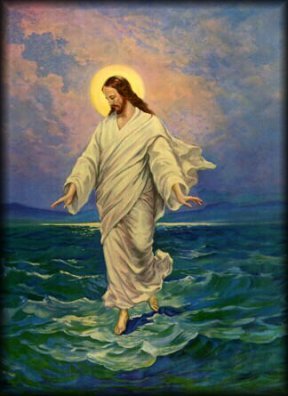
MIRACLES
MIRACLES
Geza Vermes, Dead Sea Scrolls scholar states:
"Accordingly, they organized their movement so that it corresponded faithfully to that of the Jewish people, dividing it into priest and laity (or Aaron and Israel), the priests being led by the Sons of Zadok (Zadok was the High Priest in David's day), and the laity grouped after the biblical model into twelve tribes. The structure is described in the War Rule's (Dead Sea Scroll's) account of Temple worship as it was expected to be at the end of time:
"The twelve chief priests shall minister at the daily sacrifice before
God...Below them shall be the chiefs of the Levites to the number of
twelve, one for each tribe...Below them shall be the chiefs of the
tribes.
"Still following the biblical pattern, sectarian society (apart from the Tribe of Levi) was further distinguished into units of Thousands, Hundreds, Fifties, and Tens. To what extent these figures are symbolical we do not know, but it is improbable that "Thousands" amounted to anything more than a figure of speech. It is not irrelevant, in this connection, to note that the archaeologists have deduced from the fact that the cemetery (at Qumran) contained 1,100 graves, dug over the course of roughly 200 years, that the population of Qumran, an establishment of undoubted importance, can never have numbered more than 150 to 200 souls at a time. Also it should be borne in mind that the total membership of the Essene sect in the first century CE only slightly exceeded 4,000 (Josephus, "Antiquities XVIII, 21).
"...of the uncircumcised non-Jews of the Ham fraternity (known figuratively as "The Five Thousand"). He (Jesus) granted their "multitude" (governing body) symbolic access to the ministry by serving them the "five loaves and two fishes" of the Jewish priestly candidates."
The true miracle is this: "Gentiles wishing to be baptized into Judaism (NOT THE OTHER WAY AROUND, AS IT IS TODAY), underwent a ritual in which they, as "fishes" were hauled into boats by "fishermen," to be blessed by priestly "fishers." In a similar transference of imagery, the Levite officials of the Sanctuary were called "Loaves" (the ones with the leavening, or the Truth). In the rite of ordination, the ceremony of admission to the priestly ministry, the officiating Levite priests would serve seven loaves of bread to the priests, and to the celibate candidates. They would administer five loaves and two fishes. There was some important legal symbolism in this, for whereas Gentiles might receive baptism as "fishes," the law was very firm that only Jews could become "loaves."
The Essene community at Qumran was known by many names, but in this chapter I will discuss why it was known as Egypt. When the Jews were slaves under the Pharoahs, they learned quite a bit about medical care. At Qumran, there was a facility called the Egyptian Therapeutate. That Jesus and others of the Essene, or Nazarene, sect were able to perform healing "miracles" should not be that mysterious.
At the time, Jesus and his contemporaries were on the leading edge of the medical profession. The Levites had been appointed by God in the Old Testament to be the first medical professionals in Judaism:
"And the Lord spoke to Moses and Aaron saying, "When a man has on the skin of his body a swelling, a scab, a bright spot, and it becomes on the skin of his body like a leprous sore, then he shall be brought to Aaron the priest or to one of the sons the priests. The priest shall examine the sore on the skin of the body, and if the hair on the sore has turned white, and the sore appears to be deeper than the skin of his body, it is a leprous sore. Then the priest shall examine him, and pronounce him unclean. But if the bright spot is white on the skin of his body, and does not appear to be deeper than the skin, and its hair has not turned white, then the priest shall isolate the one who has the sore seven days. And the priest shall examine him on the seventh day, and indeed if the sore appears to be as it was, and the sore has not spread on the skin, then the priests shall isolate him another seven days. Then the priest shall examine him again...And if the priest sees that the scab has indeed spread on the skin, then the priest shall pronounce him unclean. It is leprosy." (Leviticus 13:1-8)
The "Word in the Life" Bible has the following commentary in Leviticus:
Priests, the Medical Professionals. Leprosy, or skin disease, was frightening, and had to be dealt with quickly and thoroughly, lest others become contaminated. The Bible gives no indication that Israel had medical professionals. Instead, priests were called to do the work we associate today with physicians.
In the case of leprosy, the priests' job was to:
Diagnose the disease. The word "examine" is used numerous times in Leviticus 13-14, the main passage in the Law dealing with leprosy. Great care was taken to distinguish which disease was being treated, and the instructions that God gave were exacting. This suggests that the priests were to show great care and concern for the victims of leprosy. Early detection was important in order to prevent, if possible, the disease from doing its terrible work on the individual.
Prescribe treatment for the patient. The main "treatment" for the disease was to isolate the infection person. Isolation was crucial to protect others from the dreaded contagion. The text describes intricate processes to counter the ravaging effects of the sickness.
Contain costs. An important fact behind the precise details for the clothing and housing of infected persons is that during this era, many Hebrews were relatively poor. God had a concern that they not lose all of their possessions through the sanitizing process. Thus a leper's clothes were carefully purged and cleaned so as not to destroy what might be his or her only possession. Similarly, the person's house was to be carefully purged, if possible, rather than totally destroyed.
Sanitize the environment. Concern about the spread of the disease is shown in the careful process of cleaning the clothes and the residence of the patient, and rechecking it to be sure of its condition.
Therefore, the healings as described in Matthew that were so mystically performed by Jesus can all be explained by scientific and historical fact. It is well-known that the Essenes practiced raising people from spiritual death, not actual physical death, as was the case with Jesus raising Lazarus, or Simon the Zealot, or Zelotes after being "dead" for three days. Simon had angered some senior officials at Qumran, and was thus, for lack of a better work, excommunicated until he had mended his ways. Jesus raised Simon from spiritual death, and nothing more. As it says in the Dead Sea Scrolls:
"And these are the rules which the men of perfect holiness shall follow in their commerce with one another:
"Every man who enters the Council of Holiness, (The Council of those) who walk in the way of perfection as commanded by God, and who deliberately or through negligence transgresses one word of the Law of Moses, on any point whatever, shall be expelled from the Council of the Community, and shall return no more; no man of holiness shall be associated in his property or counsel in any matter at all (Simon the Lazarus was very high up in the Essene echelon). But if he as acted inadvertently, he shall be excluded from the Pure Meal and the Council and they shall interpret the rule (as follows): for two years he shall take no part in judgment or ask for counsel; but if, during that time, his way becomes perfect, then he shall return to the (Court
of) Inquiry and the Council, in accordance with the judgment of the
Congregation, provided that he commit no further inadvertent sin during two full years."