|
Hanukkah is a story about religious freedom. Many people mistakenly think that Hanukkah and Christmas are alike because they are celebrated at the same time of year. The first day of Hanukkah is actually on the 25th day of the Hebrew month Kislev, which corresponds to December 4 on the Christian calendar this year. As all Jewish holidays begin and end at sundown, the first night of Hanukkah is on December 3rd.
Although certain rituals are observed, Hanukkah has more of an historical than a religious significance. At the end of the fourth century BCE, Alexander the Great conquered the Persian Empire, of which Palestine was a part. After his death, the empire broke up into smaller Greek kingdoms. For the next two centuries, Palestine was bounced back and forth between Syria and Egypt. By the time Antiochus IV (called "Epiphanes") ascended the Syrian throne circa 175 BCE, the Jews were split into two factions: those who favored the religious tolerance afforded them by Egypt, and those who preferred the Greek culture, or Hellenism, of Syria.
Antiochus wanted all of his subjects to conform, and put a political puppet in charge of the province of Judea to help bring this about. The strict regime caused bitter resentment and renewed sympathy for Egypt. Antiochus marched on Jerusalem and plundered the Temple. The city was left in mourning. Antiochus then went on to conquer Egypt, but he was ordered by Rome to withdraw. This led him to issue a decree that everyone was to serve the Grecian gods and to become Greeks, on penalty of death. The Jews were in particular danger because of the proximity of Palestine and Egypt; however, they refused to subject and an army was sent against them. |
|
When the Temple was turned into a Grecian place of worship, the Jews revolted under the leadership of Judah Maccabee and his brothers of the Hasmonean family. The Temple was rededicated to the Jewish faith; however, only one jar of unopened holy olive oil was found with which to light the sacred lamps. Although it was only enough to last one day, a miracle occurred and the oil lasted eight days instead. The next year, a festival was created with praise and thanks to God. It was called Hanukkah ("dedication"), the Festival of Lights. The Syrian government weakened soon after, and the Hasmoneans created a new, independent Jewish kingdom in Palestine.
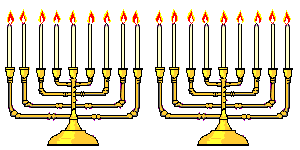
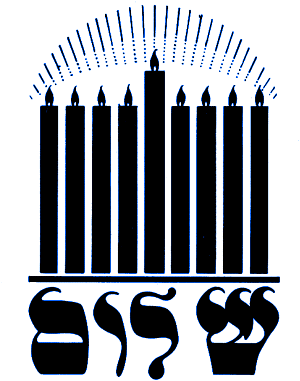
The most well-known feature of Hanukkah is the lighting of the menorah, a special candelabrum, to commemorate this event. It has eight receptacles for candles (although some are still made to hold liquid oil), plus a ninth place for the shamash, which is used to light the other candles. On the first night, just after sundown, one candle is placed to the extreme right and lit by the shamash; the next night, two are placed at the right, and so on until the eighth night, when all of the candles are inserted and lit. A departure from the norm, any family member may perform this ceremony. The candles are blessed by saying, "Blessed art Thou, Lord our God, King of the universe who has sanctified us with His commandments and commanded us to kindle the Hanukkah light. Blessed art Thou, Lord our God, King of the universe who has performed miracles for our forefathers in those days, at this time." (Translated from Hebrew.)
The menorah should be placed by a window so that all may witness the miracle of the holiday. It must burn for at least 30 minutes during the evening hours. Because of the sanctity of the lights themselves, the menorah may not be used for mundane purposes such as to read by, to light a room, or to light a cigarette. |
|