
Pan
"Pan is greatest, Pan is least. Pan is all, and all is Pan."
Pan is one of the oldest and most complex Gods worshipped by modern pagans today. His worship started in Arcadia in the Peloponnese where, it was said, that he lived on Mount Maenalus or Lycaeus. Later his worship spread to Athens where a temple for the Horned God was built at the Acropolis. From there his worship spread to Greece and beyond. The Arcadians said Hermes (who was also goat-footed and horned) was the father of Pan. The Greeks had a variety of myths regarding this chaotic God. Some said he was the son of Hermes by Dryope. Other said he was Hermes and Penelope's son. Or was he the son of off of Penelope's suitors while Ulysses was away? Some thought Zeus was his father. Another legend claims that Amalthea, the Cretan goat-goddess was Pan's mother. In Rome, Pan was identified with Faunus and also Dionysus. He was also related to the Egyptian solar God, Amon-Ra.
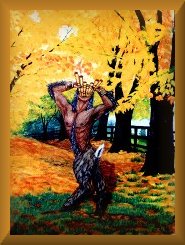
For the Greeks, Pan was the God of shepherds, flocks, woods, and also of hunting. He had the gifts of wisdom and prophecy. "He had goat's feet, in touch with the Earth. His animal legs rose to his fertile energizing loins. His torso was purely human, culminating in his wise and prophetic head, with it's power to create music."
Pan and nymphs are closely intertwined. Many of these nymphs may actually have been primordial local goddesses. Though Pan was known for his great desire for these lovely Goddesses, they often didn't desire him! One such chase resulted in the creation of the pan-pipes. Pan once pursued the nymph Syrinx. She in desperation called on her father, the river God Ladon, for help. Ladon turned her into a reed. In an attempt to find Syrinx, Pan plucked some reeds. He turned these reeds into pipes which he named the Syrinx after the nymph.
Scholars are divided over the source of Pan's name. Some think he is named after the Greek work, Pan meaning "all, everything." Others think the God's name comes from the Greek word, paon, meaning "pasturer." The word panic came from the terribly cry Pan shouted to take away the strength of his enemies and to fill them with fear.
In medieval times, the Christian church transformed Pan into the Devil. Remnants of family witchcraft traditions from that time suggest that the country folk took that name in stride and sometimes adopted it as the name for the Horned One. Often they just referred to Pan as Old Horny. Pan's image was cleaned up with the Romanticism of the 19th century, where he also lost some of his wildness and became a more gentler. Poets adopted Pan as their patron. Shelley wrote to a friend in 1821, "I am glad to hear that you do not neglect the rites of the true religion. Your letter awoke my sleeping devotion, and the same evening I ascended alone the high mountain behind my house, and suspended a garland, and raised a small turf-alter to the mountain-walking Pan. "Both Byron and Oscar Wilde wrote about Pan.
Pan, for many modern pagans, has come to represent the wild way, not only in nature but in ourselves as well. He has often been invoked to help with protecting nature from development. In "The Witches' God" by Janet and Stewart Farrar, they include a Pan ritual for such a purpose. He has also been associated, of course, with sexual magic. He can also be called to help a pagan establish their connection with the earth. Red wine is his favorite libation. Wheat bread is also appropriate -- though chocolate, of course can also be appropriate.
But Pan is much more than what his physical image presents. Remember, he was also considered a God of Wisdom and Prophecy. When approached in the guise of wisdom and prophecy, Pan can be gentle and kind. Then there is a steadfastness to him and the great age of him is much more apparent.
But always, there is an aura of lustiness. For Pan is always "Old Horny."
The Rite of Pan" Quote, The Goat Foot God,
Dion Fortune
pp. 77, The Witches' God, Janet & Stewart
Farrar, Phoenix Publishing
pp. 765-766, The Woman's Encyclopedia of Myths
and Secrets, Barbara G. Walter, Harper & Row Publishers
This article was first published in the Hazel
Moon 1996 edition of "Pagan Personal Pages."
by Jeannette K. Waldie
© 8/5/96
~*~NEVER
AGAIN
THE
BURNING
TIMES~*~
Follow this path to return to the Stories Index Page...

Follow this path to return to the Main Home Page... 
This site hosted by...