
Lugh
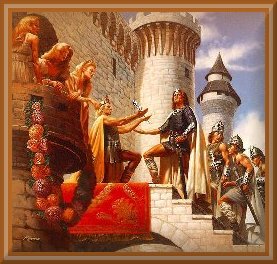
Taller than most men, he stood before the Guard. His hair glowed with the sun. "I wish to enter the Hall of Kings," he murmured. "The hall is full," the guard smirked. "Only if you have a talent that no other man in the hall has may you enter." "Do you have a Bard?" "Yes, we have a Bard?" Do you have a Farrer?" "Yes, we have a Farrer." "Do you have a Healer?" "Yes, we have a Healer." "Do you have a warrior?" "Yes, we have warriors plenty!" "Do you have a goldsmith?" "Of course!" "Do you have a weaver?" "Yes, we have a weaver." "Do you have a scribe?" "Yes, we have a scribe." "Do you have a seer?" "Yes!" (The guard was getting impatient with this foolish fellow.) "Do you have a person who can do all of these things?" "No. No man can do all those things!" "Ah, but I am no man!" And with that, Lugh displayed his full glory and strode into the Tara, the Hall of Kings.
Lugh (Shining One) is Pan-Celtic in origin. In Ireland he was also known by the names of Ioldanach or Samhioldananach ("master of all arts"). He was also called Lamhfada (La- VAH-dah) meaning "the long-armed." In Irish lore, Lugh may have been originally the King of the Formarians who was adopted by the Tuatha De Dannann and then by the Celts. He replaced Balor as the Sacrificial God and many scholars think he may have been the primary deity of the Druids.
In Wales, he was called Llew Law Gyffes or Llew of the Steady Hand. In the Mabigonian, Llew was the son of Arianrhod and Gwyddion (or his Uncle Math). The Welsh saw him as a great archer. Lugh was also worshipped in Celtic Gaul where he was called Lugus. He is often equated with Apollo, Baal and Hercules Lugh is also associated with Carlisle (Roman name was Luguvalium), Lyon (France), Leyden (Holland); and Legnica (Poland).
Lugh was a deity of many skills. He was a God of Sun, light and of the grain harvest. He was also seen as the God of fire, metallurgy, crafting, weaving, scribe, seer, and as a protector of the weak. He often took human form and walked among the Celts.
His main festival is Lughnasadh on July 31st (though some put the date as August 2nd). The Celts also named the month of August after Lugh. In Irish, it is "Lunasa; in Scottish Gaelic it is Lunasda; and in Manx it is Laa Luanys. There are several ideas about the original meaning of Lughnasadh. Many scholars feel it was funeral games in honor of Lugh's dead foster-mother, Tailte. Others think it was Lugh's marriage feast. Or, in Lugh's aspect as God of the harvest, it was a feast to honor the sacrifice of Lugh. Whatever the original purpose, the festival became a time to conduct tribal business, trade, horse racing, contests, and rituals to ensure good fortune. This was often a time for trial marriages (called Teltown Marriages) where after a year and a day, it could be dissolved by the couple returning to the ceremonial site and walking away from each other to the North and South.
Lugh is excellent to call on for artisans, especially those who work with fire or heat. He can also be evoked when one needs powers for money, strength, energy, new beginnings, business ventures, and protection.
Libation: Mead, Scotch or Irish Whisky, Whole wheat or fall fruit bread.
This articles was first published in the January 1997 edition of "Pagan Personal Pages."
by Jeannette K. Waldie
© 12/24/96
~*~NEVER
AGAIN
THE
BURNING
TIMES~*~
Follow this path to return to the Stories Index Page...
Follow this path to return to the Main Home Page... 
This site hosted by...