
Around the time of the Tuatha De Dannan, there lived a chieftain called Lir. He had four children; a daughter named Fionnuala, a son called Aodh, and twin boys by the names of Fiachra and Conn.
As the twin boys were born, his wife, Aebh, died after giving birth. Lir agreed to marry his wife's sister, Aoife, who would act as mother to the newly born twins.
At first Aoife was delighted with her sister's children, and took pleasure in the joy they gave not only to Lir, but to anyone who met them.
So dearly did their father love these four that he got them to sleep on couches in front of his own, and every morning he would wake up early to go and embrace them.
His devotion, however, awoke a fire of envy in Aoife, their stepmother. She started to hate them and resented the admiration they won from everyone. To draw attention to herself she pretended to be sick for a whole year, but even though great care and concern was shown towards her she still wasn't satisfied. She decided to get rid of them.
One day she had her chariot prepared for her and told the children to climb into it and go along with her. Fionnuala knew in her own mind that her stepmother had planned something evil against them but she could not refuse what seemed an ordinary command even though she could feel the malice in Aoife. When she got the children some way from Lir's house she pulled a sword from its scabbard in the chariot intending to kill them but a womanly instinct combined with fear of physical violence stopped her. In fury and panic she drove the chariot on to Lough Derravaragh in Co. Westmeath. She loosened the horses on the strand and told the children to climb down from the chariot, take off their clothes, and to wash themselves in the lake, saying that they were covered in dirt from the long drive.
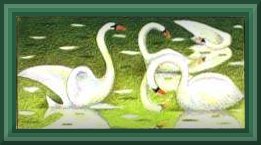
Once again Fionnuala knew that evil was afoot, but she found it impossible to disobey a sensible request. They all did as they were told, and entered the cold water of the lake. When they were swimming around, Aoife, who was trained in the arts of magic, struck the water's surface with an enchanted rod, and immediately the four lovely bodies before her changed their shapes into four swans as white as snow. Their bodies changed as they were swimming and when the transformation was complete the four shapes all turned in unison, and then Fionnuala spoke strangely through her new throat:
"What you have done to us is evil. It is an evil return for all the friendship and care that has been shown to you. Though your magic is strong it's not as strong as the power our father and his friends will bring against you in vengeance. This act of yours will finish you. But please, even if only to lessen the harshness of the punishment that awaits you, put some limit on the enchantment. Give it some end."
"all right, I'll do that," Aoife replied.
"But you're going to regret having asked this favour. You'll stay as you are until you've heard the sound of bells ringing in unison after having spent three hundred years on this lake, three hundred on the Sea of Moyle between Ireland and Scotland, and three in the Atlantic off Eris in Mayo. Those will be your adventures and this is your fate from now on."
The swans looked at her and bent their heads in sorrow. Their grief awoke some pity in Aoife and she said:
"There's nothing to be done now to mitigate this curse. You will continue to be able to speak. Also you will sing music that will be like no other music and it will ravish listeners with sweetness. You will continue to be able to think and even though your lives will be harsh you will never completely despair in spite of your pitiful condition."
She left them there and when she had gone they swam out into the deep reaches of the lake, paddling slowly.
From that time on the Tuatha Dé Danann would come to the strand to listen to their singing, and the Gaels too as the years went past, because no one had ever heard such delightful harmonies of sound to enchant the ear and fill the mind with pleasure. Not only did their distress of even the most unhappy man or woman, the swans also recited stories and poems and held conversations with learned men and their students. So they continued for three hundred years until one night Fionnuala said to the others;
"Did you know this is our last night here?"
They did not, and the three boys were saddened because being in contact with the Tuatha Dé Danann and even the Gaels was closer to being human than to be out on the fierce waters of the Sea of Moyle. In the morning they swam to the strand and they sang a poem of farewell before taking off together into the bitter sky northwards to Moyle. They were sorely missed by everyone, and it was decreed from that day forward that no one in Ireland should ever kill a swan, on pain of death or the most severe penalty.
When their second appointed term of three hundred years was past they took to the air one day, with grateful hearts to be leaving such a place, and flew westwards and south out to Erris off the Mayo coast, where they were to spend their last three centuries. Although the Atlantic sea was milder most of the time, the seas were vaster and often more turbulent even than those at Moyle.
They suffered the long Atlantic winters, with their continuous downpours, fog, and doleful days of grey light. But there were summers, too, amongst the many islands, and the scent of myrtle wafting off the bogland slopes above them. At length their time was up and Fionnuala told her brothers that they all could go back to Lir's fort in the Fews.
Gladly they flew from the Atlantic across the country, over the long lake of Lough Erne. When they got to the mound where Lir's palace had been they found a bare green hillock overgrown with clumps of nettles.
They circled over the place where there used to be a throng of talking people, shouting, the clank of armour being shaped, the loud snorts of horses, the smells of the bakehouse and the kitchen. Now there was silence and the sad movements of the grey nettles in the wind. They settled on a patch of green where the hearth used to be and sang their mournful song. Early next day, they spread their wings and flew across Ireland back to Erris, where they found a small lake on the island of Inishglora. From there they flew each day, feeding off the plentiful fish that teemed in the waters between Achill and Erris. So they continued for a while.
Until one day while they were feeding, the sound of bells ringing in unison echoed throughout the land. Instantly the children were changed back to humans, but they were old and withered and died shortly after.
A holy man that held a one of the few new churches in Ireland nearby
found them by the lake. Realizing from the ancient druid tales that these
were the four Children of Lir, he held a ceremony in their honour and buried
them all together by the lake.
~*~NEVER
AGAIN
THE
BURNING
TIMES~*~
Follow this path to return to the Stories Index Page...

Follow this path to return to the Main Home Page... 
This site hosted by...