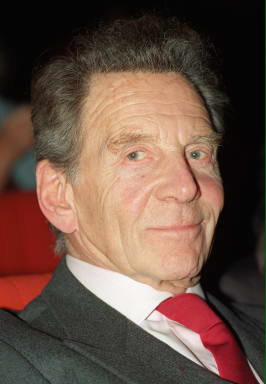
From Liberation Magazine:
URL for the original French here
Translation by Sylvie Levesque
Aumont, salutations distingu�es
The high class actor is dead at 90.
By G�RARD LEFORT
Tribute from Jospin and Chirac.The Prime minister paid tribute yesterday to a "man of conviction and courage" who will leave us the "memory of a discreet and elegant gentleman". In his press release, Lionel Jospin remembers an "actor gifted with great talent" who achieved "an exemplary career that combined movies and the theatre". As for President Chirac, he expressed his "emotion" and his "sadness" following the death of Jean-Pierre Aumont, "a formidable actor", "a man with all the talents","formidable actor who left his mark on the history of French theatre and cinema".
Jean-Pierre Aumont was handsome, extremely handsome. Right from the beginning (he was born Jean-Pierre Salomons on January 5th 1909, in Paris) and until the very end (he died in Saint-Tropez, in the night fromMonday to Tuesday). For those who would doubt this fact, they only need to ask any young woman born before 1920. Without fail, she will place Jean-Pierre Aumont in her love pantheon as the ideal lover along with the other ultimate fiancee of French cinema: the divine Danielle Darrieux. So it's not surprising that Aumont married one after the other three magnificent actresses: French Blanche Montel, whom he divorced in1940, Dominican Maria Montez in 1943, who gave him a daughter, Tina, and finally, after the untimely death of Maria Montez in 1951, Italian Marisa Pavan, twin sister of Pier Angeli (James Dean's official girlfriend), who gave him two sons.
Young leading man.
Born in a family of artists (he was actor Georges Berr's nephew, and his brother had a career as a movie-director under the name Fran�oisVilliers), Jean-Pierre Aumont ��naturally�� studied at the Conservatory, where he was noticed by Louis Jouvet who gave him his debut on the stage of the "th��tre des Champs-Elys�es" in the part of a young English teacher. Jean Cocteau, an expert in handsome blue-eyed blond men, gives him the part of �dipe in his play 'la Machine infernale' in 1934. But it's mostly the movies that take notice of him: after a brief performance in Jean Choux's Jean de la Lune and some roles in third rate movies, with titles that make one wonder (Eve cherche un p�re [Eve looking for a father], la Merveilleuse Trag�die de Lourdes [the Wonderful tragedy of Lourdes] but even so Tourneur's 'le Voleur'),he becomes, thanks to Marc All�gret (Andre Gide's most famous false nephew), a muscular lifeguard in bathing suit alongside Simone Simon in Lac aux dames in 1934. That same year, he'll play a young factory worker in Victor Trivas's Dans les rues and a lover in Julien Duvivier's Maria Chapdelaine. This is an instant triumph for him, that can be measured by the innumerable covers of movie magazines that are devoted to him. From then on, typified by his frank smile, Jean-Pierre Aumont seems forever destined to be the optimistic, dynamic young leading man. People like him as a pilot in Tourjansky's l'Equipage (1935), they adore him as the winsome cosack in Granowsky's Tarass Boulba (1936),they adulate him as the suitor in Marcel L'Herbier's 'la Porte du large' (1936). But Raymond Rouleau breaks the streak in 1937, by giving him in 'le Messager' the part of a suicidal engineer. With stunning ease, the young dandy transforms himself: ironic milkman in Marcel Carn�'s Drole de drame, he takes the risk of being unlikeable and vein H�tel du Nord, another Carn� movie in 1938. After the Munich agreements and the "cowardly relief", the era needs complex and worried heroes: Gabin in Lejour se l�ve or la Grande Illusion, and Jean-Pierre Aumont who in1939 plays a WWI soldier in a Leonide Moguy movie that has a premonitory title: 'le D�serteur' [Deserter].
A member of the Resistance
During the war, Jean-Pierre Aumont does desert but not exactly in the same sense that the French population does. Caught up by his Jewish origins, he moves to the U.S. in 1940, makes some antinazi propaganda movies (Tay Garnett's The Cross of Lorraine, 1943), joins the Free French Forces, takes part in campaigns in North Africa and the Allied landing in Provence. Wounded twice, he's awarded the 'croix de guerre'and the 'L�gion d'honneur'.
With Charles Boyer, he'll be one of the few French actors to succeed in Hollywood, undoubtedly because of his ��lovely French accent��, that had become in fashion thanks to Maurice Chevalier, but also because he embodied a certain "old Europe" casualness, what could be called tremendous class. In 1947, he appears alongside Yvonne De Carlo in Sch�h�razade, a delightfully crazy musical by Walter Reisch that takes place in Morocco in 1865,where a vessel from the Russian squadron makes a stop with young Rimski-Korsakov (Aumont) on board. He's hoping to find a piano to create with and finds instead ultra-gorgeous Cara de Talavera (Yvonne De Carlo). In1948, a remake of l'Atlantide directed by Gregg Tallas is in the same somewhat heavy style, even if Aumont in the role of the lost officer is great and Maria Montez (his wife at the time), utterly exciting as queen Antinea. Casually dabbling in everything, Jean-Pierre Aumont will also appear on the Broadway stage, most notably for a two-year run of Tovarich with VivienLeigh.
Melancholy.
Back in France, not taking himself too seriously by utterly enjoying himself, Jean-Pierre Aumont will be cardinal de Rohan in Guitry's SiVersailles m'�tait cont� (1954), Raoul Vignerte in the very heavy-handed K�nigsmark of SolangeT�rac (1953) or the "modern man" in Nicole V�dr�s strange documentary-fiction, La vie commence demain (1949), where Gide, Sartre, Le Corbusier and Picasso play their own roles. Gradually, Aumont becomes the guest star of many tv series: the serial 'les Chevaliers du ciel', in the 60s, and very recently in Jos�e Dayan's le Comte de Monte-Cristo. Cinema will call him back three times however: inTruffaut's 'la Nuit am�ricaine' (1972), Aumont is peerless as the old-school play-boy who can go barefoot in mocassins without looking ridiculous. He'll have as much class in Claude Lelouch's 'le Chat et la souris' in 1975, but it's in 1976 that Jean-Pierre Aumont overwhelmedus: after having created the part on stage, he is "the son" in Marguerite Duras's Des journ�es enti�res dans les arbres with Madeleine Renaud and Bulle Ogier. So charming and so melancholy, Jean-Pierre Aumont wrote several plays and auto-biographical works like Dis-moi d'abord que tu m'aimes [first tell me you love me] (a phrase borrowed from Mozart who would say this to the people who asked him to perform), where he speaks about his friends, from Marl�ne Dietrich to Danielle Darrieux and Orson Welles, without giving away everything about their private life. That's the thing that will remain of Jean-Pierre Aumont: a distant kindness, an exquisite politeness, a handsome man with reserve who's still a thinking man. A gentleman, a term and a quality that is not typically French.
Survivor of the Vosges campaign
Jean-Pierre Aumont was in General Diego Brosset's Jeep at the time of the accident that claimed the life of the chief of the 1st Free French Division (DFL); it was November 1944, during the Vosges campaign.
According to the 1st DFL's marching logs, November 20 1944, the day after the little town of Champagney (Vosges) had been reclaimed, some 20 km from Belfort, by the North-African 22nd marching battalion (BMNA), General Brosset was driving the Jeep that carried his driver and officer cadet Jean-Pierre Aumont. The Jeep that skidded to avoid a German mine casing on the road, dived in the Rahin, a torrent made worse by the rains. General Brosset drowned in the accident.
Obituaries / Articles