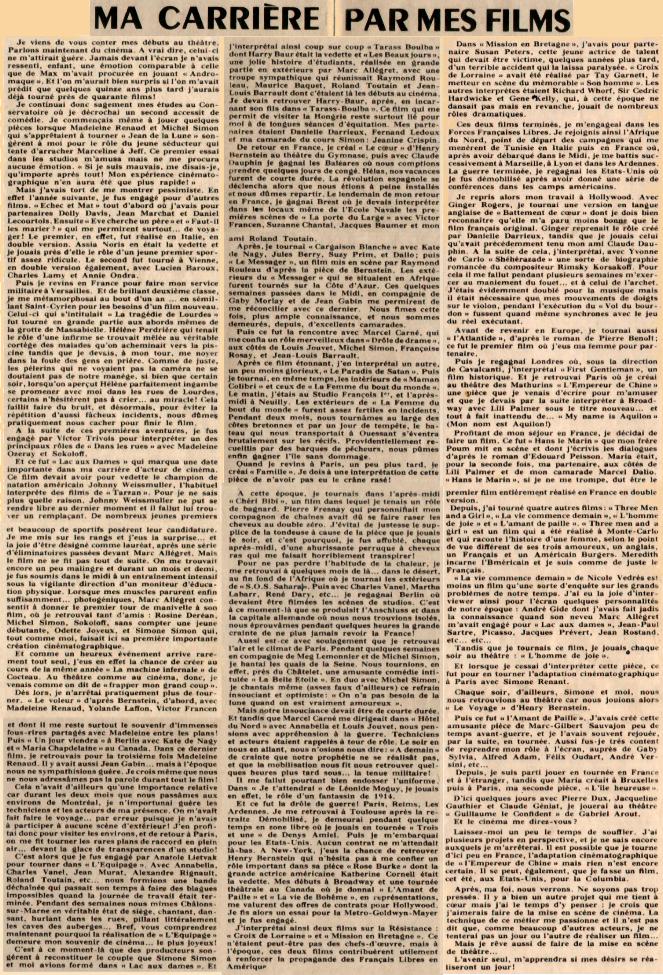
From Le Film Vecu de Jean-Pierre Aumont a supplement to Cinemonde Magazine
by Jean-Pierre Aumont
translation follows
My Career in Films
Now that I've told you about my beginnings in the theatre, let us talk about the movies. To tell the truth, I didn't
feel attracted to cinema. As a child, I had never felt in front of the movie screen the kind of emotion produced by
de Max in "Andromaque". And I would have been very surprised if someone had told me then that some 15
years later, I'd have already made almost 40 movies.
So I continued working seriously at the Conservatoire where I obtained a second accessit in comedy. I was
already beginning to appear in some plays when Madeleine Renaud and Michel Simon, who were to be in
"Jean de la Lune", thought about me for the part of the young don juan who tries to steal Marcelline away
from Jeff. My first experience in the movie studios was fun but it didn't move me in any way. I thought, "it
doesn't matter if I'm bad! My experience in movies will only be the shorter for it!"
But I was wrong in being so pessimistic. As a matter of fact, the following year, I was cast in other movies: first
in "Echec et mat", where my colleagues were Dolly Davis, Jean Marchat and Daniel Lecourtois. Then "Eve
cherche un p��re", and "Faut-il les marier?", that allowed me above all... to travel! The first of these was shot
in Italy, with two versions being shot simultaneously. Assia Noris was the star and I played opposite her the
part of an athletic young lead who was quite ridiculous. The second was shot in Vienna, also in two versions,
with Lucien Baroux, Charles Lamy and Annie Ondra.
Then I came back to France to do my military service in Versailles. And from brilliant private, I
metamorphosed after one year.... into a vivacious cadet of the St-Cyr Academy for the needs of a new film.
This one was called "La trag��die de Lourdes" and it was shot for the most part near the Massabielle grotto
itself. Helene Perdriere, playing an invalid, joined the parade of real sick people being led towards the pool
while I, in turn, had to lose myself in the crowd of praying people. As could be expected, the faithful who hadn't
seen the movie camera were unaware of what was really going on, so much so that one night, when people saw a
perfectly nimble Helene walking with me in the streets of Lourdes, the news of a miracle started spreading! It
almost caused a scandal and from that point on, to avoid such incidents from happening again, we had to
practically hide ourselves to finish the movie.
Following these early adventures, I was cast by Victor Trivois as one of the principals in "Dans les rues" with
Madeleine Ozeray and Sokoloff.
Then came "Lac aux dames" which marked an important date in my career as a movie actor. This movie was
supposed to star US swimming champion Johnny Weissmuller, well-known for his Tarzan movies. I no longer
remember the reason why, but Johnny Weissmuller became unavailable at the last moment and they had to
find a replacement. Many young male leads and athletic types wanted to take his place. I got in line with the
rest of them and, to my surprise... and joy, I won the part after a series of eliminatory heats given before Marc
Allegret. But filming didn't start right away. They thought I was too thin for the role and for a month and a
half I was subjected to intensive training in the south of France under the watchful eye of a gym instructor.
When my muscles became... attractive enough, Marc Allegret consented to start shooting his movie, where I
was reunited with so many friends: Rosine Der��an, Michel Simon, Sokoloff, and also a young newcomer
Odette Joyeux, and Simone Simon for whom this was the first major movie role, just like me.
And as good things always come in pairs, I had the good fortune of creating that same year Cocteau's "La
machine infernale". In theatre as well as in the movies, I had made a hit, as we say.
From then on, I practically never stopped making movies. First it was "Le Voleur", based on a work by
Bernstein, with Madeleine Renaud, Yolande Laffon, Victor Francen, a movie from which I've kept the
memory of endless fits of laughter shared with Madeleine Renaud between shots! Then "Un jour viendra" in
Berlin with Kate de Nagy, and "Maria Chapdelaine" in Canada. In this last movie, I was working for the
third time with Madeleine Renaud. Jean Gabin was also there... but at the time we weren't on very good
terms. As a matter of fact, I think we didn't say a word to each other throughtout the whole film!
Besides, it didn't have much importance anyway since during the 2 months we spent near Montreal, I never
bothered the technicians and actors much with my presence. They had made me take the trip... by mistake, since
I wasn't in any of the outdoor scenes! I took advantage of this to do some sightseeing and when we came back to
Paris they used back projection in the studio to make me do a few outdoor link shots.
After that, I was hired by Anatole Lietvak to do "L'equipage" with Annabella, Charles Vanel, Jean Murat,
Alexandre Rignault, Roland Toutain, etc. We were a wild gang who spent our time playing impossible pranks
when the day's work was over. For weeks, we kept Ch��lons-sur-Marne under siege, singing, dancing, yelling
in the streets, literally pillaging the wine cellars of various inns... Anyway, you'll understand easily why the
shooting of "L'��quipage" has remained my most... joyous memory in the movies!
It's at that time that producers thought about reuniting the couple that Simone Simon and I had formed in "Lac
aux dames". I was thus able to do, one after the other, "Tarass Boulba", which starred Harry Baur, and "Les
beaux jours", a lovely student story, shot for the most part on location by Marc All��gret with a friendly group
made up of Raymond Rouleau, Maurice Baquet, Roland Toutain and Jean-Louis Barrault who was making
his film debut. I was reunited with Harry Baur afterwards. I played his son in "Tarass Boulba", a movie that
allowed me to visit Hungary and that remains associated in my memory with long periods spent on horseback.
My colleagues were Danielle Darrieux, Fernand Ledoux and my friend from the Simon class at the
Conservatoire: Jeanine Crispin.
Back in France, I created "Le Coeur", by Henri Bernstein at the Gymnase theatre, then with Claude
Dauphin I went to the Baleares where we were supposed to spend a few days' vacation. Unfortunately, our
vacation didn't last long. The Spanish revolution started when we had barely got settled and we were forced to
leave. The day after my return to France, I left for Brest where I was to play in the very buildings of the Naval
School the first scenes of "La porte du large" with Victor Francen, Suzanne Chantal, Jacques Baumer and
my friend Roland Toutain.
After that, I did "Cargaison blanche" with Kate de Nagy, Jules Berry, Suzy Prim and Dalio; then "Le
messager", a film directed by Raymond Rouleau from a Bernstein play. We worked on locaton on the Cote
d'Azur to film the scenes that were supposed to be set in Africa. Those few weeks spent in the Midi with Gaby
Morlay and Jean Gabin allowed me to make up with Jean. We took the time to get to know each other and
have remained on good terms ever since.
Then I met Marcel Carne who gave me a wonderful role in "Drole de drame" alongside Louis Jouvet, Michel
Simon, Fran��oise Rosay and Jean-Louis Barrault.
After this amazing film, I did another one, a little less glorious "Le Paradis de Satan". Then I did at the same
time the studio work for "Maman Colibri" and "La Femme du bout du monde". In the morning I was at the
Fran��ois 1er studios and in the afternoon at Neuilly. The location filming for "La Femme du bout du monde"
was rather eventful. We spent two months shooting off the coast of Brittany and on a stormy day the boat that
was carrying us to Ouessant got wrecked on a reef. By some miracle, we were picked up by some fishermen
and were able to reach the island unharmed.
When I came back to Paris some time later, I created "Famille". Appearing in that play prevented me from
having my head shaved!
At the time, I was spending my afternoons making "Cheri bibi", a movie in which I played the role of a convict.
Pierre Fresnay, who was playing a fellow convict, had to have his head completely shaved. I barely escaped the
torture of the clippers because I was appearing in a play every night, and that's why in the afternoon they made
me wear an unbelievable short-haired wig that made me sweat horribly!
In order to remain used to the heat, I went some months later... to the desert, in the middle of Africa where we
did the location shots for "S.O.S. Sahara". Then with Charles Vanel, Martha Labarr, Ren�� Dary, etc., I
went back to Berlin where the studio shots were to be done. It's at that moment that the Anschluss occurred and,
isolated as we were in the German capital, we spent a few hours being afraid we'd never be able to get back to France!
So it was a great relief to be back in the air and climate of Paris. For a few weeks with Meg Lemonnier and
Michel Simon, I haunted the embankments of the Seine. We were filming near the Chatelet an amusing
comedy called "La Belle etoile". Along with Michel Simon, I was singing rather flatly the optimistic and
carefree melody "On n'a pas besoin de la lune quand on est vraiment amoureux".
But our happy-go-lucky attitude didn't last long. And while I was working with Marcel Carne on "Hotel du
Nord" with Annabella and Louis Jouvet, we were thinking with apprehension about war. Technicians and
actors were called back one after the other. At night when we would leave, we never dared say 'see you
tomorrow' for fear that it might not come true and that mobilization would reunite us a few hours later... in
military garb!
I did have to put on a uniform anyway, though. In Leonide Moguy's "Je t'attendrai", I was actually playing a
WWI foot soldier.
Then came the strange war! Paris, Reims, Les Ardennes. I ended up in Toulouse after the retreat.
Demobilized, I stayed for a while in the Free zone where I was performing on tour Denys Amiel's "Trois et
une". Then I sailed for the US. No contract awaited me there. In New York, I was lucky enough to meet
Henry Bernstein again who didn't hesitate to give me an important part in his play "Rose Burke", which
starred the great American actress Katherine Cornell. My debut on Broadway and a tour in Canada where I
gave performances of "L'amant de paille" and "La vie de Boh��me" brought me some offers from Hollywood. I
did a screen test for MGM and was hired.
That's how I was able to make two movies about the French Resistance: "Cross of Lorraine" and "Assignment
in Brittany". They may not be masterpieces, but at the time these two movies were useful in reinforcing the
propaganda for Free France in the US.
In "Assignment in Brittany", I had as a partner Susan Peters, the young talented actress who was to be victim
later of a terrible accident that left her paralized. "Cross of Lorraine" was directed by Tay Garnett, the
director of the famous "Her Man". The other actors were Richard Whorf, Sir Cedric Hardwicke and Gene
Kelly who at the time wasn't dancing but instead playing many dramatic parts.
When these two films were completed, I enrolled in the Free French Forces and went to North Africa, the
starting point of campaigns that took me from Tunisia to Italy, then to France where, after our debarkment in
the Midi, I fought in Marseilles, Lyon and the Ardennes. The war over, I went back to the US where I was
demobilized after giving a series of lectures in US camps.
I then went back to work in Hollywood. With Ginger Rogers, I made the English version of "Battement de
coeur", though I must admit that I found it inferior to the French original. Ginger took on the part created by
Danielle Darrieux while I was playing the one held before by my friend Claude Dauphin. After that I was in
"Sheherazade" with Yvonne de Carlo. This was a romanticized biography of composer Rimsky-Korsakov.
For that role, I had to spend some weeks practicing how to handle a whip... and a bow. Someone else was
actually playing the music of course, but the movement of my fingers on the violin during the performance of
"The Flight of the bumblebee" were synchronized with that of the actual performer.
Before I came back to Europe, I also made "L'Atlantide" from a novel by Pierre Beno��t; this was the first
movie where I co-starred with my wife.
Then I went to London where I was "The First Gentleman", a historical drama under the direction of
Cavalcanti. And I was back in Paris again where I created "L'Empereur de Chine" at the Th����tre des
Mathurins. This was a play I had just written for fun and that I was to perform later on Broadway with Lili
Palmer under the new and... unexpected title: "My name is Aquilon".
Taking advantage of my stay in France, I decided to make a movie. It was "Hans le marin"; my brother Poum
directed it and I wrote the dialogue from Edouard Peisson's novel. Maria was my co-star for a second time,
along with Lili Palmer and my friend Marcel Dalio. "Hans le Marin", if I'm not mistaken, must have been the
first movie shot entirely in France in a double version.
Since then I made four other films: "Three Men and a Girl", "La vie commence demain", "L'homme de joie"
and "L'amant de paille". "Three men and a girl" is a movie that was shot in Monte Carlo and it tells the story
of a woman from the different points of view of her three lovers, one British, one a Frenchman and the other, an
American. Burgess Meredith was the American and as expected I played the Frenchman.
"La vie commence demain", by Nicole Vedr��s, is not so much a movie than a kind of investigating report on
the great problems of our time. I had the joy of interviewing for the screen some great personalities of our time:
Andre Gide, who I had already met when his nephew Marc Allegret had hired me for "Lac aux Dames",
Jean-Paul Sartre, Picasso, Jacques Pr��vert, Jean Rostand, etc., etc...
As I was making that movie, I was performing "L'homme de joie" on stage every night...
And when I stopped performing that play, it was to make the screen version in Paris with Simone Renant.
Besides, Simone and I would be together every night in the theatre because we were playing Henry Bernstein's
"Le Voyage".
Then it was "L'amant de paille". I had created this amusing play written by Marc-Gilbert Sauvajon shortly
before the war, and I had performed it often afterwards on tour. That's why I was very happy to take back the
role on screen with Gaby Sylvia, Alfred Adam, F��lix Oudart, Andr�� Versini, etc...
Since then, I've been performing on tour in France and abroad while Maria was creating in Brussels and in
Paris my second play, "L'Ile heureuse".
In only a few days, I'll be performing on stage with Pierre Dux, Jacqueline Gauthier and Claude G��niat in
a Gabriel Arout play, "Le Confident".
And the movies, you ask?
Give me some time to catch my breath, I have several projects ahead, and I don't know yet which ones I'll favor.
It's possible that I will make very soon in France the screen version of "L'Empereur de Chine", but nothing has
been decided yet. I may also make a movie this summer in the US for Columbia Pictures.
After that, we'll see. Let's not hurry things too much. There is yet another project that's dear to my heart but I
still have time to think about it. I think I'd like to direct a movie. I find the technical aspect of this profession
fascinating and like many actors before me, I may try my hand at directing a film one of these days.
But I also dream of directing plays in the theater...
Only the future will tell if my hopes will be realized some day...