 |
|
|
|
|
|
|
|
|
|
|
|
|
|
|
|
|
|
|
|
|
|
|
|
|
|
|
|
|
|
|
|
|
|
|
|
|
|
|
|
|
|
|
|
|
|
|
|
|
|
|
|
|
|
|
|
|
|
|
|
|
|
|
|
|
|
|
|
|
|
|
|
|
Archaeological Research at Rotbav, Romania |
|
|
|
 |
|
|
|
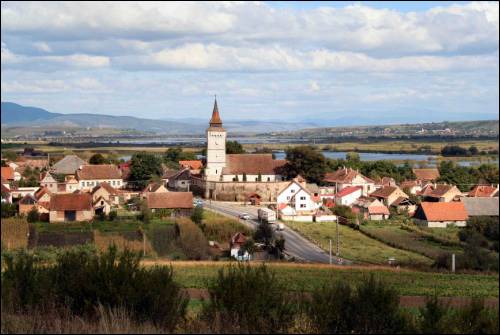
Fig. 1: The village of Rotbav with its fortified church, which was built in this form in 1738 after the whole village burnt down. |
|
|
|
� Dietrich 2006. |
|
|
| 1. Location |
|
|
| The village of Rotbav (fig. 1) lies in the subcarpathian region of south-eastern Transilvania near the river Olt, about 20km to the northwest of Brasov at 508m above sea level. |
|
|
| In written sources, Rotbav is mentioned for the first time as german founding in 1377 (the german name is Rothbach, ?red shore?). Like the whole region it has a medieval history rich in desasters caused by various waves of enemy invaders, which led also the inhabitants of Rotbav to fortifie their church as a point of refuge. |
|
|
| But at Rotbav traces of settlement activities are by far older than the Middle Ages. At the moment archaeologists know at least 9 prehistoric settlements inside and in the immediate surroundings of the modern village, starting with the eneolithic Cotofeni-Culture (ca. 3500BC). |
|
|
|
 |
|
|
|
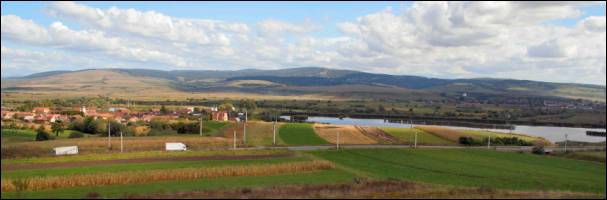
Fig. 2: The prehistoric settlement area of Rotbav, "La Paraut" from the south. Settlement activities concentrated on the area beyond the modern road. |
|
|
|
� Dietrich 2006. |
|
|
| One of these settlements, located right at the entry of Rotbav on a plateau formed by an old terrace of the Olt called by the locals "La Paraut" ("At the river", fig. 2) is of special interest to archaeologists, because it was inhabited by at least four chronologically different groups over the times: the eneolithic Cotofeni-Culture, the early and middle Bronze Age Wietenberg-Culture, the late Bronze Age Noua- Culture,the early Iron Age Gava-Culture, and maybe, as fiifth, the early Bronze Age Schneckenberg-Culture, too. |
|
|
| 2. Previous research |
|
|
| First discoveries were made incidentally in 1961, when the modern road between Brasov and Sighisoara was build. Additionally to typical archaeological findings indicating a settlement like pottery, bone tools and metal objects a grave was uncovered (an adult in crouched position in a stone box). Due to the fact that no grave goods were found, the connection of the grave to one of the cultures mentioned above was disputed over the last decades (see Dietrich and Dietrich 2006). |
|
|
|
 |
|
|
|
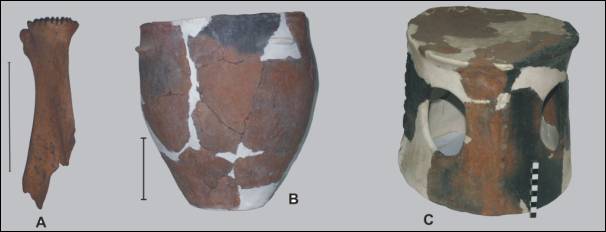
Fig. 3: Findings from the old excavations. Typical bone tool of the Noua-Culture ("omoplat crestat"), maybe for working leather(A); storage vessel of the same culture (B); portable oven ("Pyraunos") of the Wietenberg-Culture. Measures are 10cm in length, Material in the IAB. |
|
|
|
� Dietrich 2004. |
|
|
| Systematic excavations began in the year 1970 under the direction of Prof. Dr. A. Vulpe (Institute of Archaeology, Bucharest) and M. Marcu (Museum Brasov). Until 1973 seven trenches between 24 and 105m in length and 1,5m in width covering a total area of 1300sqm were excavated, discovering 149 archaeological complexes, in the main part pits of the Cotofeni-, Wietenberg-, Noua- and Gava-Cultures. In a small part of the settlement it was possible to determine an immediate stratigrafical supraposition of Noua-Materials over such of the late Wietenberg-Culture. Until today, this discovery remains the only one of its kind inside Transilvania. The rich archaeological material discovered (around 4560 fragments of pottery and numerous artefacts) remained unpublished. However, the excavations had proved, that Rotbav is one of the most important keys for understanding the South-East-Transilvanian Bronze Age. |
|
|
| 3. New Research Aims |
|
|
| Due to the importance of the archaeological material and features discovered, Rotbav forms the topic of a PHD-Study undertaken by Laura Dietrich at the Freie Universit�t Berlin. Aiming not only at chronological insights into the Bronze Age of South-eastern Transilvania, but also at settlement structure and dynamics in the region this study made it desireable to widen the picture of Rotbav by undertaking new field research. From 2005 on new excavations are on the way in Rotbav, led again by Prof. Dr. Vulpe (Institute of Archaeology Bucharest, corresponding member of the Romanian Academy of Sciences) in cooperation with Laura and Oliver Dietrich from the Institut f�r Pr�historische Arch�ologie of the University of Berlin. |
|
|
| It is attempted to get for the first time a broader insight into the settlement activities as well as into chronological relations between the Wietenberg- and Noua-Culture by excavating bigger areas of the settlement and using the input of scientists specialised in archaeozoology, archaeobotany and geophysics. |
|
|
| 4. First Results |
|
|
| Preliminar to the excavations in 2005 a systematic survey of the whole plateau was organized to determine the density of archaeological material on the settlement area. The surface was divided into a grid of squares measuring 20 x 20m, in which all archaeological material, mainly pottery, was collected. On the resulting density map areas with fewer pottery on the surface were determined for trial excavations of limited extend assuming that less pottery on the surface meant less destruction of archaeological layers through agricultural work. |
|
|
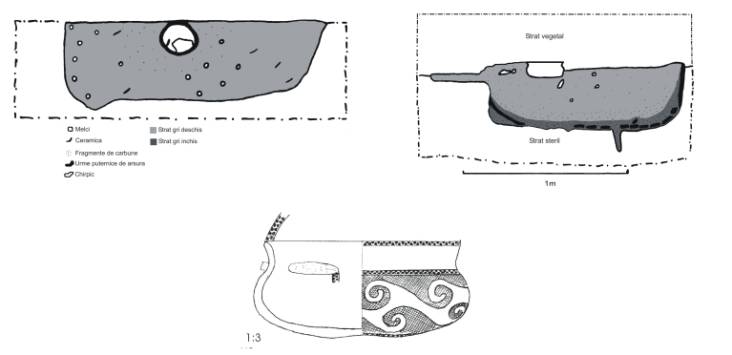
| In the northwestern part of the plateau two trechens measuring 7x7m and 14x9m (named S VIII and X continuing the counting from the older excavations) were opened to determine stratigraphy and distribution of archaeological features. 19 archaeological complexes could be observed in this area, mainly pits filled with settlement debris. Outstanding is the discovery of two graves (fig. 4) in SVIII, which can be attributed to the Wietenberg-Culture due to pottery decoration and grave rite (incineration in urns). |
|
|
|
 |
|
|
|
Fig. 4: One of the graves discovered in SVIII in 2005. View from above (left), the profile (right), the urn. |
|
|
|
�Dietrich 2006 |
|
|
| Careful excavation of the complexes, which were only slightly disturbed by the plough in the upper parts led to interesting observations concerning the funeral procedures. After digging the funeral pit a short burning fire seems to have been lighted inside it, maybe for cultic purification (fig. 4, dark layer at the bottom of the pit). The dead person was burnt somewhere away, the pit is not big and burnt enough for being the place of cremation. The rest of the pit was filled with debris collected from the cremation place, mixed with smaller bone fragments of the diseased, the main part of his ashes being filled into the urn, which was placed above this lighter gray layer. Two circles of snails were placed around the urn before the grave was filled with earth. |
|
|
| In SX an interesting finding was a portable oven ("Pyraunos") in situ. In front of it a complete skeletton of a dog was discovered, which probably puts the vessel into a cultic context. |
|
|
| Another trench, SIX, was excavated in the center of the plateau. Here the settlement activities seem to have been more intensive than in the western part and the archaeological layers are less disturbed by agricultural work. In 25sqm 16 archaeological features could be observed, including the clay wall of a burnt house, fire places and storage pits, mainly of the Wietenberg-Culture. |
|
|
| With the survey and trial excavations of 2005 the importance of Rotbav as an archaeological site could be proved. |
|
|
| Knowing the potenial, in 2006 the systematic investigations in Rotbav started. In the center of the site a systematic grid of 5x5m squares with 1m space between them connecting to SIX from 2005 was laid out and started to excavate. |
|
|
|
 |
|
|
|
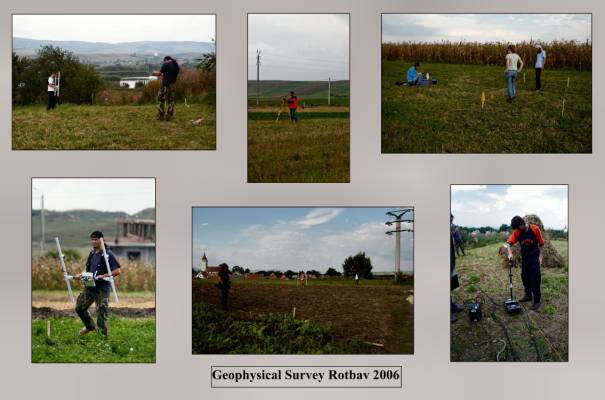
Fig. 5: Geophysical surveys in Rotbav 2006. Geomagnetic (left and lower middle), electromagnetic (upper right) and ground penetrating radar (lower left) were used. In addition, a topographical map of the area was made. |
|
|
|
�Dietrich 2006 |
|
|
| Contemporaneously geophysical surveys covering around 80% of the whole settlement surface were carried out (fig. 5) in cooperation with PHD-Students J. Shragge and K. Spikes of the University of Stanford and the Department of Geology of the University of Bucharest, financed by the SEG. The geomagnetic map shows numerous anomolies, some measuring up to7x4m, which could very likely be burnt clay floors of houses. The archaeological verification of this hypothesis is one of the main aims for the year 2007. |
|
|
| A preliminar report concerning the findings from this years campaign will be published in spring 2007. |
|
|
| 5. Research Teams |
|
|
| Archaeological Team: |
|
|
| Prof. Dr. A. Vulpe (IAB), Laura Dietrich (FU-Berlin), Oliver Dietrich (FU-Berlin) |
|
|
| Participants: Cristian Stefan (IAB), Mala Stavrescu-Bedivan (IAB), Cristian Tutu (UVT), Sorin Bobeica (UVT), Anca Soare-Minea (UB), Liliana Vasilica Alexandru (UB) |
|
|
| Geophysical Survey 2006: |
|
|
| Jeffrey Shragge (Stanford University), Kyle Spikes (Stanford University), Andrei Carp Rusu, Cristian Cocuz, Cezar Iacob, Dana Stefania Lazar, Bogdan Nichifor, Razvan Orza, Alexandru Stefan, Emil Tanasie, Iulian Voinescu, Anca Zamfir |
|
|
| The field work was financed by: |
|
|
| 2005: Romanian Ministry of Culture, Museum of Brasov |
|
|
| 2006: Romanian Ministry of Culture, SEG (Society of Exploration Geophysicists) |
|
|
| 6. Literature |
|
|
| For short mentionings concerning the old excavations see: |
|
|
| - Sz�kely 1970: Sz�kely Zolt�n, Sapaturile executate de Muzeul din Sf. Gheorghe (1959-1966). Materiale IX, 1970, 310. |
|
|
| - Boroffka 1994: Nikolaus G. O. Boroffka, Die Wietenberg-Kultur. Ein Beitrag zur Erforschung der Bronzezeit in S�dosteuropa. Universit�tsforschungen zur Pr�historischen Arch�ologie 19 (Bonn 1994), 70 Nr. 359. |
|
|
| - Florescu 1991: Adrian C. Florescu, Repertoriul culturii Noua-Coslogeni din Rom�nia. Cultura si civilisatia la Dunarea de jos IX (Calarasi 1991), 113, Nr. 461. |
|
|
| Preliminar Reports on the new research work: |
|
|
| - Vulpe, Dietrich and Dietrich 2006: Alexandru Vulpe, Laura Dietrich, Oliver Dietrich, Rotbav, comuna Feldioara, judetul Brasov, Punct "La Paraut". Cronica Cercetarilor Arheologice 2005 (Bucuresti 2006), 302-304, Nr. 160. |
|
|
| - Dietrich and Dietrich 2006: Oliver Dietrich, Laura Dietrich Observatiiprivind descoperirile cu caracter funerar din epoca bronzului de la Rotbav, comuna Feldioara, judetul Brasov. Cumidava 2006 (in press). |
|
|
| 7. Links |
|
|
| Rotbav and its medieval history: |
|
|
| www.siebenbuerger.de/ortschaften/ortschaften_r_s.html |
|
|
| www.burzenland.de/rothbach.html |
|
|
| www.brasov.ro/nou/outbv.ro |
|
|
| Geographical Details for Rotbav: |
|
|
| www.fallingrain.com/world/RO/0/Rotbav.html |
|
|
| Report on the 2005 excavation campaign: |
|
|
| www.cimec.ro/arheologie/cronicaCA2006/rapoarte/160.htm |
|
|
|
 |
|
|
|
Authors: |
|
|
|
Laura and Oliver Dietrich |
|
|
|
Freie Universit�t Berlin |
|
|
|
Institut f�r Pr�historische Arch�ologie |
|
|
|
Kontakt: |
|
|
|
laura_dietrich2004(at)yahoo.de |
|
|
|
oliver_dietrich2004(at)yahoo.de |
|
|
|
�Copyright of all contents: L. and O. Dietrich 2006 |
|