
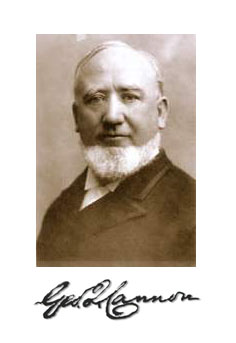
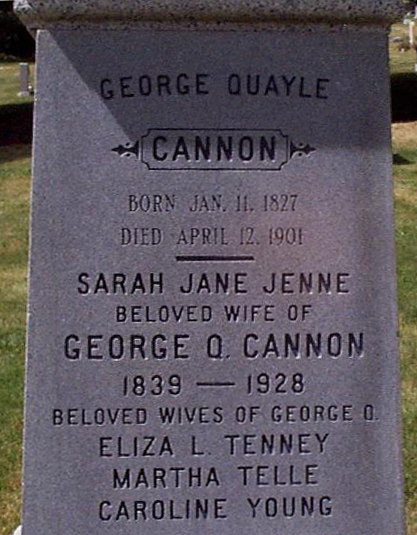
In 1849 he served a Mission to California and from there to the Sandwich Islands (Hawaii) where he served for four years. While thus engaged Elder Cannon published the first edition of the Book of Mormon in the Hawaiian language. He wrote, "When I prayed I could go unto God in faith; He listened to my prayers;
He gave me great comfort and joy; He revealed Himself to me as He never had done before, and told me that if I would persevere, I should be blessd, be the means of bringing many to the knowledge of the truth, and be spared to return home after having done a good work. many things were revealed to me, during those days, when He was the only Friend we had to lean upon, which were afterwards fulfilled. A friendship was there established between our Father and myself, which, I trust, will never be broken nor diminished, and which I hope has continued to go stronger from those days to these. (George Q. Cannon; My First Mission)
With the death of Parley P. Pratt in 1857, a vacancy in the Twelve occured. In 1859 Brigham Young opened a meeting to suggestions for a candatate. Orson Hyde proposed the First Presidency to nominate the person they desired where Brigham said, "Any man who will be faithful will have intelligence enough to magnify his calling."
"On what principle are men selected?" asked Orson Pratt.
"If a man was suggested to me of good natural judgement, possessing no higher qualifications than faithfulness and humility enough to seek the Lord for all his knowledge and who would trust in him for his strength, I would prefer him to the learned and talented."
"If the Lord should designate a boy 12 years old, he is the person we would all be willing to sustain, but if left to my own judgement to choose, I would select a man of experience who was tried in many places, faithful and diligent and a man of talent who could defend the Church in any position in which he might be placed," replied Pratt.
After much deliberation, Young finally said, "I nominate George Q. Cannon for one of the Twelve." The decision was sustained unanimously. (JH 23 October 1859) He entered the Quorum of the Twelve at the age of 33. Later a call to preside over the European Mission was cut short by his election to Congress and the need for pressing Utah's bid for statehood.
The autumn of his life was tarnished by Federal persecution of Church members who practiced plural marriage. George Q. and his five wives were harassed by federal agents and in 1885 they were forced to go into seclusion. In 1888 he surrendered himself to authorities and served six months for cohabitation. In 1873, President Young called him to serve as a Counselor to the First Presidency. From that time until the time of his death, he served in the First Presidency, serving as Counselor to an unprecedented four Presidents of the Church; Brigham Young, John Taylor , Wilford Woodruff and Lorenzo Snow.
Cannon was also called upon as Brigham's personal secretary and before the President's death remained by Brigham's bedside day and night, except briefly to eat. He was there when the time came, "he ceased to breathe at 4p.m. on Wednesday and this was so gradual as to be almost imperceptible even to those who were nearest to him, I stood close to his head during his last moments in company with Bro's Wells and John W. Young . . . His departure was like the falling asleep of a little infant, no tremor, no contortions; but as peaceful and as quiet, as still as if it were indeed the most gentle slumber."
The family requested George to take care of the funeral. So as Cannon's father took plaster mold's of Joseph and Hyrum's face, George did the same for President Young, as well as a hand cast, with careful measurements of his entire body. (GQCJ 17 January 1878)
At the death of President John Taylor, who was in hiding, Cannon and Joseph F. Smith came to him, the first time the First Presidency had been together in almost three years. A week later Taylor passed away.
Cannon wrote, "I felt that I had lost the best friend I had on earth, for he had been a father to me in early life, and my relations to him had always been of the most pleasant character. To him I owe many things which impresed me in my boyhood and youth, and which have influenced my life to a very great extent . . . I have always viewed him as one of the most noble men that have lived in this generation." (GQCJ, 5 August 1887.
At the death of President Taylor, Woodruff had asked Cannon to assist him in the affairs of the First Presidency, since Cannon had been very well versed in the past several years, the two held a very uncommon bond.
Cannon and President Woodruff retired to San Fransisco, hoping the climate would improve their health, seeing they were both very ill. At one time, Woodruff seemed in better condition than Cannon. But things soon reversed, with three doctors standing helplessly by, Woodruff, "passed away peacefully at early dawn. I took hold of his wrist, felt his pulse, and I could feel it was very faint, and while I stood there it grew fainter and fainter until it faded intirely." (GQCJ 2 September 1878)
