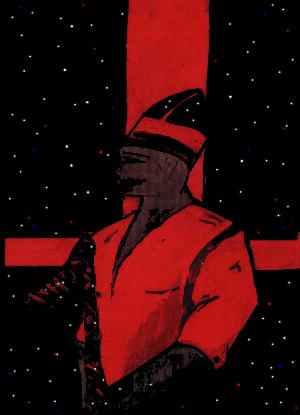
"Omi Tutu, Ana Tutu,
Tutu Ile,
Tutu Laroye"
Saint: The Holy Child of Atocha.
Day of the Week: Mondays and the third day of each month.
Colors and Collars (Ilekes):
Red and black. His collar is made up of three red beads followed by three black
beads. After the three black beads, a red bead alternates with a black bead
three times. The sequence is repeated until the desired length is obtained.
Sacrificial Animals:
Small goats, roosters. On rare occasions, monkeys, sheep, bulls, ox and deer.
Chickens should not be offered. Elegua is a glutton and will bother and torment
the participants at a ceremony until he has had his fill of blood.
Sacrificial Foods:
Smoked fish and smoked jutia. He loves yams. His favorite fruit is sugar cane.
Everything should be well spiced with corojo butter. He loves to drink
aguardiente and he favors standing water.
Herbs:
Abre camino, (Bunchosia media), Cuban spurge, sargasso, wild convulvulus,
foxtail, nettles, manyroot, crowfoot, neat's tongue, white pine nuts, jack bean,
spiny blite, nightshade, black eyed peas, ateje, (cordia collocea), heliotrope,
pigeon peas, mastic tree, camphor leaves, chili peppers, corn stalks, corn
leaves, and corn silk, avocado leaves, avocado roots, coconut husk, coconut palm
stem, corojo, guava, wild croton, coffee, cowhage, peppergrass, dried rose buds,
senna, soapberry tree, bitter bush, and mint among others.
Ornaments:
Elegua is never without his "garabato", the shepherd's hook (sometimes only a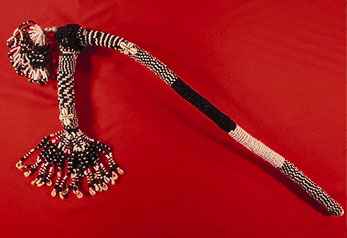 crooked stick or club) with which he metes out punishment.
He protects temples, cities and houses. He does this by residing in a helmet-shaped construction made out of stone or cement with cowrie shells for eyes. The small statue is placed next to an entrance way. From this abode, Elegua protects all the residents.
Since he is as playful as a child, tops, marbles and kites hold a special fascination for him.
Elegua is the guardian of entrances, roads and paths. He is the first Orisha to be invoked in a ceremony and the last one to be bid farewell. He has to be first in anything, just like a spoiled child. The first rhythms of the drums belong to him. He must be petitioned before all the oracles. Orunmila is the one who communicates, but Elegua guards the paths of communication. It is he who acts as an intermediary between human beings and the other Orishas.
He
is the trickster, and is feared because, with so much power controlled only by
his whim, great harm may result from his practical jokes. Like a very large and
powerful child, he is ruthless with those that cross his path when he is in the
midst of a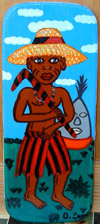 tantrum. If his
precedence is not carefully maintained, and the proper ceremonies are not
followed, Elegua becomes indignant and rushes to open the paths to Iku, death.
tantrum. If his
precedence is not carefully maintained, and the proper ceremonies are not
followed, Elegua becomes indignant and rushes to open the paths to Iku, death.
All beings have their destiny, but through Elegua's influence, destiny and luck may be changed. However, when petitioning Elegua, the Santero must always remember that he is a trickster and word the request very carefully. He can just as easily block the path to happiness and luck as open it.
Elegua appears to travellers as a small child with the face of an old man, wearing a Panama hat and smoking a good cigar. He takes on other guises in order to play his tricks and to measure the level of charity and compassion among human beings.
When Elegua possesses a Santero, he immediately heads to the door and stands guard. There, he carries out his pranks and childish mischiefs, dancing and threatening the other participants with a smack from his garabato stick.
Elegua is one of the fiercest warriors in the Yoruba pantheon. When joined with Ogun and Oshosi in battle, nothing can stand in their way.