| The
Boys in the Bubble
From growing up middle class in Orlando to becoming pop superstars, the Backstreet Boys discuss a life less ordinary from behind tinted glass. |
By Erik Hedegaard
AJ McLean, who is one-fifth of the Backstreet Boys teen-pop supergroup and the one with both the most tattoos and the most rakishly cut sideburns, is sitting inside his hotel room recalling a warning recently passed on to him by management. "What management said is, 'Watch out for this certain girl who is obsessed with you and will not be happy unless she pulls a Romeo and Juliet and kills you, then kills herself,' and I'm like, 'Jesus, now I gotta go onstage after you tell me that? Just great.' " He pauses, shuffles his hands through the pile of fast-food containers in front of him, finds his pack of cigarettes and lights one up. Exhaling, he says, "I mean, I'm singing pop music. I don't want to worry about some psycho girl. What do you do? Or, what can you do? You can't do shit. You're stuck. So you live in a bubble.''
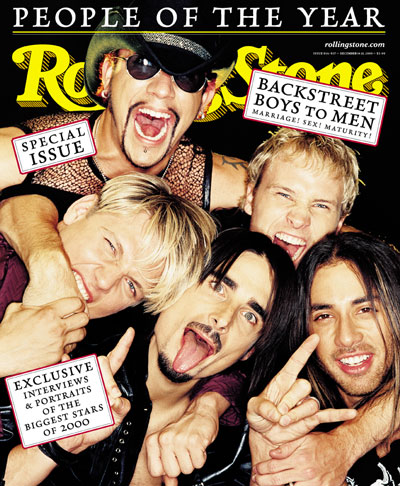
Today, the bubble has expanded to take over much of the thirty-seventh floor of Le Parker Meridien hotel, in Manhattan, not far from the sun-flooded greens of Central Park. Inside it are the five boys - besides AJ, there's Kevin Richardson, Howie Dorough, Brian Littrell and Nick Carter - plus their five bodyguards, three stylists, a hair groomer, a PR lady, a manager-type lady, a girlfriend (AJ's, named Amanda) and a few others. They've been in New York for a week so far. They don't go anywhere without their bodyguards. If they do, strange, disquieting things happen. Once, at a mall back in Orlando, where the group got its start, AJ allowed a beautiful female fan to cozy up next to him for a photograph. Suddenly, she started quaking, like she was having a grand mal seizure. When she calmed down, AJ said, "If you don't mind my asking, what the hell happened to you?'' The girl said, "I just had an orgasm.'' AJ said, "Well, OK, now . . .'' And then he got the heck out of there.
So, they spend most of their time looking at the world from the thirty-seventh floor, living out of suitcases, surrounded by half-eaten McDonald's cheeseburgers and Big Bertha golf clubs that don't get swung often enough. At the moment, they are awaiting the release of Black and Blue, their third record. In the balance hangs the future of boy bands everywhere. Should it flop, word will spread that such groups are on the way out. Should it sell, then long live not only the boys but all the other teen acts currently trying to make it, as well as already successful acts like 98 Degrees and 'N Sync.
Of course, in some ways, the Backstreet Boys wouldn't mind if 'N Sync dropped out of sight. The boys were the first of the new crop of boy bands, their first two U.S. releases, Backstreet Boys and Millennium, huge multiplatinum hits, altogether selling some 60 million copies. Then, earlier this year, along came 'N Sync's No Strings Attached album, which sold 2.41 million copies its first week out, breaking the record held until then by the boys. Now the boys have a chance to win back the honor. And it looks like they might: Record stores have pre-ordered 5 million copies of Black and Blue, and industry observers are making deeply positive predictions. Says Tom Calderone, an MTV senior vice president, "The anticipation is there.'' Says Louise Barile, editor of teen fan-mag Tiger Beat, "We used to think boy bands had a two-year life cycle, but I think the Backstreet Boys are going to keep on going.''
And yet they worry. They worry that the album will fizzle, that their fan base has dried up or been swiped by their competitors, that when they go to MTV to drop off the video for the new album's first single, "Shape of My Heart," only a few fans will show up to witness the well-publicized event. "We've been out of the mix for so long,'' says Nick Carter, tremulously, "maybe it'll only be fifteen people.'' Frankly, that's one of the things about the Backstreet Boys: They can be pretty big worriers, about their legs being too skinny, about their stomachs getting too big, about being singled out by Kevin as the group's most enthusiastic masturbator. But that's the way it is inside the Backstreet Boys' bubble.
For the most part, of course, it's been a beautiful if not altogether easy glissando of a ride to the top. The boys were living in Orlando in the early 1990s, all sons of the middle class (or lower), eager to make it as entertainers in one of the nearby theme parks or in any other similar theatrical enterprise. They meet middle-aged aviation tycoon and major-league dreamer Louis Pearlman, who thinks that with his backing the lads can become the new New Kids on the Block. Starting in 1993, he drops about $3 million on their careers. In return, they give him their lives. They play shopping malls, SeaWorld and high schools nationwide. They get a contract with Jive Records. They can't make any headway in grunge-loving America, so they go to Europe. The youngest back then is Nick, 13; the oldest is Kevin, 20. They conquer some of Europe. They conquer more of Europe. They conquer Europe again. They are moneymaking gods in Europe. Eventually, in mid-1997, they release Quit Playing Games (With My Heart) in the U.S. It's a smash. They take heat for probably being little more than talentless, soulless lip-syncers.
They also wake up one day and realize that, for all their efforts and all their touring, they each have less than $100,000 in the bank. Plus, behind their backs, Pearlman has formed another all-boy band, 'N Sync. Feeling betrayed, Brian - a regular churchgoer who knows a thing or two about right and wrong - calls in lawyers. Suits are filed, against Pearlman and two other managers Pearlman has hired. The Millennium album is being recorded. The boys are about to go on tour. The suit, rancor-filled and corrosive, threatens to screw this all up by bogging down the boys in a legal ruckus. So they decide to settle. The settlement gives Pearlman one-sixth of everything the boys make. The boys think this is grotesquely unfair. "It's ridiculous,'' says Brian. "He's doing no work.'' But the show must go on. And anyway, the money galls them less than the presence of 'N Sync as chart-busting rivals. "It's not 'N Sync itself but where 'N Sync comes from that digs me, digs me, digs me - and gets me, still and to this day,'' says Kevin one afternoon, morosely. "Mr. Pearlman was always speaking loyalty and preaching loyalty, saying, 'I love you guys; you're like my sons.' And I'd lost my father to cancer. So I looked at Lou like a father figure. But I was naive, and he's a liar. We'll always remember him for helping us get started. But we'll also remember him for screwing us blind and building another group behind our backs.''
That's one reason why the title of the new album is Black and Blue, for the way Pearlman bruised and hurt them. That's also why, in the official Backstreet Boys press-kit bio, there is no mention of Pearlman. It's as if he never did anything for the group. He has been expunged. "We're on to bigger and better things,'' says Brian. "And we're better men for it.''
Inside the bubble, up on the thirty-seventh floor, in a room cluttered with the anonymous but functional belongings of the seasoned, rootless traveler, and with the shades drawn on both the light and the darkness of the outside world, AJ McLean, 22, is saying, "Nick and Kevin probably have the quickest tempers, but I probably have the worst temper. I just go off. Like when I broke up with my ex-girlfriend, and our song came on the radio, I just grabbed a baseball bat and beat the crap out of the damn machine. When I get stressed out, I get really violent toward myself and just say, 'Screw the group! To hell with everything!' There have been times when I wake up like that and think I don't want to do this anymore. But then I sit back and think further, and then I'm like, I do want it. I live for it. These guys are my best friends. They been there for me, and I've been there for them.''
He lights a cigarette and shrugs. "Anyway,''
he goes on, "I've been in this business for twenty years. I don't know
anything else. I don't want to know anything else. I live, eat, sleep,
breathe, shit - whatever - this business. This is my life.''