Modern
Dance
Tum, pam, pam, tum, pam, pam, tum, pam, pam, tum, pam,
pam... What comes to your mind? A natural beat of drums and an African dance.
Why? It's in your blood. Dance has existed since early stage of human
development. As long as humans were able to feel rhythm, they were able to move
with the rhythm, an action, which is called dance. In
Probably, in 21st century
there are dances performed by shamans, however, they are located mainly in far
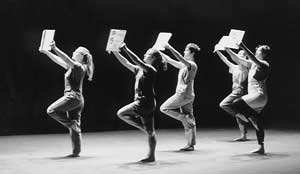
Choreography � with theatrical performance forms that are classified into different genres with such terms as ballet, modern dance, postmodern dance, and dance theatre � brings into view the problematic of what is currently being debated in the discourse of the crisis of representation. The question: 'Are we conscious of the ways in which we represent things with our bodies?' serves as the start in point again and again for the work of the Frankfurt-based choreographer William Forsythe (Forsythe 37).
Our body has its own limitations, of which we are aware. However, we are not aware of all the capabilities of our bodies. We live in our lives, without ever exploring what are bodies were born to do. The soft walk of a cat, the graceful leaps, and the comfortable positions of the bodies by bending body curves - are all things that animals do and we don't. We have forgotten about the nature of our bodies.
In addition, to a wider range of dance forms, there is also now a broader scope of dance-related activities, including professional dance ballet, modem, jazz, musical comedy, ethnic, and tap; dance taught in studios, public and private schools, community based programs, and colleges and universities; dance choreography; dance therapy; dance medicine; dance writing books, articles, journals, and tests, in addition to the writings of archivists, historians, researchers, and critics; dance notation and reconstruction; and arts management (Weeks).
�Does anyone know that it brings pleasure to bend, to stretch, to jump, to turn, to leap? A few people do. Our bodies need the exercise; we do so by pumping up our muscles in a gym, forgetting that there are many more things than just being strong and agile. Try watching a bird, a cat, a squirrel, any animal and repeat its movements, just like Martha Graham did, may be you will feel the nature's call, may be you will be a creator of yet another dance.
The spirit of the dance is awakened after hearing a rhythmic and pleasant to the ear music. Part of dancing is feeling you do the dance, feeling the music, feeling the rhythm. As an exercise before the dance you stretch and bend, and the pleasure that your body can feel while stretching is the pleasure of body that feels its natural tendencies, fulfills its purpose, and does what it was intended to do.
There is far greater purpose to the dance, than just feeling your body, there is sense of feeling all the past of human beings and human kind. Once you feel how your body can move, you can understand what you cannot do, and then you can start working on what no one has ever done before. The secret in the dance is to discover yourself and to understand how you are connected with the nature.
The modern dance is a simple combination of movements that makes you aware of yourself, it allows to understand your abilities, and gives you a chance to feel your spirit as one with nature. The modern dance got its final shape due to studies of Martha Graham and due to her new school of dance. Her work at the beginning of the 20th century had made new dance that has lasted a century and entered into the new millennium. The exercises in modern dance involve exploring of the natural animal movements. The exercises of modern dance relax and energize. Since they are natural animal like movements, they remind us of natural positions of the body, the ones our bodies used to. They remind us of what we were and what we are.
WORKS CITED
Adams, Carolyn, and Julie Adams Stranberg. Access,
education, and preservation
through the prism of American Dance. Arts Education Policy Review. 102,1(2000):19. Academic Search Elite.
Brandstetter, Gabriela, and Marta Ulvaeus. Defigurative
Choreography From Marcel
Duchamp to William Forsythe. TDR: The Drama Review. 44,4 (1998):37. Academic Search Elite.
Dyke, Jan Van. Art and Place: The Local Connection. Arts Education Policy Review.
100,3(1998):36. Academic Search Elite.
Forsythe, William, and David Levine. Program notes for The Loss of Small Detail.
(1987):37.
Freedman,
Russell. Martha Graham: A Dancer's Life. (1998).
Miller, Eliza Cushman.� In praise of uselessness. Humanist. 58,4(1998):28. Academic
Search Elite.
Walker, Carol K., and Peter Walker. Pre-professional
Dance Training Policy
Considerations. Arts Education Policy Review. 98,6(1997):20. Academic Search Elite.
Weeks, Sandra. Carriers in Dance.