| The Lunch-time LASIK Seminar | Letter to the FDA | Excerpts_A_1994 to 2000 | Excerpts_B_2000 to 1994 | THE Common Sense Article | (to be determined) |
The medical casualties described herein are not fiction. I wish it was fiction. I am writing about LASIK complications. It's very painful to watch women cry because of real-life LASIK complications.
One of the things I noticed when I first began having LASIK complications was that I wrote a lot of letters. And, some of the articles I excerpted (when I could easily read ... I can no longer easily read) have proven useful to other LASIK patients.
So I thought I'd put it all on-line and call it ... The LASIK Letters.
Readers are free to contribute letters. I am also willing to link to letters and web pages online.
Sincerely,
~ Roger ~
Roger Bratt
P.S. When I was setting up the first edition of the tale that follows, I chose to use Yahoo Geocities. That is why there is an ad in the upper-right-hand corner. I clicked on "computers" for the category of my interest, thinking that that would yield some relatively inoffensive ads for superfast graphics cards or something in the upper right hand corner. Recently, it has been defaulting to the "Classmates" ad.
It was the day after the election. It was a sales seminar, and it was scheduled to begin at noon on Wednesday, November 8, 2000.
I got no sleep the night before. I felt like a Mossad 'Katsa' going out on his first mission. Well-trained, no experience. I'd gotten an unexpected education in ophthalmology that had doctors telling me to go to med school and even offering to write a recommendation.
But I had a different mission this time. The "doctor" who would be presenting at this sales seminar was responsible for the wife of a fellow co-worker needing a corneal transplant. This fact was not widely known, and I was determined to make sure that my fellow co-workers knew about the perils on the primrose path that was being laid before them. Knew that there existed a woman whom I code-named "Julie" after one of my other friends. Knew that Julie has seen 15-20 doctors during a 2 year post-operative period. Knew that she lives in constant pain, and that the pain becomes excruciating when she uses her eyes, or is exposed to light - any light.
What I didn't tell them was that one of those doctors told her "it's all in her head." That another one of those doctors said to her face after the examination, "I'm glad I'm not you." That another one of those doctors performed a microscopic exam of her eyes - and threw away the results.
It's called spoliation of medical records, and, in the state of Massachusetts, where that "doctor" allegedly practices medicine, it's grounds for the revocation of a medical license. That "doctor" is ... "an Assistant Clinical Professor at Harvard Medical School", in addition to his private practice.
We now have a better idea of what it was that that "doctor" saw, that caused him to ax those medical records. He saw something that could stop his whole LASIK gravy train, or at least that of one of his high-volume colleagues. He sent Julie out into the world, to live the rest of her life with surgical debris in her eye, and the anguish of not knowing what is wrong.
The fact is, Julie has metal in her eye. Lots of metal. From the blade. The micro-keratome blade that is used to lacerate the cornea tangentially before an ultraviolet laser is shined into it, to re-shape the cornea. I am describing the LASIK procedure.
Julie's surgery was performed by an experienced surgeon who sold about half of his medical practice to a large, publicly held laser chain shortly after Julie's surgery. After that sale, that LASIK surgeon told a woman whose acquaintance I was later to make, that he had no surgical complications. He made this statement while he was the medical director of the Newport Beach office of a large, publicly-held LASIK chain.
That friend now lives with constant pain in her eyes, though less pain than Julie.
So, as I was driving to the conference room deep in the bowels of one of my employer's buildings (I am a design engineer for a large defense sub-contractor), I knew I needed to keep it simple, given my lack of sleep. I wanted my co-workers to know that fundamental to the LASIK procedure is the laceration of nerves in the cornea. I wanted them to know that, up until it became profitable to make the human cornea thinner, it was considered unhealthy by the ophthalmological community for a cornea to become thinner. The condition is known as corneal ectasia, or keratectasia. The onset of corneal ectasia increases the probability of a patient needing a corneal transplant, and also results in refractive errors. In the event of a corneal transplant, the probability of refractive errors increases, to near-certainty.
What does 'refractive errors' mean ? It means that it's more difficult and less pleasurable to use your eyes. It's means there is less time during each day which you can use your eyes for the practice of seeing.
In the immortal words of my friend Disgruntled Doc - a doctor who had his surgery done on one of the newest latest greatest LASIK lasers, by a skilled LASIK practitioner, and ended up with a de-centered ablation, 1/8" off center, "It is the standard of care in the field of refractive surgery to functionally blind a fraction of your patients."
LASIK is a little like "burning a contact lens into your eye". In Disgruntled Doc's situation, his de-centered ablation gives him massive irregular astigmatism. In other words, he's got a big visual problem now.
Incidentally, I have discovered some investing opportunities during my LASIK travels. One is specialty contact lenses for people with complications resulting from refractive surgery - RK (Radial Keratotomy), PRK (Photo-Refractive Keratotomy), and LASIK (Laser-Assisted In-situ Keratomileusis). It is common for patients with refractive errors induced by refractive surgery to spend thousands of dollars on such prosthetic devices, custom contact lenses, and eyeglasses to combat constantly fluctuating vision. There are tens of thousands of such patients, and soon, there will be hundreds of thousands. You do the math.
One other investment opportunity is eye-drops. I just checked Allergan stock
http://quote.yahoo.com/q?s=agn+tlcv+lcav+lvci&d=1d
and it's holding up strong. I think it has something to do with the fact that I spend about $10 a week now on Allergan eyedrops, and have done so since the time of my surgery at age 41. And the fact that there are hundreds of thousands of people like me. I wouldn't say that I'm happy with my surgery - I sued both my surgeon and the manufacturer of the laser - but I still do work, part-time now.
What I have found in speaking with many people who represent themselves as having positive outcomes from LASIK is that many of them use lots of eyedrops, and "their eyes always feel dry." This is very unfortunate, since it is common for women especially to experience eye dryness as they get older, and lots of those millions of people that have had LASIK and other forms of refractive surgery are women.
And I don't like seeing women cry.
Which is why I was really driving to the lunch-time LASIK seminar in the first place.
I got there early. In critical situations, I always leave plenty of time for flat tires. The first people I met was one of the health services coordinators who was involved in arranging the seminar. At that time, she did not know that the doctor who was about to sell LASIK at her employer's place of business was a 60-something rookie LASIK surgeon with bad eyesight who is responsible for the wife of an employee's needing a transplant.
At a defense subcontractor, when some stranger wearing an eye-patch walks up to a building with two duffle bags full of binders, standard operating procedure is to meet the receptionist and explain what your business is. I told the receptionist that I was there for the LASIK seminar, and she called one of the health services coordinators, who came quickly to the foyer.
She asked me what was in the duffle bags, and I explained - binders with some print-outs of articlees from medical journals, about LASIK. She seemed to think that was acceptable, and we walked together through a labyrinth of corridors, until we arrived at a large conference room. There were maybe 8 rows with 8 chairs in each row, and chairs around the side of the room.
What I didn't tell her was that, beneath my jocky nerd jacket -- I won't say what the emblem was, because this is a touchy subject, but it is a military program of some heft -- I was wearing a white shirt that said, in big black letters with yellow highlighting,
LASIK
IMPAIRED
MY VISION
I took a seat in the front row. Since the time of my LASIK I have needed to sit near the front to see things, but that wasn't the reason I sat near the front on that day. I was planning to stand up and take off my jacket while the surgeon was expounding on the wonders of LASIK. So that then he would understand why I was wearing the eyepatch.
Because, following my LASIK, I began experiencing double-vision, seeing two of each of my co-workers. As it turns out, my left eye is slightly cross-eyed. As my ophthalmologist at Kaiser noted in my records, "probable long-standing strabismus." That means that she thinks that I've probably been slightly cross-eyed for a long time, but that, being near-sighted, with my 'straight' right eye (I will add, my left eye doesn't feel very 'gay' right now), the strabismus did not manifest as double-vision when I was wearing eyeglasses.
But, for the time being, I had a job to do.
I un-packed my duffle bag. A friend had just given me a copy of the movie "Meet Joe Black." I really like the way the Brad Pitt character reamed a new asshole for the evil corporate raider character - calmly, coolly, with complete command of the facts. I wanted to be like Joe Black. I brought peanut butter with me - in the movie, Joe Black likes peanut butter. I un-packed the jar of peanut butter and the blueberry jam and the carton of milk and the bread. I loaded up a spoon with peanut butter and put it in my mouth.
I nearly choked to death.
After a few panicked moments, during which time I feverishly tried to wash the peanut butter from my throat and away from my wind-pipe, I decided to stick to the jam and the bread. The peanut butter remains today as it was, in a large one gallon freezer baggie, in my refrigerator.
Soon a well-dressed young man appeared, along with an optometrist. I refer to the former as Boy Friday ... some LASIK offices use the term "Patient Advocate." Another term would be uninformed salesman ... this guy didn't know that there are nerves in the cornea. He didn't look too happy when he found out that the nerves in his own cornea had been severed during his own LASIK -- information he was to receive about an hour later.
Two duffle bags full of binders, and a short wide man with an eye-patch and a jar of blueberry jam, sitting alone in the front of a large conference room, I suppose is somewhat attention-getting. Especially at a LASIK seminar. Since I wanted to emulate Brad Pitt's calm, confident asshole-reaming style in the Joe Black movie, I sat there quietly, and assessed the tactics of the situation. I'd been thinking about putting the binders on the tables, but then I knew that the LASIK salesmen would realize that I, coming as I was with information about LASIK complications, including a description of Julie's story, was not there to help them lacerate the corneas and activate the keratocytes of my fellow co-workers, in exchange for big bucks.
Boy Friday saved me. He offered to help me distribute the binders ... I'd told him they were full of medical journal articles about LASIK when he inquired. I asked him if I could take a rain-check. His offer ... the "patient advocate" offering to hand out binders full of information which would make people realize that the surgery they were being sold was not like an elective tooth filling, but more like elective heart surgery, in terms of safety ... well, hey, I needed to smile. In my sleepless state, I found this amusing. And so I smiled and chatted with the Boy Friday. I asked him if his company might be going public, "cause it seemed like a good investment" - getting in on the ground floor of a new LASIK chain - OH BOY !!
So, schmooze I did. This was part of my plan. I wanted to schmooze with the butchers - that's what the patients with the complications call these guys - before asking my questions, and taking off my jacket.
Soon, maybe about 11:35, two more people showed up. It was the LASIK surgeon himself, and another optometrist. So at this point it was me, the four LASIK people, and the two co-workers, the health-services coordinators. I got lots of attention about my eyepatch. They asked about it and I told them about two years ago I started seeing double, so that I needed to wear the eye-patch to see one well-fused image when looking at objects more than 5 feet away. They seemed all concerned and one by one came over to talk to me. I schmoozed away and ate blueberry jam and bread and drank milk.
For the first time, I saw the surgeon. The man who was responsible for a friend's needing a new cornea. Face to face, toupee and all. Looked him straight in the eye. Neither of us blinked. Neither of us smiled. I tried to schmooze, but I knew the tone of the conversation would be changing soon.
I went out into the lobby - I'd emailed with another patient about her visiting the seminar. I found out later that she was sick that day. I went back to the conference room. By this time it was packed. It was time for the 'katsa' to get the operation rolling. I sat in my chair and surveyed the audience. The room was packed. Good. I don't wear a watch, and I'd brought two alarm clocks so I knew what time it was. I positioned Clock #1 on the top of the duffle bag. Game time.
Why 2 alarm clocks ? In case one of them failed. This is what we mean by mission-critical. Theoretically all the batteries could fail at once. A slight error in judgment - I hadn't brought backup batteries. I realized there was a clock on the wall of the room, so I was guaranteed of knowing what time it was, unless there was another rolling California blackout.
This is how engineers think. Fortunately, Clock #1 continued to perform flawlessly.
I knew that once the LASIK people realized what was in the binders, they'd know "the jig is up." I didn't want this to happen until the room was full of people, at which point the LASIK people would be compelled to continue the charade of their Powerpoint presentation. They couldn't suddenly insist the binders be collected - the binders were full of medical articles written by real doctors about real LASIK complications. Along with a description of my friend 'Julie.'
A few minutes before noon, I asked Boy Friday if I could cash in my rain check, if he would help me distribute my binders. With alacrity, he received an armful, and together, we walked around the room distributing binders. A brief announcement was made, I think by one of the co-worker Health Services people, to the effect that I was the source of the binders, not the LASIK people.
Boy Friday was the MC. Since I was in the front row, I could see the faces of the optometrist and the LASIK surgeon. The OD (optometrist) was pointing to the Table of Contents with a highly pained look on his face. The expression on the face of the surgeon barely changed.
Since I was operating on zero sleep - my 16-year old fox terrier died the weekend before the election, before the lunchtime LASIK seminar. My Ford truck died. My mom's Taurus died. It was freakin' wierd. Dealing with these shoved back the compilation of the binders to the night before the seminar -- I was assembling binders while I was listening to election returns. I was too keyed-up to sleep.
Since I was operating on zero sleep, I knew I needed to follow the immortal advice of my mentor in electromagnetic field theory, and ... "Keep it Simple, Silly." (1)
My fourfold plan was to hand out the binders, discuss the laceration of corneal nerves and the thinning of the cornea which are inherent to the LASIK procedure, and to then stand up and take off my jacket, so that my co-workers, and then the LASIK people, could see what was written on the back of my shirt.
While Boy Friday was talking, I raised my arm, and asked a question about the corneal nerves that are severed by the micro-keratome. He said that there are no nerves in the cornea.
Act of Consumer Fraud #1 - there are nerves in the cornea. Denying their existence in order to sell an elective medical procedure is consumer fraud. Unfortunately, this act of consumer fraud occurred on my employer's premises, though without their prior knowledge.
The surgeon stood up and interrupted, explaining that there are nerves in the cornea, but that they are superficial.
Act of Consumer Fraud #2 - ask Julie if she thinks the nerves in her cornea that have been screaming in pain 24 hours a day for the last 26 months are superficial.
The Acts of Consumer Fraud piled up, and I took extensive notes, for future reporting to the California State Department of Consumer Affairs, and the United States Federal Trade Commission, along with the California State Medical Board, the American Medical Association, and the Ophthalmic Devices Panel at the Food and Drug Administration.
I then asked a question about the thinning of the cornea. I made up a story about meeting a relative at my brother's wedding a few years before, a relative that had had a corneal transplant. Because her cornea got too thin. I asked how a thinner cornea could be good for your visual health.
The false statements made to sell an elective surgical procedure on my employer's premises continued to pile up. I kept an eye on the clock. I knew I'd be taking off my jacket soon, and delivering a little speech.
When I first met Julie, I woke up crying the next morning, and nearly every morning for the next 6 months. The thought of what it would be like to be in her situation has had that effect on me.
Now I just cry a few times a week.
These emotions were not far from my heart as the clock ticked. I'd decided that 12:35 PM was the time by which I would take off my jacket.
At 12:34 PM on Clock #1 the surgeon said something. I don't remember what it was, but it was like pulling back the safety latch on a spiral spring, allowing it to unwind. I stood up and took off my jacket. I heard people talking and whispering behind me, and maybe a little laughter. After a moment, I turned around, and made sure that the LASIK people saw what was said on the back of my shirt.
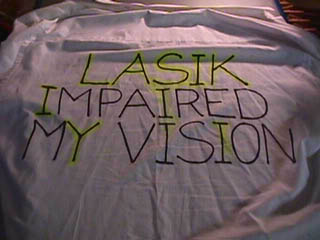
People ask me if I lift weights a lot, though I mostly swim. In other words, my back makes a good billboard. There, staring this group of co-workers in the face, after they'd been thumbing through a binder full of articles entitled things like "LASIK-dry eye connection acknowledged", was a man with a patch on his left eye. Wearing a shirt that said on the back, "LASIK Impaired My Vision."
It was my goal to compose complete sentences, and to connect them together in a manner that was grammatically, linguistically, and factally correct. I felt like I lost it, like I was yelling. I started out by talking about my grandmother, about what it was like watching an 85-year old woman die of an aortic aneurysm, in constant severe pain for 11 days. I described how incredibly much harder it is to be in the company of a person who is 40 years old and has 40 years of constant, excruciating eye-pain to look forward to - having spent the last 2 years in that condition, a condition which started on the day of her LASIK surgery early in 1999.
I think they got the point.
After 5 minutes I was spent and sat down.
The room was silent. Nobody clapped.
The LASIK people continued with their Powerpoint presentation. They enumerated various reasons why it was good to have LASIK, like, in case there was an earthquake and you didn't have your glasses.
As I was talking on the phone with Julie recently, we wondered - what happened to the people in Washington State that were having LASIK at the time of the quake ?
One more time the surgeon set me off, when he implied that a surgeon's skill was frequently responsible for the surgical complications which were becoming quite evident to my co-workers are a not infrequent by-product of Laser-Assisted In-situ Keratomileusis.
What he didn't tell them was that, comparatively, he was a rookie, and that, as a rookie, he was responsible for the wife of a co-worker, a woman who was sitting in the audience, needing a corneal transplant.
That set me off and I stood up again. I made it clear that my own LASIK surgery was performed by a highly experienced LASIK and refractive surgeon, and that Julie's LASIK surgery was performed by a highly experienced LASIK and refractive surgeon.
Such is the state of marketing in the refractive surgery industry.
During the seminar, a co-worker stepped forward and talked about his RK, and how he had fluctuating vision now.
I don't think that sales seminar resulted in many sales.
Oh yeah. One other thing. After I stood up and talk off my jacket and delivered my soliloquy, I still had a lunch to eat. I watched the Boy Friday and one of the optometrists. I observed the look they had on their faces. It was the most shit-eating look I have ever seen in my life. They actually looked like they were sitting there "savoring" invisible feces. They were clearly not enjoying their lunchtime LASIK seminar.
I think it is important to note -- one of the OD's seemed un-ruffled by my behavior and came over to talk to me afterwards. He wanted to talk about treatment options to help me with my own vision. I made it very clear to him that the ball-game here is to help the people with the constant, excruciating pain in their eyes, as a result of their LASIK, first. In general he seemed very concerned about the maintenance and restoration of visual health - as a true eye doctor would be.
In the closing seconds of our unique encounter, Boy Friday commented that he didn't appreciate being broad-sided.
I could have added but didn't - I didn't appreciate being blind-sided.
Imagine. Two doctors, lying to their patients and on national television. Telling or implying to their patients and the entire television audience that they performed LASIK on each other, when in fact they performed PRK, two vastly different procedures, with vastly different histories and sets of complications.
In fact, in 1998, the Department of Defense received a study from the American Institute of Biological Sciences. It cost American taxpayers over $1 Million, and concluded that LASIK was too dangerous and too experimental to allow it to be recommended to American soldiers.
The AIBS DOD Study didn't mention the LASIK surgeons who lie to their patients in order to sell LASIK surgeries, who deny their patient's reported symptoms, who alter clinical results by excising information regarding patients living with constant pain in their eyes, Harvard-associated "doctors" who risk losing their medical licenses by spoliating the medical records of patients who come to them looking for help.
What you see expressed here is the tip of the tip of the tip of the iceberg. I am but one patient who has witnessed officially-sanctioned medical cruelty and chicanery so Machiavellian that my trust in doctors has been shattered so thoroughly that, if I ever do need to have my appendix removed, I will probably consider doing it myself.
The day before my LASIK surgery I trusted doctors implicitly. Not any more.
I wonder if, when the story of the refractive surgery industry is told, they will make the tobacco industry look - compassionate.
My LASIK surgery was on August 14, 1998. "Doctor" Michael Gordon was my LASIK surgeon.
During a pre-op consultation, I asked "Doctor" Michael Gordon a question about LASIK, tantamount to the inquiry, "OK, what's the downside of this here LASIK, Doc ?" Michael Gordon responds. "Well, I've had laser surgery, and I use a few eye-drops every now and then."
There's only one thing - at that time, Michael Gordon had had PRK, not LASIK. PRK does not involve a micro-keratome cut - the first half of a partial corneal traansplant. The first half of LASIK is like the first half of a partial corneal transplant - a cut is made through the stroma, the middle layer of the 5 layers of the cornea. In LASIK, the cut stops just short of a complete cut. What's left is called the "flap."
In a partial corneal transplant, the cut is all the way through. No flap.
At the time, I didn't know that. I thought Michael Gordon was answering my question about LASIK by describing his experience with LASIK. He didn't. He deliberately answered my question about LASIK by describing his experience with PRK.
Then, during the pre-op consult, Michael Gordon neglects to ask me the simplest of questions about a clear contra-indication to corneal surgery - contact-lens intolerance. I am contact-lens intolerant, at that time that was the only sign of ocular surface disease. In addition to double-vision associated with a crossed left eye, I experienced a step-function increase in the symptoms of ocular surface disease on the day of my LASIK surgery. I was subsequently diagnosed with full-blown Dry Eye Syndrome, Blepharitis, and told to move to Florida - for the humidity.
I believe it was Michael Gordon's responsibility, given that he held and holds himself out to the public as a "Doctor of Medicine", with all the rights and responsibilities pertaining thereto, to ask me a simple question which would have directly addressed my suitability for elective corneal surgery. All he had to do was ask, "Are you contact-lens intolerant ?" He neglected to do so.
In the old days, I used to think that the doctors were supposed to know more than the patients. Not any more.
Should "Doctor" Michael Gordon ever wish to discuss LASIK
complications on San Diego television, I am prepared to do so. Maybe
we could do it in game show format. I've spent thousands of dollars
on eye-drops since my LASIK surgery. I could use the money.
(1) Actually, when he said it, it was, "Keep It
Simple, Stupid." But I don't like saying that to people, so I say
it the way I say it. The acronym is the same in any case - KISS.