
This is our chassis of our vehicle. The chassis was mainly designed by the 2004 FSAE team. Our objectives were to improve on the design by decreasing weight while keeping stiffness the same. By decreasing the wall thickness and outer diameter of the stiffening tubes, I was able to decrease over 15% of the weight of the chassis. I had to consider the moment of inertia of the tubes to keep the stiffness high while lowering the weight. By plotting moment of inertia vs. outer diameter & moment of inertia vs. wall thickness I could determine a suitable tube size. Cost, availability, and weldability were also contributing factors. After talking Tool Tec, our welding sponsor, I found that 0.035 wall thickness was the minimum thickness on the wall to allow low distortion and heat input. A thicker wall acts as a heat sink allowing for less heat distortion and less affect on the heat affected zone of the weld.
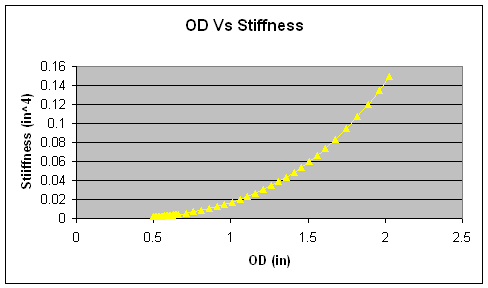
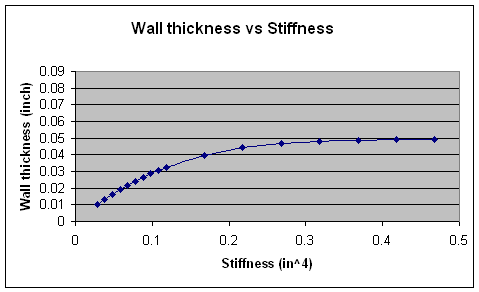
By selecting 5/8" outer diameter with a wall thickness of 0.065" 1020 CREW tubing, I was able to save 13 lbs on the chassis, weighing in at 64 lbs. The main structural components of the chassis consists of 1020 DOM 1" OD steel tubing. The wall thicknesses vary from 0.095" to 0.049". 1020 DOM tubing was chosen for its superior strength to weight ratio. DOM tubing has a much high tensile strength then cold drawn & hot rolled tubing. 4130 (Chrome Moly) was considered but the cost is double of 1020 DOM. The chassis was TIG welded for high quality, low heat input welds.