Canadian Retirement Plans
Pension benefits and pension legislation in Canada are continually evolving. An understanding of the pension benefits an individual may be entitled to upon retirement is necessary in order to plan retirement savings and postretirement cash flows.
1) Government pensions
A) Old Age Security (OAS).
The Old Age Security Act was enacted in 1952 and replaced prior provincially mandated
legislation established in the 1920s. Several improvements were introduced thereafter.
In 1965, the age for eligibility of the OAS pension benefit was reduced to age 65 from age 70.
The introduction of cost of living indexation occurred in 1972 and in 1973, OAS payments became indexed quarterly to the consumer price index (CPI).
Legislation introduced in 1977 allowed for the payment of a partial pension.
OAS has been further improved through the 1980s and 1990s to better aid low-income widows and widowers.
OAS is payable to most Canadians who reach the age 65 and is funded through general tax revenues. OAS is not automatic; it must be applied for, and does not depend upon an individual being retired. OAS benefits can be applied for up to one year in advance of the annuitant's 65th birthday.
The pension benefit received may be either a full or a partial pension depending upon the number of years that an annuitant resides in Canada after the age of 18.
A full pension is payable to a person who has resided in Canada for 40 years or more after the age of 18.
A partial pension is payable to a person who has resided in Canada for at least 10 years after reaching the age 18.
Providing that an annuitant had resided in Canada for at least 20 years after reaching 18 years of age, the OAS pension may be paid to individuals who currently reside outside of Canada.
Current maximum OAS pension benefits are approximately $411.23 per month at the time of writing. For income tax purposes, OAS benefits are considered taxable income, when the benefits are received. Additionally, since 1989, OAS benefits have been subject to a claw back. Approximately 15% of the OAS pension is clawed back at an income level of $53,000. OAS is fully clawed back (i.e. 100%) at an income level of approximately $84,500.
B) Canada Pension Plan (CPP).
The Canada Pension Plan (CPP) was enacted in 1965 and applies to almost everyone, over the age of 18, who has been employed in Canada. CPP is a contributory and earnings related pension and insurance program.
Since 1965, legislation has been passed a number of times to improve the CPP benefits. These improvements include:
In 1998, the CPP system moved from a pay as you go financing mechanism to a more complete and fuller funding, which entails increases in the contribution rate and the introduction of the new CPP investment policy.
The CPP investment board, which consists of qualified professionals, is independent of provincial and federal governments and is mandated to follow the same general investment rules that govern other types of pension plans. The investment board will report its investment results to the Canadian public on a regular and ongoing basis. At the time of writing, CPP funds have been used or invested in provincial bonds that have provided the provinces with a low-cost (subsidized) source of funds. With the creation of the CPP investment board, some changes in the ability of the provinces to fund borrowing through the issue of provincial bonds will result. These provincial bonds must now carry the same interest rate as the provinces pay on their other loans, rather than the lower interest rates the provinces have thus far been enjoying.
CPP provides three types of benefits:
1) Disability benefits to the contributor, including benefits payable to a disabled annuitant's children to the age of 18,
2) Survivor's benefits that include a lump sum death benefit and pensions to a surviving spouse and their children, and a
3) Retirement pension.
Unlike OAS that is funded from general tax revenues, CPP is a contributory program.
Since CPP is a contributory program that depends upon employment, the ability to participate in CPP is subject to qualifying income levels. In order to participate, an annuitant must earn a certain minimum income. The minimum income is specified as the yearly basic earnings (YBE) and is currently approximately $3,500 per annum. CPP is also subject to a maximum cap or ceiling level of earnings, which is known as the yearly maximum pensionable earnings (YMPE). The YMPE is adjusted at the beginning of every year and is currently approximately $36,900 per annum. The difference between the two numbers, which is called pensionable earnings, is therefore, $33,400. Both employees and employers contribute to CPP. Currently each contributes 3.2% of the employee's contributable earnings. A self-employed individual contributes 6.4% of their pensionable earnings.
The normal retirement age for CPP benefits is 65. Currently the maximum retirement pension payable by CPP is $750 per month. However, retirement benefits can begin as early as age 60 or benefits can be delayed until as late as age 70. If an annuitant continues to work, contributions can be made into the CPP program until age 70.
A retiree who begins to receive CPP benefits before the normal retirement age of 65 receives a reduced pension and conversely, a retiree who delays receipt of CPP benefits, until after age 65, receives an enhanced pension.
The reduction in retirement benefits is equal to 0.5% per month for each month that benefits are paid before the annuitant reaches age 65. In other words, the retiree who decides to receive CPP benefits beginning at age 60 will receive a pension that is reduced by 30% from the normal retirement pension. This is calculated as 0.5% per month times 60 months which equals a 30% reduction in retirement pension benefits.
A retiree who delays receipt of CPP pension benefits until age 70 will receive an enhancement in their pension of 0.5% per month for 60 months or 30%.
2) Employer-sponsored registered pension plans (RPP)
A registered pension plan (RPP) is an employer-sponsored retirement savings scheme that is designed with the intention to reward long term and loyal service to an employer with a lifetime of income. Registered plans are administered by a trustee, and must comply with certain conditions imposed by Revenue Canada and provincial government pension standards. RPPs qualify for tax advantages on the part of the employer and employee. The funds accumulated within a registered pension plan are protected from the annuitant's creditors.
An employer's determination to establish an RPP is a major decision, which is not undertaken without planning and deliberation. There are contractual obligations on the part of the employer once the decision to implement an RPP has been taken.
An employer must contribute specified amounts to an RPP that is set up for the benefit of the employees according to the pension plan's contractual requirements.
Normal retirement age in a pension plan is most often set at age 65. If an employee decides to retire before age 65, there is usually a reduction in the retirement pension. Most pension plans allow for retirement as early as age 55.
An RPP is said to be either contributory or non-contributory. In the case of a contributory RPP, the employee is required to contribute to the pension plan in addition to the contributions made on the employee's behalf by the employer. Conversely, a non-contributory pension plan requires no contribution on the part of the employee; the employer alone funds all contributions. In any event, the employer must provide at least 50% of the annual pension benefit earned.
Once an RPP has vested, the employee gains certain rights over all of the monies within the pension plan, irrespective of who originally contributed the funds to the RPP. The length of time required before vesting occurs varies from province to province but as a rule, vesting occurs after two years of employment. These rights can be exercised when an employee terminates his/her employment, whether by dismissal or resignation. Since the intent of an RPP is to provide a lifetime of income there are, by necessity, certain restrictions placed on the options available to an employee with respect to these vested pension monies. Unless the funds are of a minimal amount, they cannot be taken out as a lump sum of cash.
Pension benefit standards legislation allows the following termination options for vested RPP funds:
1) The funds may be left with the plan, where they will continue to grow, although no new contributions will be made to the plan,
2) The funds may be transferred to a new pension plan, providing the new plan allows such transfers,
3) The funds may be transferred to a "locked in" registered retirement savings plan (RRSP), or
4) The funds may be transferred to a locked in retirement arrangement (LIRA).
A locked in RRSP in no way restricts the annuitant's ability to invest the funds. Any investment, which qualifies to be held within an RRSP, will also qualify to be held within a locked in RRSP. The lock in provision, however, does restrict the ability of the annuitant to gain access to the funds. The lock in provision does not allow, at this time, an annuitant to gain access to the funds within a locked in RRSP using a RRIF. The province in which the pension plan is domiciled will determine the options available to the annuitant for the maturation of their locked in funds. For example, currently in BC, locked in RRSPs can only be matured using a type of life annuity or a life income fund (LIF). The lock in provision will also restrict or specify a minimum age (usually age 55) at which time the funds within the locked in RRSP can be accessed.
The annuitant cannot access funds from a locked-in RRSP as a lump sum cash withdrawal. The money has to stay in the locked in RRSP, and must be used to buy a life annuity at retirement age. However, under the pension laws of certain provinces, pension funds or funds from a locked-in RRSP can be transferred to a locked-in RRIF. These locked-in RRIFs are known as locked-in retirement income funds (LRIFs).
If an employee dies before retirement, the pension plan documents will detail the benefits available to the surviving spouse or to the estate. Provincial legislation dictates the minimum death benefits that an RPP must provide.
There are two basic types of registered pension plans:
i) Defined benefit plans, and
ii) Defined contribution or money purchase plans
i) Defined benefit plans.
As the name suggests, a defined benefit pension plan pays a pension to the annuitant that is based on a defined formula. The formula is normally some combination of years of pensionable service and a percentage of earnings. Under the terms of the defined benefit pension plan an actuary can estimate the pension benefit that will be received by an annuitant based upon certain actuarial assumptions, including an employee's current salary, future wage increases and investment returns earned on pension plan assets. For example, a defined benefit plan may pay an annuitant 2% of earnings for each of 35 years of pensionable service; this would entitle the annuitant to 70% of their pre-retirement earnings. The 2% of earnings formula is the richest plan that is allowed by Revenue Canada.
There are a number of methods that are used when determining a defined benefit plan's pension payment:
1) The defined benefit plan may pay a flat benefit.
Although this formula is not common, it is found in some unionized collective agreements. In terms of this type of plan, the annuitant may be entitled to some flat amount of pension such as $50 per month for each year of service provided to the employer. For example, an employee with 25 years service using the previous example, would be entitled to pension of $50 per month per year times 25 years = $1250 per month.
2) The formula may be based upon a career average of earnings.
This is simply the arithmetic average of the annuitant's annual salary. Consider an employee who spends 35 years with an employer. This employee may have started a career earning $5,000 per annum and is now earning $150,000. This employee's average salary over their career may, for example, be $65,000. Based upon 35 years of service and 2% of average earnings the annuitant would be entitled to a pension of 35 times 2% times $65,000, which equals an annual pension of $45,500.
3) The formula may be based upon the annuitant's final average of earnings.
For example, the average of the last five years earnings. Continuing the example from above in which the employee has final earnings of $150,000, they may have average final earnings of $125,000. This is a dramatic difference from the career average earnings in the example above!
Caution! An overall restriction exists which limits the maximum pension payable under a defined benefit plan to $1,722 times the number of years of pensionable service. Therefore, continuing the example, the annuitant described in situation #3 above would be limited or restricted to a maximum pension of $1,722 times 35 years of service or $60,270 per annum. Where $1,722 is the maximum annual earned benefit entitlement that is currently allowed under pension benefit standards.
With the defined benefit plan, an employer is contracting i.e. promising to pay a specified pension at retirement to an employee. Therefore, if through poor investment performance there are insufficient funds at retirement to fully fund an employee's pension, the employer must make good on the promised pension and the employer must, in some manner, acquire these monies usually from continuing operations. In other words, under the terms of the defined benefit pension plan the employer shoulders all of the investment risk. In order to minimize the possibility of investment shortfalls defined benefit pension plan assets and liabilities are required to be examined by an actuary at least once every three years (triennially). Furthermore, the actuary calculates and prepares the pension adjustment (PA) statement that is factored into the calculation of the amount that an employee can contribute to an RRSP.
ii) Defined contribution or money purchase pension plans (MPP).
Under the terms of the defined contribution or money purchase pension plan, what is known in advance is not the final pension that the annuitant receives, but the amount that is contributed into the pension plan. This contribution is a specified percentage of earnings. The maximum amount that can be contributed annually into a money purchase plan on behalf of an employee is currently $13,500 or 18% of earned income. There is no guarantee from the employer regarding the final pension amount that the annuitant is to receive at retirement.
The pension adjustment (PA) is very easy to calculate for a money purchase pension plan. The PA is simply calculated as the sum of the amount that the employer contributes on behalf of the employee plus the employee’s contributions.
The services of an actuary are not required with the money purchase pension plan. The employer's responsibility ceases when the contribution is made to the employee's pension plan. There is no further obligation on behalf of the employer. In this respect, a money purchase pension plan is similar to an RRSP in that there is no foreknowledge of the amount of pension to actually be received. The pension received at retirement by an employee is determined by three factors: the total amount accumulated in the pension plan, the interest rate in effect at the time the pension plan is annuitized, and the length of time for which pension benefits are to be received.
Which type of pension plan is best?
The answer to this question depends upon a number of factors.
Over the past decade we have witnessed the downsizing of many corporations and the related cost cutting and re-engineering that have characterized the 1990s. One method of cost saving has been for corporations to move away from providing employees with defined benefit pension plans and instead corporations are providing money purchase pension plans. Cost savings result because money purchase pension plans do not require the services of an actuary, the administration costs are lower with the money purchase plan, and the use of money purchase plans have decreased the employer's investment risk. As explained previously, in defined benefit pension plans if there are unfunded plan liabilities at the time of an employee’s retirement the employer must make good on the promised pension. Conversely, with the money purchase pension plan the employee shoulders all of the investment risks in that there is no promise of a specified pension amount and the employer's obligations cease upon contribution to the plan. It is not surprising then, to see the move in the marketplace, towards the increased usage of money purchase plans.
In general terms, a defined benefit pension plan is most valuable to an employee who is in his or her 50s and whose earnings are over $75,000, in other words, a highly compensated individual who has a relatively short time until retirement. The money purchase plan, on the other hand, is most attractive to a younger employee who has a longer time horizon over which to allow the contributions to compound and whose earnings will no doubt rise over time.
Defined benefit pension plans can typically be found in the public sector and they are still used by some large employers. It is not unusual to encounter a situation where the executives of the corporation or enterprise will be members of a defined benefit plan while the other employees are members of a money purchase pension plan. Consider that the maximum contribution to a money purchase plan is $13,500 per annum while the maximum contribution to a defined benefit plan is approximately $15,500 per annum. It is also worth noting that defined benefit pension plans can be arranged to provide for certain enhanced benefits. For example, many defined benefit plans provide pensions which are indexed to inflation and which provide augmented death benefits or survivors benefits. However, is important to note that these enhancements cost more to provide.
Maturity options for registered pension plans
Retirement benefits paid from an RPP are paid in the form of an annuity for the individual's lifetime. There are a number of basic options, which include:
a) Life only annuity.
Under this option, funds accumulated in the pension plan are used to purchase an income or pension that continues for as long as the annuitant is alive. This option is also known as a straight life, or ordinary life annuity. The advantage of the straight life annuity is that it pays the highest available monthly pension. The disadvantage of the life annuity is that when the annuitant dies all payments cease. This option would be attractive to an unmarried annuitant, or to an annuitant that has neither family obligations nor a desire to provide benefits after death.
For example, assume for the purposes of discussion that an annuitant has accumulated sufficient funds, and that interest rates are such that these funds are enough to provide a life annuity of $2,000 per month. This would be the straight life annuity payment to the annuitant.
b) Joint and last survivor annuity.
Under this type of annuity option, benefits are payable not only for the life of the annuitant but will continue after the annuitant's death to the surviving spouse for as long as the surviving spouse is alive. This is a more attractive option to an annuitant that has a spouse and wishes to provide income for the spouse's remaining lifetime. Under pension benefit standards a joint and last survivor annuity option is the standard provision required under legislation. In order to waive this option both spouses will be required to sign waiver disclaimers. This requirement is in place in order to protect the rights of the spouse and prevents the annuitant from unilaterally disinheriting the spouse. When determining the pension to be provided to both the annuitant and the surviving spouse an actuary will consider the amount of retirement funds accumulated, current interest rates, and the life expectancy's of both the annuitant and spouse. It is typical for a surviving spouse to receive a pension that is reduced after the death of the annuitant. It is not uncommon for the surviving spouse's pension to be 60% of the pension that was received while the annuitant was alive. It may be possible to arrange the annuity in such a manner that there is no reduction upon the death of the annuitant, in which case, a lower pension would be payable during both lifetimes.
Using the previous assumption of the straight life annuity of $2,000, in the case of the joint survivor option the annuitant might receive a lifetime pension of $1,600 per month and after the annuitant's death, the surviving spouse would receive 60% or $960 per month for their remaining lifetime. Conversely, if it was arranged so that there was no reduction to the surviving spouse upon the death of the annuitant, the pension might be $1,200 per month for the lifetime of both spouses.
It is important to note that since the life expectancy's of both spouses are considered, the difference in ages between the two spouses is a major factor determining the pension amounts. Everything else being equal, the larger the spread in ages between spouses the lower the payouts will be. Additionally, once this decision to opt for a joint and survivor pension is taken, it is irrevocable. Note also, that should the annuitant out live the spouse and subsequently remarry, the new spouse has no rights to any part of the survivors pension.
c) Life annuity with a guarantee period (also called a refund annuity).
Under this annuity option, a specified amount is paid for the annuitant's lifetime. However, in order to protect the surviving spouse there is a guarantee as to the minimum amount repaid to the survivor.
Continuing the example from above, assume a guarantee of 15 years. The annuitant might receive a pension of $1,800 per month for life. Now, suppose that the annuitant dies after receiving 5 years of payments, in which case the surviving spouse would continue to receive $1,800 per month for 10 more years at which time payments cease. Conversely, if the annuitant lives to be 100 years old, the $1,800 per month would continue until the annuitant's death. The annuitant can not out live the pension income since it is a form of a life annuity.
In all of the above examples, the amounts illustrated are fictional, however it should be noted that although the amounts are fictional the relationships between the amounts paid by the different types of life annuity are valid and serve to illustrate the relative costs and benefits of each choice. In other words, it is not unusual in the marketplace, for a life only annuity to pay approximately 20% more than the joint survivor annuity or approximately 10% more than a life annuity with a guarantee. These relationships, of course, will vary with interest rates in the general economy. Anytime that retirement planning is being performed, it is necessary to carefully review the options that can be provided by the specific pension plan in question. These projections should be obtained from the plan itself in the case of a defined benefit plan or the appropriate life annuity pension amounts can be estimated very closely by obtaining quotations from a reputable annuity brokerage firm.
d) Life income fund (LIF).
Under this option pension funds are rolled into the LIF which is somewhat similar to a registered retirement income fund (RRIF), in that a certain minimum and specified income must be paid on an annual basis, but the annuitant may be paid up to a stipulated maximum amount. Unlike a RRIF however, the maximum amount that can be paid by the LIF is restricted. This restriction is a protective feature, which ensures that the annuitant cannot remove all the funds. This restriction is in place because a LIF merely defers, until age 80 (as a maximum), the conversion of the remaining funds into one of the three RPP annuity options previously mentioned. In other words, a LIF merely defers the conversion to an annuity; it does not replace it. Some provinces have introduced a locked in retirement income fund (LRIF) which allows the annuitant to have access to the funds in a manner similar to a RRIF. Over time, more of the provinces will probably move in a similar direction.
3) Deferred profit-sharing plan (DPSP)
A deferred profit-sharing plan (DPSP) is a formally registered savings arrangement whereby an employer contributes a stated percentage of net profits. A DPSP is not subject to any provincial pension legislation. There is usually a clause in the plan that specifies the procedure to be followed in a year of zero profits or losses. Only the employer makes contributions to an employee's DPSP; the employee does not contribute on their own behalf. The maximum allowable annual contribution to a DPSP is $6,750 or 18% of earnings.
The pension adjustment (PA) is easily calculated for a DPSP, it is simply the amount contributed by the employer.
The income from a DPSP is considered, for income tax purposes, to be taxable when received by the employee. The receipt of proceeds from a DPSP would be at normal retirement age or as allowed by the terms of the profit-sharing plan. Unlike registered pension plans, a DPSP may pay lump sum cash payments to an annuitant. The DPSP may also allow transfers to RRSPs, RPPs, or RRIFs.
4) Registered retirement savings plans (RRSP)
Registered retirement savings plans (RRSP) were first introduced into the Canadian marketplace starting in 1957 and have become one the most popular and widely used retirement planning tools available to Canadians.
Most Canadians are familiar with the RRSP's two major tax advantages: deduction and deferral.
RRSPs are usually established as a trust. Funds, which are contributed into the trust for the benefit of the beneficiary (the annuitant), by the contributor (settlor), are deductible from income when determining taxable income. Usually the contributor and beneficiary is the same person, however, it is possible for the contributor to designate the spouse as the annuitant. Additionally, any growth that occurs within an RRSP is sheltered from current income taxes until the funds are eventually removed from the shelter of the RRSP. Under current legislation, the RRSP must be matured by the end of the year in which the annuitant turns 69 years of age. At the present time, an RRSP can invest up to 20% of its book value into foreign investments.
Types of RRSPs
There are several types, or classifications, of RRSPs available to Canadians although the Income Tax Act treats them identically.
A) Deposit plans.
B) The Canadian government, through Canada Investment and Savings, has recently introduced Canada premium bonds (CPB's).
C) Managed plans.
D) There are certain advantages to owning an RRSP that is issued by a life insurance company.
E) Self-directed RRSP.
RRSP rules
1. Contribution limits.
The maximum amount that an individual can contribute to an RRSP in any given year depends upon the annuitant's previous years income. Revenue Canada currently stipulates that an individual can deduct from income taxes the lesser of $13,500 or 18% of the previous years "earned income" less the annuitant's pension adjustment (PA) for that year. The annuitant's PA is usually reported on the T4 slip, is available from Revenue Canada, and is noted on the annuitant's notice of assessment. A T4 slip is the annual statement produced by employers, which is required to be provided to employees for the purposes of income tax preparation.
"Earned income" is specifically defined within the Income Tax Act. According to Revenue Canada's definition, "earned income" includes employment income, net business income, net rental income, and CPP and QPP disability benefits.
If an annuitant does not contribute the maximum RRSP amount that Revenue Canada allows in a given year, these unused deductions are not lost. An annuitant's unused contribution room, from as far back as 1991 may be accumulated and carried forward to future years. In 1996, the rules were altered to allow undeducted amounts to be carried forward indefinitely. These undeducted amounts can be paid into an RRSP anytime in addition to an annuitant's allowable contribution for any year.
Excess contributions can also be made to an RRSP. Since 1995, allowable excess contributions have been limited to a maximum total of $2,000. There are penalties imposed by Revenue Canada upon annuitant's who contribute more than this $2,000 limit. These excess contributions are not tax deductible and violation of the $2,000 limit is subject to penalty taxes of 1% per month, while the excess amounts remain in the RRSP.
2. Spousal RRSPs.
Spousal RRSPs allow the annuitant to pre-plan a splitting of income that will benefit both spouses after retirement. The idea is quite simple. The contributor may make deductible contributions within their own normal contribution limits to an RRSP for his or her spouse. These contributions to the spousal RRSP in no way affect the limits that the spouse may make to his or her own RRSP. Since 1992, the definition of the spouse has included opposite sex common law spouses. As of the time of writing, same-sex spouses are precluded from this planning technique.
Income splitting operates because of the progressive nature the Canadian income tax system. The progressive nature of the tax system simply means that the more income that is earned, the higher the income tax that is paid. This progressive nature of the Canadian tax system leads to a phenomenon known as the marginal tax rate or tax bracket. Marginal tax rate refers to the amount or rate of tax that is paid on $1 of additional income (at the margin). Income splitting improves after-tax efficiency in that $70,000 of annual income will attract less income taxes if each spouse earns annual income of $35,000, than if one spouse were to pay tax on the entire $70,000.
In order to minimize abuses of this income splitting opportunity, Revenue Canada imposes certain restrictions. The three-year rule states that if the spouse were to withdraw the funds from the spousal RRSP, in the year of withdrawal or the 2 previous tax years, no contributions to a spousal RRSP can be made to any spousal plan. If funds are withdrawn within this three-year period these amounts, up to the amount that was originally deducted, will be attributed back to the contributor spouse and included in their income. The three-year rule does not apply when, at retirement, funds that were contributed to the spousal RRSP are rolled into a RRIF and the minimum income is withdrawn from the RRIF, even if withdrawals begin within the three-year period. However, if more than the minimum amount is withdrawn from the RRIF the three-year rule will apply.
3. Eligible contributions.
Although most Canadians contribute cash to an RRSP there is no requirement that the contributions be in this form. Any qualified investment is considered an eligible contribution such as blue-chip stocks or bonds. However, it must be noted that a contribution of eligible property is deemed to be a disposition which occurs at current fair market value (FMV) and therefore, any gains realized by this form of transfer will be taxable in the year that the contribution was made. Additionally, any capital losses incurred on such a transfer are not allowable and therefore any asset with accrued losses should usually not be transferred.
Planning with RRSPs
1. Early contributions.
Prudent planning dictates that annual contributions be made as early in the year as possible to insure the full benefits of compounding. RRSP contributions for any given tax year must be made within the year or within the first sixty days of the subsequent year. Early contributions may make it possible for the contributor to apply for the reduction of withholding taxes at source as allowed by Revenue Canada.
There is no restriction contained within the Income Tax Act that specifies at what minimum age contributions can be made to an RRSP. The Act does however stipulate that the annuitant must have earned income. Other restrictions that exist in the marketplace are likely to have been imposed by a financial institution, not by Revenue Canada. The parents of children who have earned income should investigate the feasibility of filing income tax returns on behalf of the child in order to protect or lock in the undeducted RRSP contributions which will benefit the child in later life.
If it is not possible to contribute a lump sum of cash early in the year, an individual should make regular and ongoing contributions to the RRSP. This strategy is referred to as dollar cost averaging. Dollar cost averaging involves setting aside a specific amount of money on a regular basis, usually monthly. The idea is that rather than trying to time an investment decision, which the experts tell us is virtually impossible on a consistent basis, the investor allows the volatility of the markets to work for rather than against him or her. Dollar cost averaging is particularly attractive when investing into volatile vehicles such as equities or when interest rates are moving up and down unpredictably.
This disciplined approach to investing ensures that an investor purchases more when prices are low and purchases less when prices are high. Dollar cost averaging can be viewed as a hedging strategy because of the discipline instilled upon the investor. The more volatile the investment vehicle is, the more beneficial the strategy of dollar cost averaging.
2. Delayed RRSP deduction.
The RRSP rules allow a contribution to be made to an RRSP in any particular year, but there is no requirement that the tax deduction be taken in a particular year. This allows the taxpayer the opportunity to take the tax deduction when it is most beneficial. This may be an advantage to someone who has volatile income for example, a commissioned salesperson, who for whatever reason has temporarily low income in one year. The contributed funds will compound on a tax-deferred basis, and an individual will benefit from greater tax saving when income returns to the normal level (higher marginal tax bracket). Delayed deduction may also benefit someone who takes a leave of absence, leaves the workforce temporarily to raise a child, or who becomes a nonresident but will return to Canada at some point in future. The downside to this strategy is that the income tax will be prepaid and therefore one must consider the time value of money when evaluating the appropriateness of this particular strategy.
3. Spousal RRSPs.
As mentioned previously, an individual can make deductible contributions to an RRSP on behalf of a spouse subject to the individual taxpayers overall maximum deductible limit. This strategy can benefit the couple when the spouse is expected to earn less retirement income than the contributor and thereby affect a split of income.
The use of spousal RRSPs can also be an appropriate strategy when the spouse is younger than the contributor and therefore allows for a longer period of tax deferral. Revenue Canada precludes individuals over the age 69 from contributing to their own RRSP. However, assuming that the contributor has "earned income", deductible contributions can be made to a spousal RRSP up until the end of the year that the spouse reaches age 69.
4. RRSP mortgages.
It is possible for a taxpayer to arrange a mortgage loan from a self-directed RRSP. This mortgage loan can be used to finance the purchase of a principal residence either for the annuitant or for another non-arms length individual. The rules stipulate that the mortgage must be arranged with the same conditions as those provided by a regular lender. In other words, the interest rate payable on the mortgage loan must be arranged at market rates. The Income Tax Act further stipulates that the mortgage must be insured by Canada Mortgage and Housing Corporation (CMHC), and it must be secured by Canadian real estate.
This strategy is particularly advantageous to an individual whose RRSP is currently invested in GICs, TDs, CPB's, T-bills or other types of deposits. The individual will benefit by any spread that exists between the interest rate paid on any existing mortgage loan and the interest rate earned on the deposits held within the RRSP.
One must carefully weigh the costs and benefits of this particular strategy. The individual will require a self-directed RRSP for which the annuitant will most likely be charged an annual administration fee. Additionally, there is the added expense of purchasing CMHC insurance, legal fees and any other administrative charges levied by the trustee. Anyone considering this particular strategy must be cognizant of the ongoing fees and expenses; however, it can make a great deal of common sense to employ this strategy and pay interest to oneself rather than to make payments to a financial institution, providing of course, that one has the necessary funds accumulated within the RRSP. This strategy merely reinforces the argument to contribute as early as possible and as much as possible to an RRSP.
5. Homebuyers plan.
First time homebuyers may borrow up to $20,000 from their RRSPs in order to finance the purchase of an owner occupied principal residence. An individual is considered a first-time buyer if neither the individual nor their spouse owned their own home and lived in it as their principal residence in any of the 5 calendar years before the withdrawal. If funds are withdrawn from the RRSP to purchase a home, the purchase must be made by October 1 of the year following the withdrawal. These loans must be repaid however, and they can be amortized over periods of up to 15 years, which results in a minimum annual repayment of $1,333. This 15-year repayment period must commence in the second calendar year after withdrawal. If in any year a minimum repayment is not made the difference between the minimum requirement and the actual repayment will be included in the taxpayers income for that year.
Homebuyers are precluded from deducting from income any RRSP contributions that are withdrawn to fund a homebuyers plan within 90 days of deposit.
Any funds withdrawn from an RRSP forego the tax-deferred income that those funds would earn; however, this disadvantage must be weighed against the benefit of homeownership and a tax-free capital gain that can accrue on an individuals principal residence. In fact, like many retirees who at some point downsize their principal residence, the individual may be better off buying the home as soon as possible. At retirement, downsizing the home generates tax-free capital, which can at that point be reinvested to produce additional income and may in fact produce a better situation than that of having pretax funds tied up within the RRSP.
6. Lifelong learning and training.
Beginning in 1999 individuals will be able to withdraw up to $20,000 from their RRSPs on a tax-free basis to finance full-time educational retraining for themselves or for their spouses. These withdrawals can be structured with the maximum of $10,000 being withdrawn annually. Repayments must begin no later than 60 days after the 5th year following the first withdrawal and must be repaid in equal installments over a 10-year period.
7. Tax efficiency.
For many individuals and couples, RRSPs represent the majority of their investment assets. When these RRSPs are eventually matured all of the income that is produced, is fully taxable and this income is taxed at the individuals marginal tax rate. Where possible, investments such as interest-bearing deposits, CPB's, T-bills, and bonds are most advantageously held within the tax-sheltered structure of the RRSP. Investments for which preferential tax treatment exists, such as common stock (capital gains) and preferred shares (dividends), should be held, where possible, outside of the RRSP in order to reap the maximum benefits afforded to investors under the Income Tax Act, for these types of income.
An individual who holds cash in a self-directed RRSP and securities outside of the RRSP should consider the possibility of a swap of the assets. Although there may be income taxes triggered on this deemed disposition, this tactic allows the individual to continue to hold the securities and places cash in hand which can be used for other purposes, such as reducing debt on which interest is not deductible.
The value of the tax deferral gained by using an RRSP depends on an individual's age, time until withdrawal, and tax bracket. Generally speaking, it requires a long holding period for dividend or capital gain producing securities held within an RRSP to offset the higher income taxes that will be applicable when the income from the securities is finally withdrawn from the RRSP.
Labour Sponsored Venture Capital Corporations (LSVCC) provide venture capital for small to medium-sized Canadian businesses. LSVCCs are investment funds that are sponsored by labour organizations. To stimulate venture capital creation, the federal and provincial governments provide tax credits to investors in LSVCCs and in most provinces, these vehicles can be held within one's RRSP.
Individuals investing in LSVCCs receive a federal tax credit of 15% of the cost of the investment and the maximum federal tax credit is $750. Some provinces have matching credits that increase the total credits available to $1,500 for a $5,000 purchase of LSVCC shares.
If purchased through an RRSP, the tax benefits are significant. For example, a $5,000 contribution to an RRSP is deductible under the regular RRSP rules, and the individual also receives the LSVCC tax credits. Depending on the province, and assuming a marginal tax rate of 50%, an individual purchasing $5,000 of LSVCC shares in an RRSP saves about $4,000 in tax.
Additionally, recent amendments allow the investors who own LSVCCs within their RRSPs the ability to increase the maximum amount of foreign content allowed within the RRSP. With this current change, for each $1 invested in an LSVCC, investors can hold an additional $3 of foreign content to an overall maximum of 40% of the RRSP’s book value.
8. Borrowing to contribute to an RRSP.
As a rule, interest expense that is incurred on funds borrowed to purchase income-earning investments is deductible for income tax purposes. Revenue Canada requires a reasonable expectation of future income potential from the investment, which is greater than the interest expense claimed. Income for this purpose includes interest and dividends; it does not include capital gains.
Conversely, interest on funds that are borrowed to make an RRSP investment is not deductible for income tax purposes. Some individuals argue that it is preferable to borrow rather than to forego the current tax year’s RRSP contribution. This is a form of forced savings. This strategy is most effective if the tax refund generated by the RRSP contribution is used to retire the loan as soon as possible. One of the major benefits that make RRSPs so attractive is the reinvestment of the tax savings. Taxpayers, who borrow therefore, are missing out on a major component of the total return and benefit from the RRSP vehicle. A powerful argument can be made that these individuals would be further ahead in the long run, to make monthly contributions to the RRSP rather than to make monthly payments on the loan. However, given the stock market returns which Canadians have enjoyed over the last decade, the legions of dedicated sales people who have espoused the use of debt, huge advertising campaign's every winter (RRSP season) by the financial institutions, and the availability of easy credit, this argument for the most part has been ignored or at best it has been relegated to the background.
Registered Retirement Savings Plan (RRSP) maturity options
The longer that an individual can delay taking income from the RRSP, the longer the time frame available for the funds to compound and to continue to grow. In may be prudent to derive income from non-registered investment funds before depleting registered sources in order to maximize the tax-deferred compounding.
Nevertheless, at some point and by the end of the year in which an individual turns age 69 at the latest, there is a requirement to mature the funds held within an RRSP. If the decision regarding the maturation of the RRSP is not taken by the annuitant at age 69, Revenue Canada will make the decision for them. Although age 69 is the deadline for the maturation of an RRSP, funds can be withdrawn from the plan anytime beforehand.
Eventually as funds are withdrawn from the RRSP, income taxes are payable.
There are three methods by which funds in an RRSP can be matured:
1) Cash withdrawal,
2) Annuities, or
3) Registered Retirement Income Fund (RRIF).
Cash withdrawal
Cash withdrawal is the method that Revenue Canada deems to be the maturation option unless otherwise specified by the annuitant. Any amounts withdrawn in cash from an RRSP must be included in income in the year of withdrawal. All withdrawals from an RRSP are taxed as ordinary income even if the funds were accumulated as capital gains or from dividends. Partial withdrawals from an RRSP plan are permitted and these partial withdrawals do not deregister the entire plan.
Lump sum cash withdrawals from an RRSP are subject to withholding tax. Withdrawals of up to $5,000 are subject withholding tax of 10% (25% in Quebec). Withdrawals of up to $15,000 are subject withholding taxes of 20% (33% in Quebec), and withdrawals of more than $15,000 are subject withholding tax of 30% (38% in Quebec). Withholding taxes are credited against the actual amount of income tax owed by the taxpayer, which will depend upon other sources of income for the tax year.
Although cash withdrawals from an RRSP are certainly an allowable option, this is the least attractive method of maturing an RRSP from a tax efficiency perspective.
Annuities
Funds held within an RRSP can be used to purchase an annuity. The amount of income paid from the annuity will depend upon the value of the funds to be invested, current market interest rates, the age of the annuitant, and type of annuity payout option which is purchased.
RRSP funds can be used to purchase life only annuities, joint survivor annuities, or a life annuity with a guarantee period (refund annuity). These are identical annuity options to those described previously under the maturation of registered pension plans.
Additionally, RRSP funds can be used to purchase a term certain annuity (TCA) which are also known as fixed term annuities. A TCA will provide an income stream up to the age of 90, or until the spouse is age 90.
Annuities offer the advantage of predictable and stable income that is guaranteed for the length of time that is specified in the particular annuity contract that is chosen. This advantage is particularly evident to individuals who purchased life annuities during the early 1980s when interest rates reached 18%, and who have watched interest rates subsequently plummet. Life annuities also offer the distinct advantage, of a lifetime of guaranteed income that can never be outlived.
Annuities have a number of drawbacks. Once the decision has been taken to annuitize the RRSP funds, the decision is irrevocable and the contract cannot be altered in any way. Subject to the guarantee's that are offered by CompCorp with respect to annuity income, the safety of the investment income depends upon a strong issuing company. Annuities are illiquid and, depending upon the option chosen, principal and earnings can be lost in the event of the pre-mature death of the annuitant.
Registered Retirement Income Fund (RRIF)
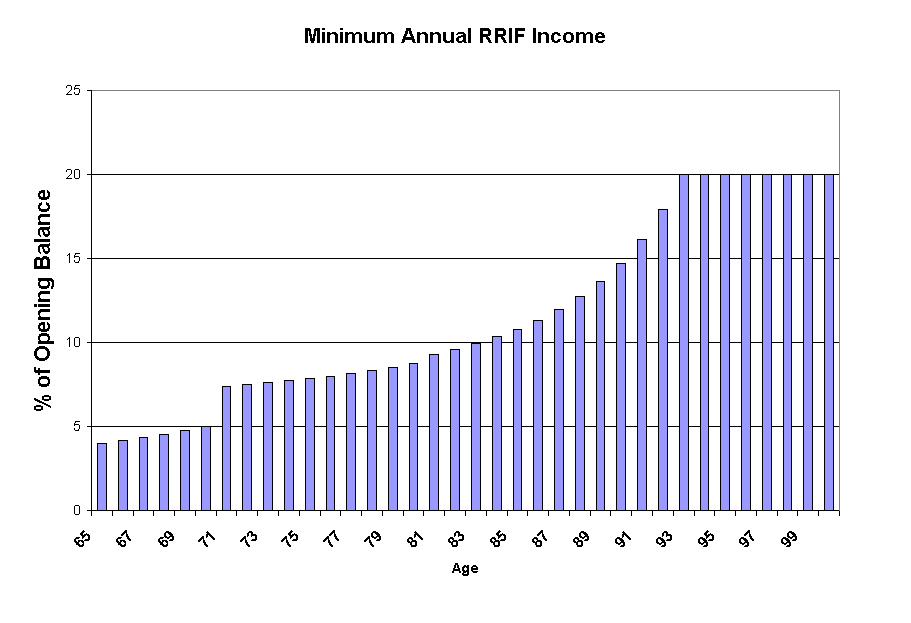
Registered retirement income funds (RRIFs) are fundamentally the extension of an RRSP. A RRIF enables an individual to continue to control, and to continue compounding, on a tax-deferred basis, the investment of retirement assets after the age of 69. Funds are easily transferred from an RRSP to the RRIF, which continues to hold investments, or assets that are identical to those which are considered to be qualifying investments for RRSP purposes. Capital must be paid out of a RRIF at least annually, subject to Revenue Canada's rules that require that a specified minimum income must be withdrawn each year.
The minimum amount, which must be withdrawn from a RRIF in any particular year, is that stipulated percentage which is based upon the annuitant's age, and the minimum withdrawal increases over time. The age that is used to determine the minimum withdrawal can be either the age of the annuitant or it may be based upon the age of the annuitant's spouse. If the couple have other sources of retirement income, basing the minimum withdrawal on the age of the youngest spouse ensures that income taxes are minimized.
RRIFs offer the advantage of control and flexibility. A RRIF, like an RRSP, can be self-directed with all investment decisions and choices controlled by the annuitant. A RRIF does not stipulate the maximum withdrawal, therefore funds can be withdrawn at anytime and in any amount that the annuitant sees fit (subject to Revenue Canada's minimum withdrawal rules). Any withdrawals that exceed the specified minimum for any given age are subject to withholding tax at source.
Retiring allowances
Retirement allowances are payments that are received by an employee in recognition of long service or alternatively these allowances are payments for loss of employment. Retirement allowances are normally fully taxable as ordinary income however, the recipient may roll these monies, subject certain to restrictions, into an RRSP, in addition to the employee's annual deductible RRSP limit.
The maximum that can be rolled into an RRSP is $2,000 for each year or part year of employment prior to 1996, with the employer who is paying the retiring allowance. An additional $1,500 maybe rolled into an RRSP, for each year of employment before 1989 for which an employer's contributions to an RPP or DPSP had not yet vested in the employee. Starting in 1996, although the rollover's are still allowed, the limits will be restricted to years of employment before 1996. In order to avoid withholding taxes recipients of the retiring allowance should request that the employer directly transfer the funds to the RRSP.
Evaluating early retirement packages
Increases in global competitiveness and corporate cost reduction programs have made early retirement incentive packages commonplace in Canada in recent years. For some employees early retirement packages have been a boon that has allowed them to carry on a lifestyle similar to that which they enjoyed while working. For other employees early retirement can be a bane. Often the difference in the two situations can be directly attributable to a hasty acceptance or rejection of the proffered retirement package. Early retirement packages are usually complicated arrangements and typically, employees are given a limited time in which to make a decision that will often impact the rest of their lives.
Considerations when evaluating a retirement package:
Is the individual planning to return to the workforce by seeking other employment or starting a business?