Financial decision-making
The goal of financial planning is to increase and maximize investable net worth through the effective manipulation of money and credit.
An investor's ability to maximize investable net worth is greatly aided by the ability to choose amongst competing investment options. Various formulas and tools can be used by investors to determine the extant value or the past performance of their investments.
Analytical tools
Depending on the type of investment that is owned or under consideration by an investor, various tools may be used to measure and evaluate the return or value of that investment.
Much of financial planning requires answers to mathematical questions that involve the time value of money. Time value of money (TVM) represents the trade-off between the present use and the future gain of money. Time value of money moves all money flows either back to the present or out to a common future date. It measures the costs and benefits of investment alternatives that occur in different time periods. The most common example is when an investor gives money to someone else, who subsequently puts it to work, and then pays the investor interest in return for the use of the investor's money. This interest is compensation for the temporary loss to the investor of the use of the money invested.
Although it is possible to compute all time value of money problems mathematically using formulae or by the use of compound interest tables, computers and financial calculators add simplicity and efficiency to these computations.
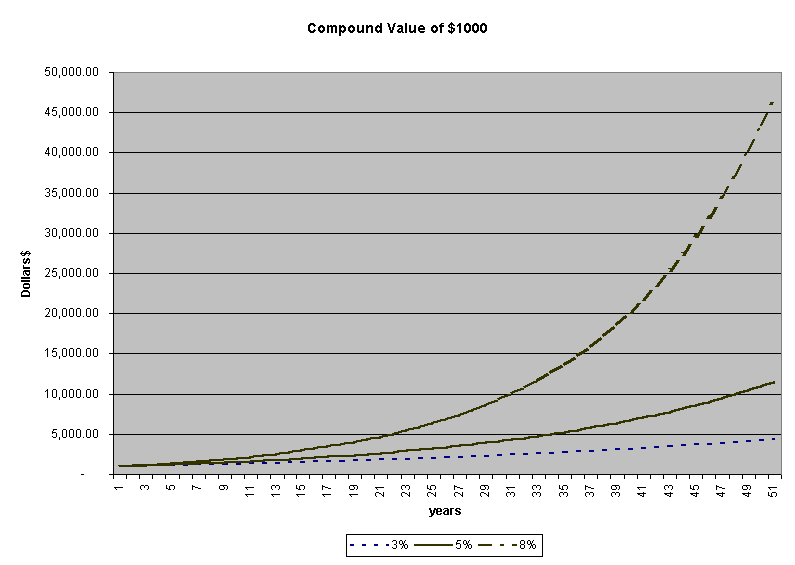
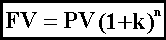
Compound interest is interest earned on both principal and interest. Interest is compounded when it is computed, added to the principal amount, and reinvested. The process of calculating the future sum or value (FV) of an investment is called compounding.
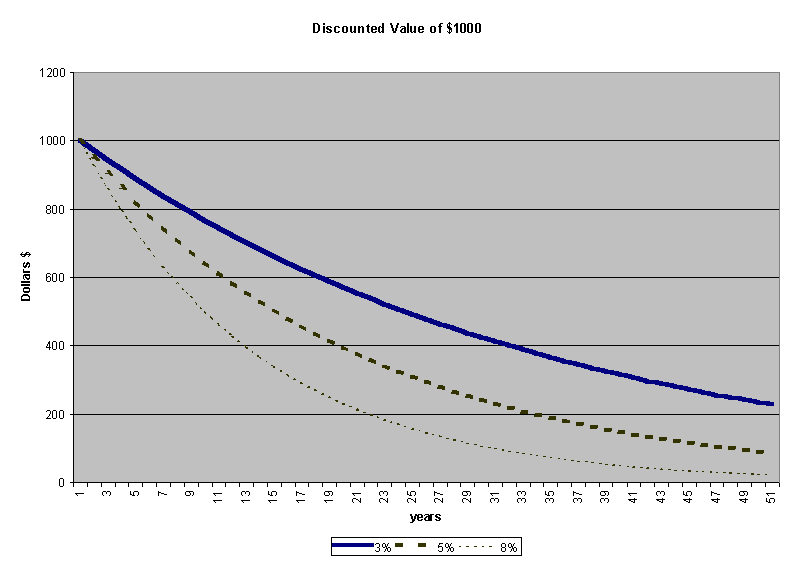
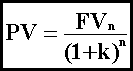
The process of calculating the present value (PV) of a future sum is called discounting.
Compounding and discounting are reciprocals of one another. This means they are inverse mathematical functions of one another.
An annuity is defined as a series of payments or receipts of a fixed dollar amount, for a specified number of time periods.
An ordinary annuity assumes that these payments or receipts occur at the end of the period. Conversely, an annuity due assumes that the payments or receipts occur at the beginning of the period. In finance, the usual assumption or norm is the use of an ordinary annuity i.e. payments or receipts occurring at the end of the period. The use of an annuity due is signaled via key words such as..." starting today", "immediately", "starting now" or words to a similar effect.
A perpetuity is a special type of an annuity that has no maturity date. An example of a perpetuity is a preferred share that pays a fixed and stated dividend amount forever.
Capital budgeting is different from cash flow budgeting and provides additional analytical benefits to an investor. Capital budgeting is the process, which is commonly employed in corporate finance, of allocating capital to investments whose benefits will be spread over several time periods. Typically, an investor is faced with more potential investment choices than can be successfully undertaken because of the lack of funds. Capital rationing therefore must occur when there is an upper limit or maximum amount placed on the ability to invest or with which to make capital expenditures. The investor requires some sound and logical methods by which to rank potential investments in order to make reasonable capital rationing decisions.
Capital budgeting evaluates an investment's incremental cash flows and evaluates these cash flows relative to an investment's cost. Capital budgeting uses cash flows rather than profits because the cash flows better reflect the timing of both the costs and benefits of an investment
decision. Specifically, only the incremental after-tax cash flows are used when determining whether to undertake a particular investment.
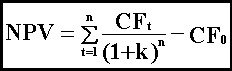
Net present value (NPV) is a method used in evaluating and ranking investments, whereby the net present value of all cash outflows (such as the cost of the investment) and cash inflows (such as the investment's return) are calculated using a given discount or hurdle rate. An investment is considered acceptable if the NPV is positive. NPV is used to rank different investment options, from the highest NPV to the lowest NPV. An investment is rejected if the NPV is negative since this indicates that the investment does not improve the investor's current net worth.
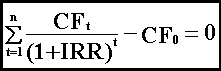
Internal rate of return (IRR) is the discount or hurdle rate at which the present value (PV) of all of the future cash flows of an investment exactly equal the total cost of the investment. The IRR is a special case of the net present value calculation because the IRR is the rate of return at which the NPV of an investment equals zero. An investor should compute both the NPV and the IRR for each potential investment in order to verify, or in order to provide additional insights into, the merits of a particular investment choice. Without the use of a computer or financial calculator the calculation of the IRR is done by a process known as iteration, which can be extremely time-consuming and frustrating.
IRR ranks various investments differently than NPV if:
1) Two projects have different initial investments, and when
2) The timing of the cash flows from the investments is different.
Capitalization (Cap) rate can be referred to as the capitalization rate of an asset. The Cap rate is the interest rate used to convert a series of future payments into a single present value (PV) and is most commonly used in valuing real estate.
Payback period is the length of time required to recover an initial investment. The payback period is calculated as the original investment divided by annual cash flow. It can also be referred to as a cash recovery period.
Dividend discount model (DDM) is a valuation technique used for estimating the intrinsic value of a stock. DDM models calculate the discounted present value of all future dividends or future earnings. DDMs describe the relationship between a stock's current price and the present value of all future dividend payments or earnings. This model can be used to determine the value of a common stock.
The Gordon growth model (also known as the constant growth DDM)

where
P
0 = current market stock priceD
0 = current dividend just paidD
1 = dividend paid 1 year from nowk
s = required rate of return on a stock investmentg = long term sustainable growth rate of the stock
Return on equity (ROE) is the after-tax profit earned by a company compared to the total cost of its equity shares.
Return on assets (ROA) is the after-tax profit compared to the firms total tangible assets.
Return on investment (ROI) or return on invested capital can be defined as the after-tax profit earned by a corporation compared to the firms total invested capital. Total invested capital includes common and preferred equity plus all funded debt.
Keeping score: types of returns
Investment returns are the rewards for investing. Return includes both realized current income (interest, dividends, rent, realized capital gains or losses) and any unrealized capital appreciation or depreciation.
Types of return include:
What is value?
Value has a number of meanings and will be defined and used differently by various financial advisors. Value can be stated as the book value. Book value is an accounting term, which employs historic cost as opposed to the current cost of an asset. Book value is typically the value shown on the balance sheet of a company.
Current fair market value (FMV) is the observed value of an asset as it trades in the marketplace or the appraised value.
Liquidation value is the value that an asset would bring if it were to be sold.
Intrinsic value is the present value of all future cash flows.
Although there are many types of value definitions, in general, the value of an asset is determined by three factors:
1. The amount and timing of expected future cash inflows,
2. The riskiness of these future cash flows, and
3. The investor's required rate of return.
Glossary
Annual percentage rate (APR). An annualized interest rate that ignores the effects of compounding. It is calculated by multiplying the periodic interest rate by the number of periods in a year. Bond yields are typically calculated by this method.
Book value per common share. Assuming no preferred shares outstanding, the book value per common share is calculated as the total assets minus total liabilities divided by the average number of common shares outstanding.
Capital cost allowance (CCA). The amount an owner of an income producing asset is allowed to deduct for income tax purposes as a result of owning a depreciable asset. CCA is a tax shield that allows an investor to deduct the cost of depreciating capital assets from income. Under the Income Tax Act, Canada Customs and Revenue Agency (CCRA) regards this as a necessary expense for producing income. Investors calculate CCA so that it allows a recovery over time, of the original amount invested. Generally, investors may claim only 50% of the allowable CCA expense in the year of acquisition.
Capitalization or capital structure. Total dollar amounts of all permanent sources of financing. Calculated as the total of all negotiated debt, preferred and common stock, contributed surplus and retained earnings of the company.
Capitalization method. A method of appraising real estate. Calculated as net operating income (NOI) divided by the property's current fair market value (FMV).
Cash flow. One measure of a company's financial status. Cash flow can be calculated directly or indirectly. One technique of reconstructing a cash flow statement calculates cash flow as net income for a period plus any non-cash deductions, such as depreciation, amortization, depletion, deferred income taxes, and minority interest.
Depreciation. Depreciation is an accounting expense that allows for the deduction of the initial cost of an asset over subsequent periods. The amount by which the value of improvements has decreased over time, because of wear and tear. The periodic costs of owning depreciable assets (such as buildings and equipment) that are subject to deterioration. No depreciation expense can be taken on land.
Dilution. The reduction of earnings per common share assuming all convertible securities are converted to common shares.
Fair market value (FMV). The current market price at which an asset passes from a willing seller to an interested buyer.
Fixed asset. A balance sheet item. Tangible, long-term assets that are held for use by the business and used to earn revenue. Examples are real estate or equipment.
Effective annual interest rate (EAR). The interest rate as if it were compounded only once per year. The periodic interest rate times the number of compound periods in the year equals the effective annual rate (EAR). The EAR is the actual interest rate earned/paid after adjusting the nominal or stated interest rate for the frequency of compounding employed.
Effective interest rate. The periodic interest rate considering both the frequency of compounding and the nominal rate of interest.
Equity or Shareholders' Equity or Stockholders Equity. The residual ownership interest of common and preferred shareholders. It is calculated using total assets minus total liabilities of a company. Also referred to as net worth.
Income method or investment method. An appraisal method typically used for valuing rental real estate. This valuation tool converts the net income stream produced by the property into a market value by using a capitalization rate.
Inflation risk is the likelihood that the real return of the fixed-income investment will be less than the nominal (dollar) return. Inflation risk is referred to as the risk of unanticipated increases in future inflation.
Intangible asset. An asset with no physical form, e.g., goodwill.
Intrinsic value. The real and true value of a security. This value can be different from the market price, and it can be different from the accounting book value.
Iteration. A mathematical process in which a series of operations is repeated until an answer is derived. It is a method of approximating and deriving an answer by repeatedly re-computing until a solution is arrived at.
Leverage. The use of debt to finance the purchase and ownership of investments. The use of debt magnifies the potential variations of yields on the equity portion of the investment.
Net operating income (NOI). Gross revenue minus vacancy allowance, bad debt allowance, and total operating expenses. NOI is calculated excluding income tax, mortgage payments, and depreciation expense.
Opportunity cost. The earnings potential of an investment that is passed up in favor of current consumption or by choosing an alternate investment.
Physical depreciation. The loss in value of a depreciable asset due to wear and tear.
Preferred stock. The nonvoting class of share capital that is entitled to a dividend payment before the company pays dividends to the common shareholders. Preferred stock also has preference over the common shareholders with respect to claims on the company's assets in the case of liquidation.
Straight-line depreciation method. One of the allowable methods used to calculate depreciation expense for accounting purposes. The annual depreciation expense is calculated as purchase price minus expected salvage value divided by the economic lifetime.
Real interest rate. The nominal rate of interest minus the inflation rate, where the inflation rate is defined as the percentage change in the Consumer Price Index (CPI).
Rule of 72. Approximates a compound growth rate an investor would require in order to double the original investment. 72 divided by the interest rate equals the time required for this doubling of capital to occur.
Treasury shares. Common stocks that the company has repurchased in the marketplace are called treasury stock. In addition, treasury shares consist of those shares that are authorized for sale by the company but that are not yet issued.
Valuation. The determination or calculation of the worth, at a specified date or time, of an asset or investment.
Questions.
1) How can a capitalization rate (Cap rate) be used by an investor?
The capitalization (Cap rate) rate is typically used when evaluating and analyzing real estate investments. The Cap rate is calculated by dividing net operating income (NOI) by the property's current fair market value (FMV). Alternatively, this formula can also be rearranged algebraically, and can be used to calculate the maximum amount that an investor would be prepared to pay for a piece of real estate, when the Cap rate is known.
2) Why should an investor use mathematical tools when investing?
Many individuals are frightened by the thought of having to perform mathematical calculations no doubt dredging up distasteful memories of high school algebra classes. However, with the use of technology in the form of hand-held calculators and computer programs, this anxiety and stress is unnecessary. We have included several Websites in this book that we have found particularly useful in aiding students and investors to overcome the dread of mathematics.
The mathematical tools are important to an investor in several respects. The use of mathematics is necessary and helpful when an investor is setting goals and determining the realism of these objectives. Mathematics is used to determine the amount that is required to be saved on a regular basis in order for an investor to achieve the type of retirement desired. The knowledge of mathematics also allows the investor to formulate "what if" scenarios. For example, the investor may wish to know how long their retirement nest egg will last, given a certain level of consumption in retirement, or the interest rate that is required to achieve their retirement objectives. The investor may wish to investigate the effects of different interest rates on their required savings or on their level of consumption during retirement. Employing modern portfolio theory, since risk and reward are related, it stands to reason that if an investor requires an interest rate of 20%, to reach their retirement goals, then an investor will obviously have to consider their risk tolerance in their choice of investment compared with an individual who requires a 5% return in order to achieve the same level of consumption during retirement.
Many companies provide investors with excellent mathematical tools. However, the investor must bear in mind that these companies are not altruistic and that they have other motives, which may not be precisely identical to objectives of the investor. If the investor is unaware of the method used in a computation, then the investor must rely on the assumptions and methods of the other party. Basic mathematics skills allow the investor to make their own decisions and use their own assumptions in order to arrive at individual answers to their own questions. No one has a greater stake in an individual's retirement plan than the individual himself or herself. In other words, the best defense is a good offense!
3) A term deposit pays 5% interest. What is the nominal rate?
The nominal rate is a named or stated rate. In this case, the nominal rate is 5%.
4) If a customer it is charged 2.75% interest rate, compounded monthly, on a department store credit card, how much is the annual interest rate?
An individual who does not understand the time value of money would simply calculate that the annual interest rate is 12 × (0.0275) which equals 33%. This is known as the annual percentage rate (APR), and although it is commonly used, it does not take compounding into account. In order to calculate the annual interest rate that is actually charged the investor must use the effective annual rate (EAR), which accounts for both the frequency of compounding and the nominal rate. The effective annual rate is calculated as: EAR =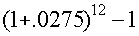 =
= 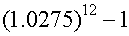
which equals 38.48% annually, a significant difference!
The following questions can be answered using a financial calculator.
where the necessary keystrokes on the calculator are as follows:
n = number of compounding periods
i = interest rate per compounding period
pmt = periodic payment
PV = present value
FV = future value
NPV = net present value
CFo, CFi,CF2,CF3 = cash flow function keys
IRR = internal rate of return
5) An investor is putting $2,000 per year into a mutual fund that averages a return of 9% per year. How many years will these payments have to be made before the fund will be worth $100,000 (rounded to the nearest whole number of years)?
i = 9%, pmt = ($2,000), FV = $100,000 Compute n.
n = 20 years (rounded up to the nearest whole number)
6) The common stock of XYZ is currently selling in the market for $36.67. XYZ has just paid its annual dividend $2.00, and the dividend is expected to grow at 10% per year indefinitely. What rate of return can an investor expect to earn on this investment in XYZ stock?
This question can be answered by algebraically manipulating the formula for the constant growth dividend discount model, and solving for k.
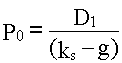

Therefore, an investor in the stock of XYZ can expect to earn a 16% rate of return.
7) An insurance salesperson offers an annuity contract that will pay $100,000 after 20 years if the annuitant pays $2,000 per year with the first payment due immediately. What rate of return is being offered?
Note: this question requires the use of an annuity due in the calculation! Be sure to switch calculator to Begin mode.
n = 20 years, pmt = ($2,000) per year, FV = $100,000, Compute i.
i = 8.10%
8) Find the Net Present Value (NPV) of the following cash flow schedule using a 10% discount rate:
|
Year |
Cash Flow |
|
0 |
$(3,000) |
|
1 |
(5,000) |
|
2 |
2,000 |
|
3 |
4,000 |
|
4 |
6,000 |
|
5 |
(1,000) |
This question uses the net present value function of the financial calculator.
CFo = ($3,000), CFi = ($5,000), CF2 = $2,000, CF3 = $4,000, CF4 = $6,000, CF5 = ($1,000),
i = 10%, Compute NPV.
NPV = $589.86
9) Calculate the internal rate of return (IRR) of a $10,000 investment that is expected to produce the following cash flows:
Year Cash Flow
2 $7,000
3 6,000
4 3,000
This question uses the internal rate of return (IRR) functions of the financial calculator.
CFo = ($10,000), CFi = 0, CF2 = $7,000, CF3 = $6,000, CF4 = $3,000, Compute IRR.
IRR = 19.00%
NOTE! Be sure that the first cash flow (CFi) is entered as a 0 value.
10) The earnings of the ABC Company are currently $2.00 per share. If the earnings per share grow over the next five years at an annual growth rate of 10%, how much will they be at the end of that time?
n = 5 years, i = 10%, PV = $2.00, Compute FV.
FV = $3.22
11) A stock is expected to pay an annual dividend of $0, $2, and $4 per share at the end of each of the next three years, respectively. At the end of the third year, the stock is expected to sell for $80 per share. If the stock is currently selling at $50 per share, what is the expected return on a three-year investment in this stock?
This question can be solved using the internal rate of return functions of the financial calculator.
CFo = ($50), CFi = $0, CF2 = $2, CF3 = $4+$80=$84, Compute IRR.
IRR = 20.00%
NOTE. The third cash flow includes the $4 dividend plus the $80 sale price of the stock. The first cash flow of zero dollars at the end of the first-year must be entered into the calculator.
Appendix
The Mathematics of Finance
Essential Symbols
FV = future value
PV = present value
k = nominal interest rate
n = number years
pmt = periodic payment
m = number of compounding periods in year
i =periodic interest rate; interest rate per compound period
infl =annual rate of inflation
k
real =real interest rateEAR = effective annual interest rate
NPV = net present value
IRR = internal rate of return
CF
0 = initial cash flowCF
t = cash flow in period tP
0 = current market priceD
0 = current cash dividends just paidD
t = dividend expected in year tI
t = interest earned in year tM = par or maturity value of a bond
MTR = marginal tax rate
s = sample standard deviation
Future Value of $1
Present Value of $1
Net Present Value (NPV)
Internal Rate of Return (IRR)
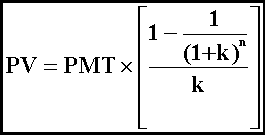
Present Value of an Annuity of $1
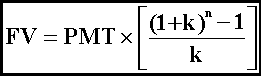
Future Value of an Annuity of $1
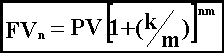
Future Value of $1 with more Frequent than annual Compounding
Present Value of an Annuity Due of $1
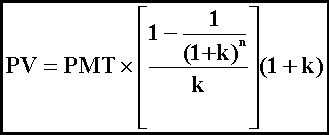
Future Value of an Annuity Due of $1
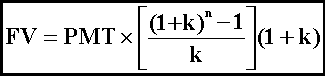
Effective Annual Compound Interest Rate
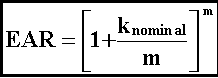
Annual Percentage Rate

Real Rate of Return
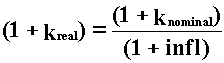
Capitalization rate or Cap rate
