Basic economic concepts
An understanding of the national and international economic environment is very important in preparing to make and implement financial decisions. The following basic economic concepts will help the investor to comprehend the economic environment before committing to a retirement or investment plan.
Gross domestic product and gross national product.
Gross domestic product (GDP) is a measure of the goods and services produced by labor and property that is located in Canada. For the purposes of the GDP calculation, it does not matter whether Canadian residents own the resources; it matters only that the labor and other resources are located in Canada. GDP is the most common measure or international standard of national economic performance that is used by governments and economists worldwide.
Gross national product (GNP) is a measure of the goods and services that are produced by labor and property that is supplied by Canadian residents. It does not matter whether or not the laborers or the property is actually located in Canada, so long as the resources are owned by Canadians.
Since there is more foreign investment (particularly U.S.) in Canada than there is Canadian investment abroad, Canadian GDP is much larger than Canadian GNP. By way of contrast, for the U.S., GDP and GNP are nearly identical.
The economy's ability to produce is measured by its potential GDP. The growth in potential GDP is a function of:
Supply and Demand
The demand for a product is defined as the quantity of the product which consumers are willing to purchase.
Factors that affect the demand relationship of a product include:
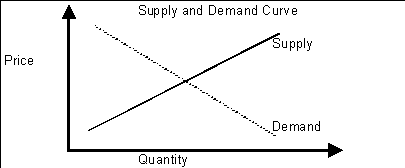
The demand curve for a product portrays the important relationship that exists between the quantity of a product that would be purchased and the prices that are charged for the product. Movement along the demand curve reflects a change in the quantity demanded. For example when prices decline, the quantity of the product demanded by consumers will increase. This is called the law of demand, and explains why demand curves normally slope downward and to the right. When the demand curve shifts, this is known as a change in demand. Change in demand is caused by some factor other than price.
The price elasticity of demand refers to the responsiveness of the quantity of goods that are demanded in relation to changes in the price of the product. Most products have elastic demand. Demand is said to be elastic when a given change in price produces a greater percent change in the quantity of the product that is demanded. The elasticity of demand is determined by the availability of substitute products and the percentage of the consumers total budget that is spent on the product. Necessities, in general, tend to be more inelastic than luxury goods. Gasoline represents a good example of a product with elastic demand. On the other hand, some products will be in demand no matter what the price; for example, insulin, which is used by diabetics. If the price of insulin were to double, in all probability the quantity of insulin demanded would remain constant. This situation is known as inelastic demand.
The supply of a product is defined as the quantity of the product which producers or manufacturers are willing to produce and sell.
A change in supply is different from the change in the quantity supplied. A change in the quantity supplied occurs when the price of the product itself changes, and this change is depicted as a movement along the existing supply curve. A change in supply occurs because of factors other than price. A change in supply is reflected by a movement or shift, of the entire supply curve, up or down.
The factors that affect supply changes, and which can shift the supply curve include:
Profit is the major determinant of a supply curve. Therefore, a major factor that affects the supply curve is production cost. The law of supply says that, in the short run, producers will manufacture more of the product at higher prices. Supply curves normally slope upward and to the right. This relationship exists because companies will only produce more of a given product if the price at which they can sell the product covers the cost of production and yields a profit.
Interest rates and yield curves
Arguably, interest rates are the singular most important factor, which affect securities markets and investments. Interest rates can be thought of as the cost or price of money and therefore, interest rates have a powerful effect on the Canadian economy as follows:
The level of interest rates in a closed economy that does not engage in trade with foreigners, is determined primarily by the supply and demand for credit (loanable funds). The supply of loanable funds is determined by savers who invest their money, which is then, in turn, loaned to consumers. The willingness to save is based upon the individual's willingness to trade current consumption for future consumption. The price demanded for this tradeoff is the interest rate.
The demand for loanable funds is a function of the desire for current consumption, and the lower the cost or interest rate, the greater the demand for loanable funds.
Creditors will consider a debtor's credit risk in establishing the interest rate to be charged. Specifically, the higher the risk of default the higher the interest rate charged. Additionally, if a creditor believes that inflation will rise over the term of the loan, the nominal interest rate charged for the loan will be increased so that the debt will be repaid in real dollars.
In a free market open economy which engages in international trading, the level of interest rates, in addition to the domestic supply and demand factors just discussed, is also impacted by:
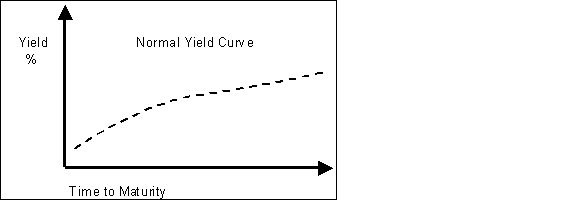
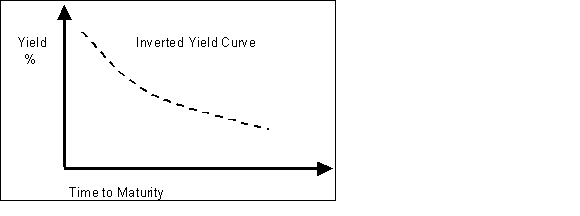
The yield curve is a graphic representation of the relationship that exists between short and long-term interest rates at different points in time over the business cycle. Changes in the level of interest rates can dramatically affect both the price and the demand for debt securities. The bellwether or benchmark that is used to establish the level of interest rates in the Canadian economy is the federal government's treasury bills (T-bills) and bond issues. Under everyday and commonplace conditions, usually long-term interest rates are higher than short-term interest rates. When interest rates are plotted on a graph against the term to maturity, the resulting depiction of the term structure for interest rates is known as a normal yield curve. When short-term rates are higher than long-term rates, the yield curve is said to be inverted. The yield curve will often be inverted at the peak of an economic cycle because the Bank of Canada will attempt to slowdown the pace of economic activity by manipulating short-term interest rates upwards, through its intervention in the money-market and other open market operations.
The term structure of interest rates is described by different theories, which attempt to elucidate the shape of the yield curve.
Inflation
The Bank of Canada defines inflation as the persistent rise in the cost of living over time.
The most common measure of inflation is the consumer price index (CPI). The CPI measures the cost each month to buy a basket of consumer goods. This basket of goods supposedly represents the same goods that typically would be purchased by an average family. The calculation of the CPI assumes that the same type and quantity of goods are purchased each month or each year, and the price of this basket of goods is compared and measured relative to a predefined base period. Another important indicator of inflation, are the settlements of collective agreements for unionized employees wage demands.
The economic consequences of inflation include:
Unemployment
One on the goals of economic policy is to produce and maintain full employment. Full employment does not mean zero unemployment. There will always be a certain number of unemployed persons in the Canadian economy for various reasons.
The business cycle
An understanding of the business cycle helps an investor to focus on the "big picture", and is essential in order to set both short and long-term investment strategies and policies.
Business activity can be classified as having seasonal variations, cyclical fluctuations, and long-term secular trends. In addition, the economy and business activity can be affected by random and unexpected occurrences such as a war or "Asian flu". Over the long run, the Canadian economy has continued to expand and grow. However, this long-term growth has been volatile at times and the economy has experienced periodic fluctuations, which are known as the business cycle. There are no firm rules for identifying recessions or for dating business cycles; however, Statistics Canada defines a recession as two consecutive quarters of declining GDP growth. Although each business cycle is itself unique, most business cycles follow a more or less predictable pattern.
Although no business cycle will exactly match the previous cycle, some similarities and general conclusions can be drawn with respect to business and economic cycles and investment strategies in general. These strategies and phases can be tracked by watching certain economic indicators.
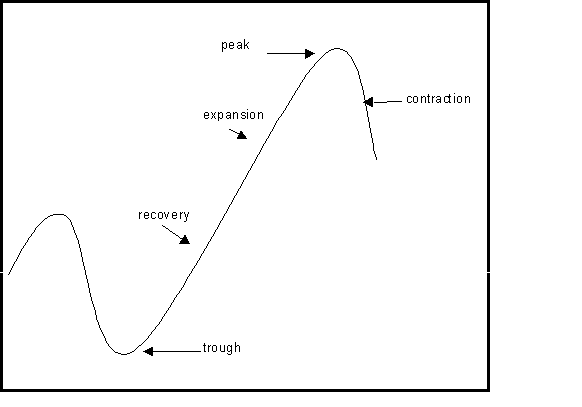
The business cycle consists of four segments, which can be identified by the following signs or signals:
1) Recovery and expansion.
Inflation is stable, or rising only slightly. Typically, these stages last longer than the contraction phase.
Businesses are investing in new capacity to meet increased consumer demand. Corporate profits are rising because profit margins are increasing. Business is confident about the future and is planning production increases. New business start-ups outnumber bankruptcies. Inventories are under control. Retail sales are healthy.
Unemployment is steady or falling. Job creation is strong. Personal incomes are rising. Consumer confidence is high. Demand for credit is high. Consumer spending and housing construction fuels increasing economic activity.
Confidence is high and expectations become excessively optimistic. Investors are told that this time the world is different and that the trees will in fact "grow to the sky"
Typically, in the late stages of the expansion phase the central bank will start to tighten credit in an attempt to cool the economy off by raising short-term interest rates.
Stock and bond markets are booming.
Investment strategy at this point in the business cycle is to stop buying common stocks because the expansion, at some point, must end.
2) Peak.
Optimism and overconfidence override prudence and caution. Stock market and other economic indices are higher than the long-term trends.
Inflation is rising quickly caused by wage increases, labor shortages and product shortages. The pace of economic activity is high and efficiency starts to wane.
Business revenues are down, profits are falling. Production costs are rising faster than prices, which causes profit margins to shrink. Business is no longer making large capital investment. Business output typically exceeds sales. Inventories start to build up due to falling sales. Accounts receivable start to rise, which causes a shortage of working capital and this forces businesses to seek bank financing. Business confidence erodes.
Consumer confidence declines, housing sales fall, and big-ticket consumer spending drops as consumers worry about the future.
Central bank intervention to control inflation, by raising short-term interest rates often causes inverted yield curves at this point in the cycle. Monetary policy bias is towards tightening credit, aimed at causing the economy to slow.
Rising interest rates cause bond prices to fall. Stock prices have weakened and stock market activity drops off. New stock and bond issues are poorly accepted by investors and become rare.
The investment strategy at this point in the cycle is to sell stocks of companies in cyclical industries, stocks with high P/E ratios, and low yielding stocks. Profits earned in the rising stock market should be invested in short term paper such as T-bills or money-market funds, which benefit from rising interest rates.
3) Recession or contraction.
When a recession is apparent and economically the outlook is gloomy. This phase is shorter in duration than the expansion phase normally is.
Corporate profits are falling. Business failures increase. Industrial production falls. Business confidence deteriorates.
Unemployment rises. Consumer confidence falls. Consumers stop spending and become more cautious. New home construction falls. Personal bankruptcies rise. The nightly News and newspapers are pessimistic about the future.
Stock market activities weaken and decline.
The central bank is using lower interest rates and is encouraging credit granting in order to attempt to stimulate economic activity.
The investment strategy at this point in the cycle is to sell short-term bonds and to buy mid and long-term bonds which will benefit from falling interest rates.
4) Trough.
The end of the recession is apparent and gradually conditions that are more favorable start to surface. Stock and bond indices are below the long-term trends. The rate of the deterioration of the economy starts to slow. The leading economic indicators are improving and signs of stability start to return.
Production output is low. Business sales are depressed. Business outlook is pessimistic. There is minimal new capital investment. Inventories have declined.
Unemployment is high. Personal income is down which causes reduced consumption. Consumer confidence is low. Doom and gloom are rampant. "The sky is falling".
However, the inflation rate is falling along with interest rates. Labor is plentiful. Pent-up demand starts to build in the economy. Typically, raw material prices have fallen. Slowly, business and consumer confidence starts to rise.
At this point in the cycle, the central bank is attempting to stimulate economic growth by easing credit. Short-term interest rates are reduced in an attempt to restart the economy.
The investment strategy at this point in the cycle is to sell long-term bonds. Profits from long-term bonds should be repositioned by purchasing common stocks of cyclical industries that have fallen out of favor.
The Phases of the Business Cycle
The Bank of Canada
The Bank of Canada (the Bank) is Canada's central bank. It is known as the banker's bank since the Bank of Canada does not receive retail deposits from consumers, but does hold the deposits of financial institutions and governments. The Bank of Canada was created by an act of Parliament in 1934 and commenced operations in 1935. Since 1938, the Minister of Finance has held all of the share capital of the Bank of Canada.
According to the Bank of Canada Act, the Bank has four primary functions:
The most visible and important of the Bank of Canada's functions is that of implementing monetary policy. The Bank's principal task when implementing monetary policy is to determine the optimum rate of growth of the money supply. This task is complicated and the Bank must distinguish between monetary needs which arise from seasonal trends in the economy, changes in the business cycle, and needs which arise due to unexpected, and usually externally induced shocks to the Canadian economy for example "the Asian flu". The Bank of Canada has a variety of means at its disposal with which to implement monetary policy.
These methods include:
The best known of the Bank's monetary policy tools is the setting of the Bank of Canada rate. The Bank of Canada Rate or Bank rate is the short-term lending rate charged by the Bank of Canada for advances made to financial institutions. The Bank rate is conveyed by the Bank's participation in the money markets. The money market is where short-term borrowers and lenders come together. Some examples of investments traded in the money market are Treasury Bills (T-bills), commercial paper and bankers acceptances.
Foreign exchange rates.
Global economic conditions affect Canadian companies selling products into foreign markets, as witnessed by the "Asian flu" and its damage to the BC economy in the late 1990s. Additionally, the globalization of business may introduce new competitors and trading partners.
The Canadian economy is unquestionably highly dependent upon foreign trade. This dependence on trading means that the value of the Canadian dollar is vitally important to the livelihood and living standards of millions of Canadians. The foreign exchange marketplace is global in scope and foreign exchange rates are based on the supply and demand for a particular currency. In the international foreign exchange markets, currencies are traded around the clock and the accepted convention is that all foreign exchange rates are established or measured relative to the U.S. dollar, which is considered to be the international standard.
In the international arena, a country may employ either a fixed or a floating exchange rate system. Under a fixed exchange rate system the currency is pegged against other currencies, usually by imposing currency controls which preclude the citizens from holding foreign currencies; or the central bank will take measures to ensure that the currency stays within a fixed range by purchasing or selling currency in the foreign exchange market. Currently, an example of the fixed exchange rate system is the Hong Kong dollar.
A floating exchange rate means that the central bank will only intervene in the foreign exchange marketplace when it considers the movement of the currency to be excessive. Central banks can either buy or sell in the foreign exchange market, or they can manipulate short-term interest rates. The Canadian dollar has been freely floating since the 1950s. When the Canadian dollar is under downward pressure, the Bank of Canada will intervene in the foreign exchange market by purchasing Canadian dollars in an attempt to increase the demand for the Canadian dollar and thereby attempting to support the value and strengthening of the dollar.
When the Canadian dollar is weak relative to the U.S. dollar, products produced in Canada are relatively inexpensive to an American consumer. In other words, a weak Canadian dollar benefits Canadian exporters. At the same time, a weak Canadian dollar means that products produced in the U.S. are expensive when purchased by Canadians, which translates to mean that a weak Canadian dollar puts Canadian importers at a comparative disadvantage relative to their U.S. counterparts.
It is virtually impossible in Canada to read a business newspaper or listen to a newscast when there is not some mention that is made to the external value of the Canadian dollar.
Factors influencing the foreign exchange rate.
When examined in isolation the effect of each of the above factors on the exchange rate seems obvious and straightforward. However, in the real world, these factors when considered together often obscure the resulting impact upon a currency.
Financial institutions
The world of investment has emerged as an important cornerstone in planning and organizing one's financial resources. Regulations and securities law are available in Canada to protect investors and to provide them with a level of confidence in their dealings with the domestic markets. A number of federal and provincial laws regulate the activities and actions of participants in the securities markets.
The Office of the Superintendent of Financial Institutions (OSFI) was established by legislation that merged the Department of Insurance and the Office of the Inspector General of Banks. This legislation established a single agency responsible for the regulation and supervision of Federally Regulated Financial Institutions (FRFIs). OSFI is also responsible for monitoring federally regulated pension plans. Other financial institutions and pension plans are provincially incorporated and are therefore not regulated by OSFI.
FRFIs include all banks, all federally incorporated or registered insurance, trust and loan companies, cooperative credit associations, and fraternal benefit societies. Although legislation, regulation, guidelines and policy statements affect how FRFIs conduct their business, day-to-day operations are not subject to government oversight. FRFI legislation and regulations are available at the Department of Justice's WebSite.
OSFI does not regulate the Canadian securities industry.
In Canada, the regulation of the securities business is a provincial responsibility.
Regulation of the primary and secondary securities markets has important consequences for investors.
The primary market is the market for new issues of securities, typically involving underwriters and corporate issuers.
The secondary market is the market where previously issued securities are traded, including both the organized exchanges and the over-the-counter (OTC) network. The OTC market is a computer and telephone network of securities dealers for the trading of securities not listed on other exchanges. Without the existence of an extensive investment dealer community and efficient and orderly security markets, the costs and risks involved in the issuing of securities would rise.