Managing & Maintaining a PC
Lab 01
September 1st, 2005
Maxime and Jason
Purpose: To learn how to use a multimeter, read its documentation and keeping track of results.
To test the resistance, voltage and current of different objects.
Materials:
Multimeter ( analog & digital)
Tool kit
Resistors
PS2 Cable
Speaker
Power Cord
Fuses
Diodes
Batteries
Power Packs
Light Bulb
Computer
Procedures:
Read Documentation of the multimeter
Calibrate analog multimeter
Test the resistance of the given objects (Part 1)
Test the current and voltage of the computer and the wall outlet (Part 2)
Test the voltage of the given objects (Part 3)
Test any other object (s) of personal interest
Keep a record of the results
Data:
Part 1
| Tested Object | Resistance with analog (Ohms) | Resistance with Digital (Ohms) |
| Hand to hand | 1 000 000 | 1 600 000 000 |
| Tongue | 60 000 | 1 540 000 000 |
| Resistor 1 | 5 000 | 10 000 000 |
| Resistor 2 | 4 500 | 8 000 000 |
| PS2 Cable | 0 | 0 |
| Speaker | 0 | 0 |
| Power Cord | 0 | 0 |
| Light Bulb | 0 | 0 |
| Binder Rings | Untested | 24 000 000 |
Part 2
| Tested Object | Current (amps) |
| Monitor (1st) | 3.8 to 1 |
| Monitor (2nd) | 1.7 to 1 |
| System Boot (1st) | 2.2 to 0.2 |
| System Boot (2nd) | 1.9 to 0.2 |
Part 3
| Tested Object | Voltage with Analog(50v) | Voltage with Digital(20v) |
| Battery Eveready | 0.6 | 254 |
| Battery Sunpower | 0.4 | 258 |
| Battery Duracell | 0.4 | 155 |
| Power Pack (12v ac) | 0.5 | 23 (200v) |
| Power Pack (13.8v ac) | 0.65 | 26 (200v) |
| Power Pack (12v DC) | Untested | 283 (500v) |
Observations: We observed that the digital multimeter is probably very inaccurate or we just didn't know how to use it even though Jason read the documentation. The results we got with the digital multimeter were way off the results we got with the analog multimeter, which were probably right. If we take the battery with the analog multimeter we got 0.6 volts which is right because the battery is almost dead or dead, but with the digital multimeter we got results over 200 hundred, which seams incomprehensible to us.
Now, if we take a look at the color code of the resistors:
| BLK | BRN | RED | ORG | YEL | GRN | BLU | VIO | GRA | WHI |
| 0 | 1 | 2 | 3 | 4 | 5 | 6 | 7 | 8 | 9 |
So, the two resistors we tested had the same color code, which was: Yellow/Violet/Red/Gold
This means that the resistor has a resistance of 47 * 10^2 = 4700 more or less 5%. This means that the results we got with the analog multimeter were almost in the tolerance level. On the other hand, with the digital multimeter, we got results that, again, are way off. The range of the tolerance level is 4465 to 4935 so one of the resistor was within tolerance, but the other was just a bit out of tolerance according to our results.
The Speaker, the power cord, the light bulb and the PS2 cable were apparently working since we got a resistance of 0.
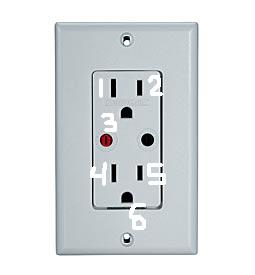
Here are the combinations we tried for the wall outlet:
| Combinations | Results |
| #2 and #5 | 0 |
| #1 and #2 | 110 |
| #1 and #3 | 110 |
| #2 and #3 | 0 |
The result we got are right since the voltage that goes out
of a wall outlet is 110. Another observation that was made is that if we were to plug something on #2 and #5 no electricity would come out.
When booting a computer, we have seen that a jump in the amount of current occurs. After a fraction of a second, the current starts to stabilize, but continues to fluctuate a bit. This surge in energy shows us that when a system boots up, it requires a lot of energy. When doing a 2nd attempt on both the monitor and system boot, we noticed that it didn't require as much current as the first attempt because some components are still energized in the computer and monitor.
Conclusion:
In conclusion, most of the results we got with the analog multimeter were or seem right and the results with the digital multimeter were way off. Using a multimeter can be very helpful in finding out if some objects don't work or if there are blown out transistors, fuses, etc. Reading the documentation before starting is a good idea because it is always best to learn about an object before using it. Taking down the results was another important part of this lab because keeping a record of everything that was done is essential to our understanding of what we have done and to others who want to view what we have done.