Whats new
About me
My opinion
Quotes
The French!
Pictures
My Weapons
Links
Guestbook
History of North Korean Infiltrations
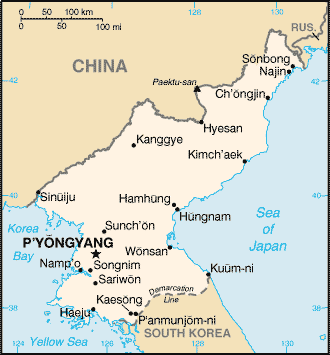
Targeting South Korea Since the division of the peninsula, North Korea has used subversion and sabotage against South Korea as part of its effort at reunification. Historically, the military part of this effort has centered on military infiltration, border incidents designed to raise tensions, and psychological warfare operations aimed at the South Korean armed forces. Infiltration by North Korean military agents was commonplace in South Korea after the armistice in 1953. Over time, however, there were clear shifts in emphasis, method, and apparent goals. P'yongyang initially sent agents to gather intelligence and to build a revolutionary base in South Korea.
The 1960s saw a dramatic shift to violent attempts to destabilize South Korea, including commando raids and incidents along the DMZ that occasionally escalated into firefights involving artillery. The raids peaked in 1968, when more than 600 infiltrations were reported, including an unsuccessful commando attack on the South Korean presidential mansion by thirty-one members of North Korea's 124th Army Unit. The unit came within 500 meters of the president's residence before being stopped. During this incident, twenty-eight infiltrators and thirty-seven South Koreans were killed. That same year, 120 commandos infiltrated two east coast provinces in an unsuccessful attempt to organize a Vietnamese-type guerrilla war.
Seizure of the USS Pueblo:
On 23 January 1968 North Korean patrol boats seized the USS Pueblo, a US Navy intelligence-gathering vessel, in the international waters of the East Sea off Wonsan. One USS Pueblo crewmember was killed  and 82 were taken POW and held captive.North Korea made the utmost use of the Pueblo incident in its crafty propaganda, believing that the United States, deeply involved in the Vietnam War then, would not be able to use the force of arms on the Korean Peninsula.Eleven months after the seizure North Korea repatriated 82 Pueblo crewmen and one set of remains to the United States through P'anmunjom. Upon signature of the US admitting to espionage in the coastal waters of the Sea of Japan, the 82 POWs were freed. Upon their return on 28 December, 1968, the crew was treated poorly by the public and the military and only in 1990 did they receive the POW ribbons to which they were entitled. The ship remains in Wonson Harbor, North Korea.
The same day, 31 North Koreans dressed in South Korean uniforms crossed the Demilitarized Zone (DMZ) and got to within one block of the South Korean presidential palace, the Blue House. However, the raid was detected and the men were executed
In 1969 over 150 infiltrations were attempted, involving almost 400 agents. Thereafter, P'yongyang's infiltration efforts abated somewhat, and the emphasis reverted to intelligence gathering, covert networks, and terrorism. Subsequent incidents of North Korean terrorism focused on the assassination of the South Korean president or other high officials.
In November 1970, an infiltrator was killed while planting a bomb intended to kill South Korean president Park Chung Hee at the Seoul National Cemetery.
In 1974 a Korean resident of Japan visiting Seoul killed Park's wife in another unsuccessful presidential assassination attempt
From the mid-1970s to the early 1980s, most North Korean infiltration was conducted by heavily armed reconnaissance teams. These were increasingly intercepted and neutralized by South Korean security forces.
After shifting to sea infiltration for a brief period in the 1980s, P'yongyang apparently discarded military reconnaissance in favor of inserting agents into third countries.
October 9, 1983, a three-man team from North Korea's intelligence services attempted to assassinate South Korean president Chun Doo Hwan while he was on a state visit to Rangoon, Burma. The remotecontrolled bomb exploded prematurely. Chun was unharmed, but eighteen South Korean officials, including four cabinet ministers, were killed and fourteen other persons were injured. One of the North Korean agents was killed, two were captured, and one confessed to the incident.
On November 29, 1987, a bomb exploded aboard a Korean Air jetliner returning from the Middle East, killing 135 passengers on board. The bomb was placed by two North Korean agents. The male agent committed suicide after being apprehended. The female agent was turned over to South Korean authorities; she confessed to being a North Korean intelligence agent and revealed that the mission was directed by Kim Jong Il as part of a campaign to discredit South Korea before the 1988 Seoul Olympics.
In 1976 two soldiers were brutally killed with axes when they attempted to remove a tree that was obstructing the vision of UN soldiers on the DMZ. This was cought on tape by the US Army.
1984, one South Korean and three North Korean soldiers were killed in a firefight when a Soviet translator attempted to defect by crossing the DMZ into South Korea.
A US intelligence agent (retired) who worked in South Korea said: " Far more astonishing are the events about which the public was never told. These incidents are particularly revealing as to how much effort the US has put into avoiding going to full scale war since 1953. For example, it's estimated that North Korea has dug approximately 20 tunnels under the DMZ into South Korea. These are invasion routes, two for every North Korean combat infantry division along the border. In the late winter of 1990, the same year that Iraq invaded Kuwait, one of these tunnels was discovered by the US Army. This was the fourth such tunnel that had been found since the beginning of the 1953 ceasefire. The official story offered by the US military at the time was that only a few bomb sniffing dogs were killed by mines. However, a soldier I knew who served in the unit which went down into the tunnel told me a far different story. According to this man, US and South Korean forces were confronted by an entire North Korean company under the DMZ on the South Korean side. What ensued was a firefight which resulted in the deaths of more than 50 North Koreans as well as a half dozen or so American soldiers. That same year, approximately two months after this skirmish, it was announced that North Korea was finally releasing the remains of several soldiers who had been killed during the Korean War. According to my source, the North Koreans did this in exchange for the bodies of all the men who were killed in the invasion tunnel months earlier
Another incident was recently revealed to me at an anti-war presentation I was giving where I met a man who served in the US Army in the early 1960s and was stationed in South Korea on the DMZ. According to this man, one of his buddies was killed by sniper fire while he was driving his Jeep. The man's parents were told that he died when his vehicle overturned on a slippery road. The casket, as is likely common in deaths such as this, was sent home sealed according to my source.
These public and hidden events fit into a long history of hostility between North Korea and the United States. Despite what the White House has stated, under both Republican and Democratic presidents, North Korea has always been militarily a far greater threat than Iraq. They have had more soldiers under arms, have been committed to using those soldiers in combat against South Korean and US soldiers for the past 50 years, and have been controlled by an extreme and brutal isolationist, Stalinist-style Communist regime that is responsible for hundreds of thousands of civilian deaths. If we added up the numbers, the North Korean government is responsible for far more deaths than Saddam Hussein. "