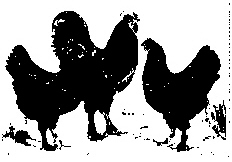
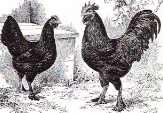
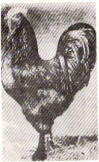
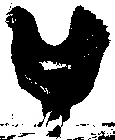
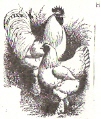
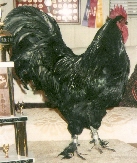
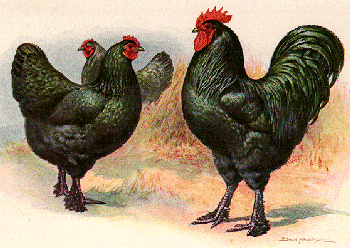
LANGSHAN STANDARD FROM THE AMERICAN STANDARD OF PERFECTION 1998 INCLUDES LARGE FOWL AND BANTAM, COLORS IN BLACK, BLUE AND WHITE.
HISTORY
The Black Langshan originated in China, where it has been bred over a very long period of years. Its prepotent reproductive qualities indicate it to be a pure race of domesticated poultry. Black Langshans were imported from China into England by the late Major Croad, so there is a class of "Croad Langshans" in the English Standard. They became a Standard variety in this country in 1883. White Langshans were admitted to the Standard in 1893 and Blue Langshans were admitted to the Standard in 1986.
Langshans are the dual purpose fowls of the Asiatic Class, being smaller than the Brahma and Cochin and more active. The male develops a large, well-spread tail with feathers of great length the sickles often attaining a length of sixteen or seventeen inches.
The closely-fitting saddle feathers, fully-hackled neck and upright carriage give the effect of a short back. The surface plumage throughout is cloase and smooth. The body in both
sexes should be eenly balanced on firm, straight legs, with very little backward bend at the hocks. The height of the Langshan should be gained by depth of body and erectness of carriage, and not from what may be described as stiltiness of legs. Close-standing hocks and narrowness of body are highly objectionable.
ECONOMIC QUALITIES
General purpose fowl for production of meat and eggs. Color of skin: white. Color of egg shells: very dark brown.
DISQUALIFICATIONS(these apply to 3 colors of Langshans)
Shanks not feathered down the outer sides, feathers not growing on the outer toes beyond the middle joint; vulture-like hocks; yellow skin; bottoms of feet, yellow in any part. (See General Disqualifications and Cutting for Defects).
STANDARD WEIGHTS
Cock...............9 1/2 pounds Hen.............7 1/2 pounds
Cockerel.........8 pounds Pullet..........6 1/2 pounds
SHAPE --- MALE
COMB: Single; of medium size, straight, upright, having five points, evenly serrated, notconforming closely to neck, fine in texture.
BEAK: Stout at base, well curved.
FACE: Smooth, fine in texture.
EYES: Moderately large, round.
WATTLES: Moderately large, round.
EAR-LOBES: Oblong, well-developed.
HEAD: Medium in size, rather broad.
NECK: Good length, well-arched.
HACKLE: Abundant, flowing well over shoulders.
BACK: Short, broad, flat at shoulders, rising from middle of back in a decidedly sharp concave sweep to tail.
SADDLE FEATHERS: Abundant, flowing over sides.
TAIL: Long, large, full, well-spread at base, carried at an angle of seventy-five degrees (75deg)above horizontal.
MAIN TAIL FEATHERS: Broad and overlapping.
SICKLES: Long, extending decidely beyond the tail.
COVERTS: Long, longer the better.
WINGS: Medium size, well-folded, carried closely to body without drooping. Primariesand Secondaries - broad and overlapping in natural order when wing is folded.
BREAST: Broad, round, deep.
BODY AND FLUFF: Body - rather broad and deep in front of thighs. Fluff - moderately full; not so abundant as to hide profile of hocks.
LEGS AND TOES: Legs set well apart and straight when viewed from front. Lower thighs - moderately long, strong, well feathered. Shanks - moderately long, stout in bone,straight; feathered down outer sides. Toes - Four on each foot; long, straight, slender; outer toes feathered to the end; middle toes, free from feathers.
SHAPE --- FEMALE
COMB: Single; smaller than that of male, straight, upright, having five points, evenly serrated, fine in texture.
BEAK: Stout at base, well curved.
FACE: Smooth, fine in texture.
EYES: Moderately large, round.
WATTLES: Fairly developed, well-rounded; fine in texture.
EAR-LOBES: Oblong, well-developed.
HEAD: Medium in size, rather broad.
NECK: Good length, well-arched.
BACK: Medium in lenght, broad, flat at shoulders, rising from middle of back in a sharp concave sweep ending well up on tail.
TAIL: Rather long, well spread at base, carried at an angle of seventy degrees (70deg) above horizontal; carried well above and beyond the cushion and furnished with long coverts.
MAIN TAIL FEATHERS: Broad and overlapping.
WINGS: Good size, well-folded, carried closely to body without drooping. Primariesand Secondaries - broad and overlapping in natural order when wing is folded.
BREAST: Broad, round, deep.
BODY AND FLUFF: Body - broad, deep well balanced. Fluff - moderately full; not so abundant as to hide profile of hocks.
LEGS AND TOES: Legs set well apart and straight when viewed from front. Lower thighs - moderately long, well covered with soft feathers. Shanks - moderately long, stout in bone,straight; feathered down outer sides. Toes - Four on each foot; long, straight, slender; outer toes feathered to the end; middle toes, free from feathers.

Forrest Beauford, Secty-Treas
18077 S Hwy 88
Claremore, OK 74017
Phone 1-918-341-2238
Dues: 10.00 - Family 15.00 Lifetime 100.00
National Meet: 17,18,19 Nov. Crossroads
Poultry Show, Indianapolis, IN. Expect close
to 10,000 birds there. Join and show !!
Vice-President: Richard Hickman
Secy-Tres: Forrest Beauford