The Byzantine period explains the incredible's amount of churches. The architecture of the Byzantine empire which was Byzantine architecture. Have been emerged gradually after AD 330, when Constantine moved the capital of the Roman empire to Byzantium, was call Constantinople and now is Istanbul. It developed into a remarkable synthesis between Roman and Middle eastern architecture, they take the knowledge of the brickwork and concrete construction, from the east the use of dome. Byzantine solution to the problem of limited dome roofing over rectangular and square spaces gave new solution to the architects, giving more freedom to varied and complex plan forms.
The Byzantine churches have a unique architecture (Examples like the church of Aghia Sofia in Istanbul). under Byzantine period, architect build many churches on Greek and Roman temple feature. The most distinctive characteristic of the churches were the dome roof and there are cross planned with the combination of a basilica and a symmetrical central plan. And the golden age of Byzantine architecture was under the rule of Justin in 527-565 many examples of all Byzantine architecture was built between this period for examples Hagia Sophia.
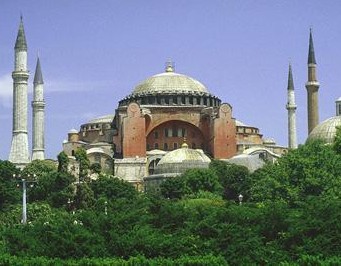 |
The Church of the Hagia Sophia was built under the Emperor Justinian c.532-33 in Byzantium (Istanbul), The height of the dome is 183 feet. The tall thin towers, "minarets," were added in the 15th century when the structure was converted to a Mosque under the conquering Muslims. Today, the "Hagia Sophia" is a museum. |
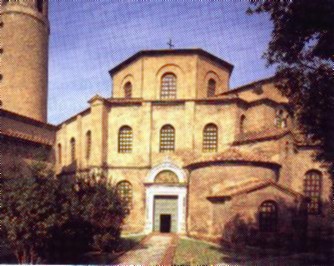 |
The Church of San Vitale in Ravenna, Italy, c.526-547, has an octagonal plan and a domed central core. |
The style of Hagia Sophia or church of Divine Wisdom, was to have a large dome in the middle of the structure, 4 huge stone piers stand at corner of the corner of the a square, 30 m across and linked by semi circular arches. Dome and semi dome form a vast oval shaped nave 70 m long , beyond lies the lower structure of the entrance narthex, aisles and apse, the semi dome and their support buttress the main dome, to east and west, 4 massive over the aisles give support to the north and south sides. bi side that the dome remained the main focus of byzantine church for the remainder of the empire. the eastern orthodox preferred a low light, somber and almost mysterious mood in their services. The clergy worked often behind the scenes with brief appearances. They did not embrace the loud organs and congregational coors hip which is seen in the western catholic church. So the Hagia Sophia became the model for the Byzantine church because it was an architectural style that fit with the type of work ship the orthodox church wanted to emphasize.
Although many of the important buildings of Constantinople have been destroyed, impressive examples are still extant throughout the provinces and on the outer fringes of the empire, notably in Bulgaria, Russia, Armenia, and Sicily.
A great Byzantine architectural achievement is the octagonal church of San Vitale (consecrated 547) in Ravenna. The church of St. Mark's in Venice was based on a Byzantine prototype, and Byzantine workmen were employed by Arab rulers in the Holy Land and in Ottonian Germany during the 11th cent.
There are also churches which were built by timber. The wooden Anglo Saxon Churches, built on 4 great post with a Byzantine Plan with a central tower, however the remains of these churches were long gone.