Ye Be Gods: A Synergistic* Analysis of
Oedipus Tyrannus
As translated by Luci Berkowitz and
Theodore F. Brunner
Prologue:
I will argue in this paper that Oedipus Rex reveals the archetype (psychosexualecological/ human face [excuse the verbal burp but there really should be a word for that if there isn't already]- perhaps Hermes, perhaps Apollo, Zeus, Dionysus, or even Artemis) of all communication and information, of mythology. Given the significance of this tragic play by the Greek poet, Sophocles, to civilization and more specifically to intellectual/entertainment culture, one wonders what life would be like without it.
The question I will begin with, then, is, "is there a cultural artifact (or Oracle, really) besides Oedipus Rex, besides, even drama and literature, that can approach the same thematical characteristics of the human condition? [identity, sexuality, vision, religion, politics, reality, ancestry, communication, entertainment, empathy] Is there a mythological body from which to contextualize the broader significance of this masterwork?
To answer this question (or attempt to), I must confront the nature of the Mask, for it appears in this play that the more one analyzes its themes and structure, that the various Characters become subordinate in identity, to Sophocles' vision of humanity and the nature of both role and nature. Although this paper is not intended as a work of mythological conceit in itself, I find I must enter the myth, so to speak, in order to discover what meaning this play has for me and the relevance of this meaning to what other's have found.
What if the Sun is alive? Does Oedipus Rex even matter at all to our culture? I must begin to answer the original question posed with further questions. Our culture has become quietly accustomed over the years to treating the Earth as a living entity compared to a diffuse or unconscious or fantastical Miltonesque Life. In fact the ecological endeavors of mankind in the 21st century very much depend upon the reality of Earth Mother or Goddess - she dies, we die, that sort of thing. Although, we moderns eschew assigning her a broad cultural persona or anthropomorphic mythology. However, most today would agree that She(the earth) is very much alive. This is not ecological rhetoric on my part. I am simply trying to acquaint myself with my own subconscious mythology. When it comes to earth- polity matters, I am much more interested about how one or all's regard (and I think we all in the end have pretty much equal regard) for the earth affects the cultural value assigned to the human body and art as a whole. Although the Renaissance has already come and gone, one can never have too much Humanism.
To get myself even deeper into a quasi-intellectual quagmire from which I may never escape, what if one identifies 3 main tiers of metaphor from which we derive both cultural mythology and cultural empathy(how are emotions relate cultural ideals and vision, the future): For the sake of this paper, I'll call them the Sun, the Sky, and the Earth(or Water) - if the earth or the human is anything, it is a body of Water, a mythological truth of the ancient Maya of Mexico, or simply, Truth felt, seen and acted. If life has a plot, I will quote Aristotle, "The most important of the [main elements of plot] is the incidents of the story. Tragedy is essentially an imitation not of persons but of action and life"(The Basic Works of Aristotle. Richard McKeon. Random House: New York, 1461.)
* * **Synergistic refers to a form of structural analysis which treats literature as a complete
system of information and communication similar, in process, to all systems of information and
communication or culture(the sharing & preserving of knowledge) as outlined by Todd Siler in
Breaking the Mind Barrier: the New ArtScience of Neurocosmology. To wit, the science/art (or
mythology) of structure or, let's face it, Tele-Vision - the modern and silent art of self-reflective
consciousness, the art of soul, of culture, of life and myth itself - the common. In the end, this
paper is about "making toast in the morning" or "doing the laundry".
Part I of II
The Greek tragic drama Oedipus Tyrannus is written by the poet Sophocles. This play contains many if not all of the elements of a great drama as outlined by Aristotle in his classic dissertation on poetry and tragedy, the Poetics: It incorporates reversal and recognition of truth; it is plot rather than character driven; and it contains noble caricatures of humanity. For me, it arouses a great sense of fear and pity. However, I do not find this cathartic - the word I would use is "inspiring".
Perhaps because I do not view Greek mythology as very far or different from our own. Our mythology or, the logic by which we, as a collective culture, possess understanding and knowledge, is very much grounded in reason and science. Since it is by the development of reason that culture has been able to explore character, to move away from the religious or pious nature of drama toward our secular humanist entertainment forms, it is our entertainment technology, in fact, that contains the anterior or supernatural forces beyond modern communication, God or the gods.
The thesis which I am circling in on is that we no longer identify with Oedipus the way the
Greeks of antiquity would have identified with Oedipus. Sophocles, in transforming the cultural
personage of Oedipus (demigod) into this play, has at once, removed the gods from the central
axis of the plot and yet reincarnated them in its structure or "technology". As a result, there is an
incarnation of character foreshadowed by this drama, in that each of the ostensibly individual
characters are Oedipus in archetype (the role each serves in the process of transference and
performance of community responsibility, identity and guilt for which the epic age of heroes
(Homer's Iliad, Odyssey) is the cultural and literary ancestor - The latter could be summed up by
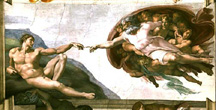
"the touch or breath of God into man", the former Oedipal
Michelangelo's
Creation of Adam
mythology/technology by "the death of the gods or God", the birth of Emerson's will to power or individual vitality and self-expression); something more clearly evident outside the setting of dramatic (and religious) ritual. The player is initiated into the mask of Oedipus as each of the character's identities or shame is drawn into question, setting the stage, so to speak, for the transformation of Mask into god, creating or simply being an artifact of the evolution of individual exploration upon the stage, going form allegory to empathy - setting the stage, even, whereby characters in all media may take on greater levels of personal intention (or self-determination), and otherwise anterior forces of plot and character may take the form of actual cultural forces and entities rather than fantastical "gods" - the plots to which we are so accustomed in modern film and novel, save perhaps, for horror and fantasy. And, in my opinion, if Oedipus Tyrannus has a direct ancestor in our age it is horror and fantasy - I would feel cartharthis if this were a horror genre.
Oedipus Rex is an artifact of not the artifact in the evolution of entertainment consciousness into the present unity of cultural empathy in entertainment with cultural structures and systems - the ability to celebrate and obtain pleasure from the differences amongst people and groups of people vis a vis the very technology which preserves in creative history the ancestral/racial blood sacrifice which is also our global "history", the surplus cultural "shame" or translucent identity (eg. The Soviet Devil of the Cold War, the collective Mask applied to certain nations or groups in order to project sexual-imaginative cartharthis (The Jews of WWII)- the stuff that great art and great cultural movements are made of when cultural entities communicate.) being directed at the polity of the earth's ecology [sans the supernatural significance of its forces and systems as it seems She was the first Thespian, the Dionysus or Aphrodite of Greek Myth, going further back, Gilgamesh and Inanna as they were also ritualistically observed by ancient cultures and focussing historically around the figure of Christ - Who J.R. Tolkien calls "the last great myth", a figure whose structural component of body may be equally represented by the body (or mythological structure) of humanity as much as the body of humanity's structural mythology (technology), making all forms of modern communication and entertainment "self-reflective" both personally and collectively ie. A living conduit of self-knowledge and cultural memory, a mythic cup or holy grail, containing the sweat off the brow of Logos or Jove, what I call Psychedelic Sweat, a living artifactual stream created by humanity's and the universe's journey towards one another, towards the reality of love, freedom, creative authority, and imagination, towards God as much as towards our consciousness of our inevitable movement into higher levels of conscious participation in reality through the androgynous ocean of time of which each individual is a cultural nexus (foreshadowed by the advent of Democracy), a gravitational pebble around which reality ripples outward in concentric spheres much like those of any planetary body, our bodies themselves being but the first small waves of the ocean that contains our greater being)] and humanity as a whole rather than to specific ethnic groups (broadly speaking - the reality being cross-cultural animosity is still rampant but marginalized my mainstream media - a natural polity in itself it could be argued, and this paper sets the foundation, for me, for such an argument, which is why I'm writing it in such an intellectually wide-open style).
Therefore, I begin my exploration of this play by analysing its only relevant part - its structure, for the structure itself is a mask - the characters themselves do virtually nothing and the plot or explicit "event", even, is communicative only as a facile comedy or folk-tale. As well most other thematical questions raised by this play have already been answered by our culture in the form of psychology and social science. Real cultural changes (what is for me, merely subtle changes in my perception, retro-active, as are humanity's since birth in terms of structural response or nervous system growth/maturity) take place when changes occur in how man views man(and in our age such perceptions do not preclude the "pre-existent" intention or change in the genetic structure of both the universe and our species) and since how we view our race is primarily through entertainment, it is how we view and interact with entertainment media on a mythic level (that of our bodies intrinsic unity with nature in the form of the imagination and sexuality or gender, or what, as a whole, I call psychotropicsexualecology - what humanity has been doing since the dawn of time and has already mastered through the scope and every branch of human knowledge, societal structure and social ritual, performing God) that interests me - just a little, anyway;)
The structure of Oedipus Tyrannus is one of concealment. We know that the original audience was familiar with the story of Oedipus. Therefore, we know that it incorporates the illusion of event or dramatic irony. Echoing this dramatic irony, there is also the illusion that the characters surrounding Oedipus have "sight" when there is equal evidence that they are as blind as he. Ironically, the moment Oedipus gains any insight he blinds himself; These are very much folk myths struggling for individual identity or simply "the ability to see as the gods" as the audience, as us. The characters function through what they conceal, as the technology of media, from language to the social self(thanks to Freud), by what it conceals. And concealment, for the most part, has turned out to be a pretty good thing, for it gives us and artists the pleasure of revealing and remembering, for memory itself functions as a form of entertainment and pleasure - by concealing, we may remember, we may have a sense of time and participate in time, the Oedipal eroticization of time being best preserved(by 21st c. civilization as a whole and) by Wallace Steven's Peter Quince at the Clavier, which also, coincidentally, performs the death of God and birth of the will to power. Were it not for technology of concealment, of self, we would not have the books, history, a stream of past to future, the ability, even , to relate sensual pleasure to time, an impetus for creative intention - development; in purely psychological terms, the ability to relate the dreams of a child to the pleasures of an adult as displayed by the poetic master, William Wordsworth, for instance - the reality of serendipity. (A great contemporary example in modern film, relating the collective dream of democracy with the archetypal dream of individual freedom, being "Field of Dreams" starring Kevin Costner, unifying, if I might digress(laugh) the neo-paganism of the Jeffersonian Enlightenment with esoteric Christianity or Gnosticism - a great film, a great example of synergistically "watching a film", performing self-reflectively (in terms of our collective TV culture) what it means to be free as at once an individual and one part of a greater whole, performing God in the 21st century.
Oedipus Tyrannus, then, is the story of what life would be like if there were no language - literature-do describe it - no technology of ancestry of history by which to cultivate and tame the animal for the sake of the gods - us. Oedipus is a riddle for which we are the solution, and this we can only reveal as a race, for we , like the gods, are equally anterior to the main events of the plot (events which are few - most everything happens outside the localized time and place of the play making us, really, the main event), for, paradoxically, were we not, the play would not be able to exist, we would not have developed the consciousness or literacy to explore, as this play does in structure, the subtle workings of culture and myth, of body and soul. We are Separated, or left for dead, by our very cells, we are the Sphinx, murdering the dumb animal-Oedipus, the dream of collective culture or family with our very attention our very beings, killing the voice and the body of the primal one (our ability to be with "another" with no sexual obligation) while also drowning within the body or womb of that one, our unconscious memory of sexual ancestry and unity with the earth or archetypal Mother, "drowning in waves of dread and despair"(33). The structure of Oedipus Tyrannus, then, echoing the Dionysian Androgyne of the Gnostic or twin-rayed Soul, unifying forces divine and forces profane, God and Man.
The structural concealment is most obvious at the beginning of the play when Oedipus addresses the city. He refers to Apollo's alter as his own and exudes foreknowledge, as would a god. Oedipus says to the priest "tell me why they sit before my altar" (3). He then states "I know well the pain you suffer" (4). In one page, Oedipus has transformed from god to man leading the reader to distrust his identity. One of the reason for this, I believe, is that Sophocles is highlighting, via folk myth, that mythology is generated by humanity while, at once, archetypal of the memory of intent [formed in rituals (albeit oral) of sharing much like this one in which language (the technology of communication and creative memory - Water(Hera - One) and Promethean Fire, Apollo-Zeus and Athena, mythology and technology, Knowing and Knowing that we Know) evolved] which we share with mythological figures - the intelligence of the logic of mythology reflecting our own intelligence and creative intent - intent to know ourselves, an intent as mysterious and unknown as to liken its embodiment in us with its embodiment in the elements, what in this play becomes the element of the sun (Apollo, the Sky (Zeus) and Civilization(Athena) or the Chorus or the body of cultural memory and intent, water or the Mutable/Death, the unconscious, the animal. It could be argued that Oedipus Tyrannus , in structure, is a psychological and artistic support for our collective cultural mode of sexual imaginative unity with the elements and each other, for the poetry of civilization. [quote Yeats from "the evolution of culture and consciousness" ... The unity, at least, between self, mythology and element supportable by modern reason. Ie without the sun we wouldn't have vision, nor would we be here to see it and visa versa - this anthropic logic equally applicable to the sky (atmosphere and time) and even civilization itself (our ability to listen or resonate with the sound of the universe as reflected by the structure and content of Wallace Steven's "Peter Quince at the Clavier" :
Beauty is momentary in the mind--
The fitful tracing of a portal;
But in the flesh it is immortal.
The body dies; the body's beauty lives.
So evenings die, in their green going,
A wave, interminably flowing.
So gardens die, their meek breath scenting
The cowl of winter, done repenting.
So maidens die, to the auroral
Celebration of a maiden's choral
Susanna's music touched the bawdy strings
Of those white elders; but, escaping,
Left only death's ironic scraping.
Now, in its immortality, it plays
On the clear viol of her memory,
And makes a constant sacrament of praise).
According to Milton Bates in Wallace Stevens: A Mythology of Self, University of California Press, Berkeley, CA., Susanna's beauty "belongs to the world of process rather than the world of art or thought"- an important note considering the heightened responsibility of the individual in our age to listen to the reality than imbues culture with meaning, the reality of time, cycle, structure, creative responsibility, and shame reflected by Oedipus Tyrannus but also by the sound of "death's ironic scraping"(Stevens, again) invited by the reality of the Earth's seemingly corrupted or violated body, the reality or evolution of identity. "Know thyself", humanity. That sort of thing.
Oedipus Tyrannus is an archetype of all communication technology and mythology because it enacts, in structure or process, the isomorphic processes or rituals of discovering who we are, sharing what we know, and preserving the rituals of this sharing in both the ways we celebrate our evolving sense of identity through culture and technology and the value to which we assign these artifacts of evolving consciousness and awareness of ecological unity. If the purpose of the tragedy is to induce pity and fear for the purpose of cartharthis or release, I see the purpose of technology's communication as the inducement of memory , aw, and sharing for sake of humility and vanity, for the sake of all suffering endured that I may enjoy and respond to this cultural artifact without being marginalized by a cultural entity or authority that presumes to know more than its citizens about the culture in which they live and love and learn and share.
In a sense, the mask of Oedipus is shared by each of the characters. The mask of Oedipus itself changes amidst the fluctuating light/shadow of this play's structure. If masterworks such as this could be called phenomena in that they resonate harmoniously from one time an place to another, then it is my pleasure and arrogance to assume that Oedipus Rex, the Greek tragedy of antiquity , has chanced to sprinkle its crystalline knowledge into the face of 21st century humanity. Its flat characterization, and mythic plot, where primary events take place outside the play itself (what seems to be the mode of tragedy as outline by Aristotle, for that time) and confined the probable to dramatic fate lead itself to a glimpse of movement withing the collective psyche of culture, religion, myth., and entertainment, the process even of knowledge, identity and communication in idea and form, the sensual redemption, as well, of it all. (Technology is Sexy).
Analysis of the play's inner themes and psychology is abundant. However, I believe these interpretations to be as entertaining as the play itself, especially with regard to Freud and sexuality. I say "entertaining" because we seem to be able to boast of a level of cultural response to the eternal dilemma of sexual being that was such a source of social unrest for centuries.. Given the chronology of the evolution of language and culture, our investigations of the root structures of myth and psyche are bound to be, ironically perhaps, Aristotelean "imitations" of structural movements in psyche and culture that have already taken place beneath the level of historical awareness (if history can be seen a sensing "body") and left, even more ironically, the cultural/personal artifact of language and knowledge as its response, our response, the means by which to view and resonate with the intent of evolution. This, in part, is why I cannot relate to Oedipus and find little or no emotional release in this play. It uses such a translucent structure or concealment (like great poetry) that no identification with character can take place on an emotional level (for me and perhaps for anyone in our "age). This, for me, reveals, paradoxically, the play's genius. Whether the culture of Greece at this time has lost or is losing identification with religious mythology, necessitating replacement with more "realistic" drama, I don't know. What I see is what could likely be Sophocles' intent to reveal mythological (in the religious sense for the Greeks) conceit. Removing the cultural noise inherent in a 20th century linguistic study of Oedipus, I find its root structure to be a simple allegory depicting the monumental dilemma of man as man versus man as God, related to which is the dramatic fate of self-knowledge, "Know yourself, Oedipus," says Teiresias, for it is Oedipus' fate as our, to know ourselves as well as the gods' desire to know us - Sophocles suggests, and I agree, that it is the seeming unity of these desires as discovered through art and reason that gives all art and reason a one to one correspondence with the physical cosmos, suggesting that not only can we imitate nature but that we may also participate in its intension and desire ie be as the gods.
Again, though, to take us out of the realm of "idea", we as a culture are already the response to this theme in cultural and art technology. Using the concept and process of "metaphorm" coined by Todd Siler, an artscientist from MIT, it is possible to make relational connections between patterns and forms of the universe (in body and perception of body) and processes of art/science/communication technology. It's very simple, really. And the bottom line, as we see in Oedipus, is that the universe can't help but stumble upon itself, it is its flaw and monumental desire.
The sun, for instance, is a metaphorm for humanity. The interaction of the sun and earth creates' all of life, and calamity , the is , at heart, responsible for every physical living dynamic of the earth and solar system - it is its "nature" or gravity to do so - a simple and broad observation. What is as simple though seemingly terrifying and awe inspiring is that we, as a race, possess equal gravity especially with regard to our assumption of global responsibility, for the state of the Earth's global ecology. (We have created a monumental effect, we have the capability to kill our father (blind our atmosphere) and mother - and this assumption of responsibility, without scapegoating a gender or a God, we assume and know that we can and must understand our "nature" even if we are somewhat at the mercy of mystery. My personal contention is that it would be a great aid to discover and assure an equal cultural identity/ gender (the collective sense of value for all Body, from art to persons) relative to no other culture but "the gods" themselves. We have already enacted this mythic identity through time and, like Sophocles' culture, we merely lack the recognition of our instinctual development in a shared knowledge, an evolved mythology which, as far as I am concerned, is equal to an evolved spirituality rooted in the value of both Humanity and our Creations (technology, literature, social systems etc). And, like Sophocles's play, Oedipus Tyrannus, it is our selective memory, as gods, which conceals the bestial narrative of our instinctual and divine evolution. Relative to this awareness or recognition, as a race, we perhaps are a source of pity and fear to for who else but ourselves (the structural them of much art/entertainment) - this is itself is assuring. Fate doesn't always have to be tragic.
We, like the sun , drink in the water of memory (or usurp the forces of father-mother in our case (the formation of technologies of concealment, formed so instinctually as to belli our ability perhaps until the 21st century to understand how harmonious is the development of sexual consciousness (instinct, knowledge and awareness - body, self, and soul) with media and communication technology but stored in the rhythms of the solar system as the sun, similarly in process, feed off of the darkness to create light, darkness in this case the Hydrogen and Helium ancestors of the Universe's birth, one of which is the primary element of our bodies, which similarly feed of and restructure the water of the unconscious or archetype, the meta-play or Beast which moves, like all matter, in and out of time at speeds faster than light itself.
So you see, there is a monumental biological and imaginative (metaphorical) correlation between art-science, culture, and cosmos, above and below. We are very really the gods and it is our ecological or monumental flaw which redeems us and renews our sense of identity (similarly expressed in the anterior philosophies of Wordsworth, "Intimations of Immortality" and Milton's Paradise Lost - our fear or guilt is our redemption.
How ironic, that it is no the power of God which we should have feared, but the sublime responsibility no better preserved and sheared than through art, entertainment and literature.
All in all is who we are
The very sweetest
Touch the Water constantly
And there come One
With lips as bold
As eyes with but old
For what light has cast against his withered cheek
Dare drown that vision in
The pleasure of not finding
For if in vain that search
The Water rushes to
Glistening in the Sun
Sounds sweeter still
The sun or Apollo, then as much as we understand its physical structure and process, can also, at our god-like leisure, be a living metaphor (art in the sky) for the perfected creative intent that is Humanity [And if we can finally unify Relativity with Quantum Mechanics there is no reason not to assume that the process of living sun and earth is enacted in the living electrons and neutrinos of human flesh, that we, as bodies, possess as much amounts of "gravity" and creative potential - human soul unmasked at last. How about a new cultural/global holiday that combines all the others into one, like, say, Solar Freedom Day dedicated to the while and whimsy of the individual soul and honour the life and death of every human being - maybe combine it with the already popular Earth Day celebration - I'm Musing, of course).
It may be necessary to once again get "mythological" to explore the universe even further, to realize that the universe is god's cultural technology of sharing and knowing what we know. To discover the original drama again and maybe for the first time not as a religion but as an artscience of spirituality and artistic meditation - for the sake of learning, loving and sharing.
Oedipus Tyrannus is a good play, and I like it. I am sincerely in awe of humanity every time
Apollo rises and sets. Oedipus is everyman. Oedipus is the Door to the house of the gods and the
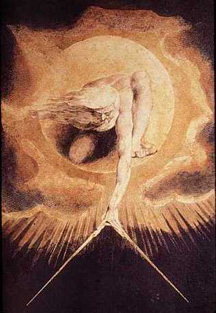
cleansing of the Door of perception that is History. We are truly living in Ancient Days...
"Ancient Days", by William Blake
Part II: Quote by Quote Exegesis
1. Page 3, Oedipus: "You, old one - age gives you the right to speak for all of them - you tell me why they [citizens of Thebes] sit before my altar."
Ambiguous Identity - Oedipus is also a folk personage instead of a god but also an allegory for
human fate, the relationship between man and the forces beyond(or anterior to) the gods as they
were perceived, the "disposition of Nature . . . and supreme over both gods and men", as Meyer
Fortes quotes E. R. Dodds in "The Greeks and the Irrational"(Fortes, Oedipus Tyrannus, 50).
2. Page 3, Oedipus: "Why do you sit as suppliants crowned with laurel branches?"
Concealment of knowledge and allusion to identity, laurel branches ironically dramatic
indications of the death of a noble figure. The death of God, perhaps, in the process of
self-concealment.
3. Page 4, Priest: "No we do not think you a god."
Identity, Concealment. The Priest conceals the divinity of Oedipus - a folk personage thus
malleable to the structural demands of this allegorical plot.
4. Page 4, Priest: "It was you who once before came to Thebes and freed us from the spell [of the Sphinx] that hypnotized our lives."
Priest: "God aided you [Oedipus]."
The Sphinx metaphor for the concealment of the gods' identity and the existential torment which consumes citizens of Greece in the presence of religious mythology ---Oedipus play is the riddle of the Sphinx, an archetype of the process by which man individuates from religious superstition and confronts the mystery of fate and intent and language/mythology, our most intimate connection to nature next to our biological fate - old age and death.
The Priest makes the first act of seemingly unconscious concealment. The Priest of Zeus or God needs/assigns religious faith in the acts of a folk-myth and in doing so, wears the mask of Oedipus, of one fated to take responsibility for the tragedy, for the profane/divine mysteries of life.
5. Oedipus takes the offered responsibility. Like a good personage, he is transformed in the telling by the evolution of poetry-craft or even, to some extent, witchcraft - the sharing of the magic ritual, magic utterances which transform the imagination and perception. (All literature/theatre from drama to book to tv, really)
Page 4, Oedipus: "I know well the pain you suffer . . .no one among you suffer more than I."
6. Identity. Page 6, Priest: "Come, Apollo, come yourself, who sent these oracles! Come as our saviour! Come! Deliver us from this plague!"
Is he freely associating between Zeus and Apollo? Oedipus Rex - the play's very identity is
mutable - implying that Oedipus the personage is language or literature - the play is like Oedipus,
it is representative of the human form, all that is Oracle (The structures, built on the sacrifice of
Body, that relay creative authority - eg King and Slave alike, government and citizen, content and
structure, cultural mythology and cultural technology, tv, film, book, gender). Oracle of god, all
order or syntax usurping time or God into myth or shared knowledge, making the distinction
between fate and destiny, body and knowledge(or myth or reality) itself a mutable reality as it
should be - lest mystery, too, die with God. And I am demonstrating mystery, or concealment, is
the very way by which we progress, consuming mystery and producing mystery (are we not just
as much a mystery to ourselves now than the universe was to the first guy to open his eyes?),
light for light, dark for dark, and if all is sound( or poetry), who should see the difference? For,
apparently, Zeus speaks through Apollo, through rhythm of light and sound, form and movement
(art), from a particle to a planet. The first mode of concealment being the individuation from the
"chorus" the sound of many voices made one - the primal or first state, the use of language
separating us from song.
7. Chorus: "O prophecy [poetry?] of Zeus, sweet is the sound of your word as they come to our glorious city of Thebes from Apollo's glittering shrine. Yet I quake and I dread and I tremble at those words."
Perhaps because Zeus knew himself as Chorus, one voice now made two.
Identity: Sympathy. The Chorus goes on to lament their/her/his own grief, such as Oedipus. The chorus sings the guilt of individuation even as it enacts individuation - such enactment evident by invocation of gods an goddesses - the sexual polarity of the divine and the mythology by which to preserve and eventually share that knowledge (a cosmic S.O.S.) Which it yet conceals - the desire of the gods in being in human form and the naked responsibility that it entails, a responsibility fulfilled by their cries of anguish in the imagination, a war, even of the evolving imagination represented by Ares.
The Chorus, here is the whole play, and thereby, in structure, within the lay echoes the unity of song with Apollonian form or dramatic individual vision. Sophocles, it seems, is bridging the transition in art form chorus to secular drama, a transition which I believe echoes the mystery of fate that imbues all human life - Sophocles, too, saw this.
Here, the Chorus invokes Athena, daughter of Zeus, who, as we know has her own matters to contend with in the Oedipus drama. Zeus is separated into Apollo and Athena, a metaphorm for the evolution of sexual consciousness. Thus, the Chorus invokes/introduces the persons of Rhythm, light - Apollo - ,and Earth goddess - Rhythm, light, water(musical or artistic or even civilized sympathy, the voice of Justice)
The Chorus is Sophocles' invitation to the audience of sensual first sin of enjoying this sort of beastial blaspheme of quasi-characterization - giving the Chorus a mask of concealment and allowing the audience to experience in memory the moment or ritual of individuation from the primal oneness or first tone. The play is not cathartic but alchemically transformative above and beyond mere emotional bleeding, it is a sharing of communal blood and water, the communal kill or sacrament invoked by every ritual of human existence for the sake of learning and higher art and self-knowledge. "Eat this, and live forever," as the gods. Life is art is ritual or the rhythm of knowledge in form and action and perception, and memory, and nature. Ritual being but my humanistic variation of Aristotle's "imitation", expressing , I believe, a deeper unity between the artistic intention of humanity and nature. What our generation would call Rock n' Roll or what I would equate with poetry. However, even the Chorus is not safe from the shame of individuation, or form the Mask of Oedipus, as it or even God's sympathy reflects back on it: "I did not kill the king" (8), revealing a certain sense of universal irony, or perhaps it is simply creative naivety.
Ritual/Active Imaginings
Claw and howl like beasts
Pictures of the Soul
Flicker in and out of hellish flame
The door so thinly sealed
Is but a tree in a garden
The truth so tightly bound
Is but a serpent's fang
That swells the sea of sacrifice.
* * *
WORK CITED
Sophocles, Oedipus Tyrannus. Trans. & Eds: Luci Berkowitz And Theodore F. Brunner,
University of California. W.W. Norton & Company: New York, 1970. 2-33.
BIBLIOGRAPHY:
For a look at the intrinsic unity of modern discourse and "the problem of time",
Koen DePrych's Knowledge, Evolution, and Paradox: The Ontology of Language
For a look at the artscience of structure and process as it is related to the human condition and culture,
Siler, Todd. Breaking the mind Barrier: The Artscience of Neurocosmology. New York,
N.Y.:Touchstone, 1990
For alook through the eyes of a cultural historian (the best one, in my opinion) upon time's spiral
and our mythological/scientific place in it,
Thompson, William Irwin. The Time Falling Bodies Take To Light. New York, N.Y.:
St. Martin's Press, 1981.
And, finally, for a paradigm for an emerging global consciousness rooted firmly in the
humanities,
Elgin, Duane. Awakening Earth: Exploring the evolution of human culture and consciousness.
New York: Morrow, 1993.
Bickerton, Derek. Language and Human Behaviour. Seattle: University of Washington Press,
1995
"Bickerton demonstrates that each of the properties distinguishing human intelligence and consciousness from that of other animals can be shown to derive straightforwardly from properties of language.
Bickerton argues that human language arose not as a means of communication, not as a skill, and
not as a product of culture but as an evolutionary adaptation which allows us to form patterns of
information that we may act on without having to wait for experience to teach us" - Reference
and Research Book News.
Just a little further...(optionally)
The Sun, then, is a living physical structure by which we can know an live the Gnostic God - Helios: The centre of mythology as is the Earth or Athena and contrary to Yeats, the centre does hold, apparently. This is the essence of the simplicity of "the sun is alive" - the sun is a phosphine, an image hardwired into the processes of being, of soul. It cannot be a rhetorical statement; it is a statement that honours the creative being that is every human, free to perceive as he will, to create himself as he will - we can learn know and become because it is our Nature to do so. The art of synergistic or spherical analysis is an expression or ray of human life and freedom but also the structure by which we share knowledge or ourselves at the same time the universe (in this case, the sun) shares knowledge with us. The metaphorical weight one grants the sun is the hard-one freedom of every human being. We are the sun. Words are the sun. The sun is, in word, the linguistic nexus of the movement of body and being. And if that doesn't do it for you, the sun is in the orange I eat to stay alive. The orange, enjoying much the same relationship with the sun as we, only we can more reflectively conscious of it. So, the sun is alive because we are alive, a truth already revealed by every human life, by the archetype of all human action or "imitation", the archetype that is language itself, the "process" of its evolution preserved in "structure" by Oedipus Tyrannus, by civilization itself - for that "structure" reveals the human evolutionary necessity for sexual-imaginative "concealment" for the purpose of consciousness evolution. Archetype is simply stored action or rhythm, active memory or imagination. Everything, then, is the performance of archetype or the original/eternal action/rhythm - everything is myth, the ability to bring knowledge in and out of time for the sake of vitality, for the sake of soul. We are living inside the Sun.
Oedipus Tyrannus, then, is the psychosexualecological archetype of all communication, information and mythology. "Psychosexual" refers to the dynamic nature of self and knowledge. I add "ecological" because the process of self is so intimately related to how we view ourselves relative to the planet on which we live (the science of knowing the mind of God - what we, as a race, have been occupied with all of 40,000 years. I say, "archetype of communication" to mean the rituals of sharing and the various ways these ritual are enacted through technology , language, education, art, system - our knowledge of the structure of ritual or archetype or mind or memory of God occupying the classification "mythology" - from rocket science to Greek gods. Ie. So much of what we classify as information is also or instead the formal systems of relation (languages/discourses) by which we structure information for sharing. Conclusion: Our culture is spontaneously combusting into the age of the gods, (the intellectual basis of which is outlined in the early part of William Irwin Thompson's The Time Falling Bodies Take To Light, New York: St.Martins Press, 1981.) Or conscious mythology - ecological and evolutionary stewardship and participation. One further on this: I discovered a text entitled Knowledge, Evolution, and Paradox: The Ontology of Language upon Frederick Tuner, Founders Professor of Arts and Humanities at the University of Texas comments:
It is already clear that postmodernism [whatever that is] is an unsatisfactory view of the world the
skepticism, antifoundationalism, and distrust of any form of narrative or argument that has
characterized this last phase of modernism cannot long resist its own corrosive critique. What
view of the world will succeed postmodernism? To answer this question, it is necessary to take
up several challenges abandoned along the way as metaphysical, insoluble in terms of the
contemporary science, pr politically formidable: the problem of how different disciplinary worlds
can belong to the same world, the problem of the apparent incomensurability of different
language-games, the problem of the nature of time the problem of how mind and consciousness
can be embodied in the physical brain, the problem of origins and evolution, and above all, the
problem of time.
Koen DePrych's book, in a remarkable synthesis*(my emphasis) lays the groundwork for an
answer. Using new concepts derived form the study of iterative, chaotic and probabilistic
processes in nature and in the computer, he develops a way of looking at both the sciences and
the humanities that fully meets the concerns of the mainstream of modern philosophy, while
opening up whole new areas of research. This book joins a handful of important and daring new
works that have recently broken with the current conventional wisdom of the humanities, ane that
chart the altered shape of the academy as it will exist in the twenty-first century"
And by quoting this, I simply hope to highlight the unity of this collage of cultural response. Exploration at the expense of exposition always warping formal "rationality"(but I love to learn no regurgitate), on the surface, anyway, and, in any case, I gained a renewed respect for the creative challenge that faces artist and scholar alike. Professional Rationality to the rescue, that sort of thing.
This is primarily a linguistic development - hearing gnosis (thought formulation is a type of
hearing or archetype/ritual, an artifact of cosmic sexual-imaginative intention) - a spherical
response to the consequences of human consumption in the 21st century. Similarly, in
psychology, to why the first bison were painted on the cave walls of Lascaux in France. It is an
artistic evolution. For, as Duane Elgin notes in her book, Awakening Earth:Exploring the
dimensions of human evolution:
Written literacy would have seemed almost impossible during the agrarian era but the norm in
the industrial era, so, too, can a literacy of consciousness seem almost unimaginable today but
become widely accessible only a few generations into the future. (162)
Spherical literacy, as I call it, is how we can advance and revel in the inventions of sight-oriented
reason (linear perspective), for by listening to the surrounding ocean of bodies and time (as every
literary author throughout time has always done, paving the way for how we may view literature
and culture and imagination and, well, psychosexualecology) , by listening to Zeus or the Sky or
our own sensibilities, our innate blueness, we may grant our visions, real and imagined, greater
vibrancy and become a participating member of the ocean that is time and humanity, as we
always have been. I'm talking about culturally codified ecstasy to enhance enjoyment of both
material possession and entertainment.
Endnote on Synergistic or Spherical Analysis:
This paper is primarily an exploratory paper. But that is why I am at university, to explore my
senses, to see the world around me differently by exercising my "literacy of
consciousness"(Awakening Earth. Duane Elgin, 162). As a writer, every paper I write is a work
in process. However, I appreciate that it may be very difficult to follow simply because of its
amateur syntax. Having this particular inspiration, I am also mindful of the need to follow the
parameters given to me by my instructors, whose criticism is invaluable. Having said that,
Oedipus Tyrannus allows for great literary exploration and, in my opinion, writing a 1500 word
paper on the seminal work of western civilization is like going to Utopia and watching TV,
which is what I would do, anyway.
In taking this approach, I am torn between writing what I know will be understood and that
which I feel inspired to write. If I have to sacrifice one for the other, it will be that which is
strictly "rational" (this one time, anyway). Although, I, like most, have read enough to know
when I am reading something irrelevant or irrational and this is not that. In fact, considering the
cultural climate in which we live as eloquently and rationally outlined by Duane Elgin, it makes
great sense to me, in structure, anyway:
On the one hand, a communications revolution is sweeping the planet, providing humanity with
the tools needed to achieve a dramatic new level of understanding and reconciliation that in turn
can support a future of sustainable global development. On the other hand, powerful
countervailing trends are also at work - climate change, overpopulation, dwindling reserves of
oil, the ruin of rain forests, soil erosion, ozone depletion, and many more. In the next few
decades, these driving trends will either devastate or transform the economic, cultural, and
political fabric of the planet" (Duane Elgin, Awakening Earth).
A great time to be alive, and a privilege. Surely my anomalous style of prose can be enjoyed.
What a great time to pain pretty pictures of reason, technology, culture, entertainment,
consciousness, language, consumption, Humanity, upon our "cave walls" - it all starts and ends
with a pretty picture.
I have, therefore, infused this piece with some of my own personal subjective conceits - an artifact of the added artistic/intellectual authority garnered by many people of our generation - it doesn't' necessarily mean I am correct, but it does mean that usual methods of establishing logical cohesion are somewhat out of date. I have done this also because the sheer magnitude of Oedipus Rex led me to inquire into its structure in a way that precluded customary reverence for the authority of traditional logic (for me). I have tried to take mercy upon my reader, perhaps they will extend me the same courtesy?
In my opinion, this paper, if nothing else, highlights the artistic nature of reason and exegesis .
Much criticism is expected and needed. Please enjoy. I like to create things I don't, myself, quite
understand - it keeps me honest, like Oedipus;) , and preserves my sense of awe at my own sheer
dumbness. The Renaissance never really ended. We are still learning to confront Cosmos through
the human component.
William Blake