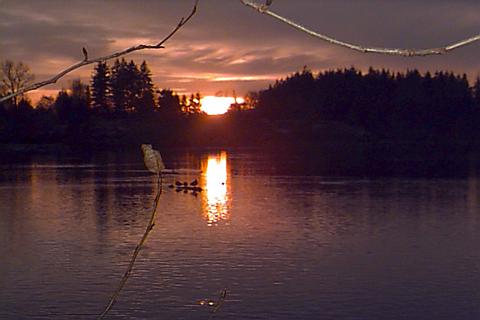
Humanistic Intention & Light in
"The Lamp at Noon":
A Synergistic* Analysis
(Story by Sinclair Ross)
Sinclair Ross's "The Lamp at Noon" is a short story encompassing nature's anthropomorphic face. In the text, it can be show that the relationship between the two main characters is as much a conflict between each other as it is a conflict between nature and humanity in general. Ross's manipulation of the stormy environment in which the story is set is such a masterful imitation of the emotional forces that occupy the two main characters that it could be argued that the author is also suggesting a conflict between nature and nature.
William Butler Yeats once wrote that "art and poetry, by constantly using symbolism, continually remind us that nature itself is a symbol. To remember this, is to be redeemed from nature's death and destruction" (qtd in Yeats' Worlds 29). We are introduced to the first and most pivotal symbol of this story in the very first line: " A little before noon she lit the lamp" (26). Immediately following this statement, we are introduced to a "demented wind" (26). This is a very powerful way for Ross to begin this story because he places two very pivotal symbols at the very beginning, two symbols that, like nature, will enact their own drama as the story progresses.
*Synergistic refers to a form of structural analysis which treats literature as a complete system of
information and communication similar, in process, to all systems of information and
communication or culture(the sharing & preserving of knowledge) as outlined by Todd Siler in
Breaking the Mind Barrier: the New ArtScience of Neurocosmology. To wit, the science/art (or
mythology) of structure or, let's face it, Tele-Vision - the modern and silent art of self-reflective
consciousness, the art of soul, of culture, of life and myth itself - the common. In the end, this
paper is about "making toast in the morning" or "doing the laundry".
These two symbols (or shadow characters - metaphors for the metaphorical Body such as Body of Literature, Body of Nature, Body of Humanity, the Lamp being, then, fire harnessed, body of light, sun, harnessed in say media technology ie literature, mythology, Prometheus - who stole the body of light from the gods. Thus, a synergistic symbol, similar is process of communication to all media forms, serving even as a mythological entity for the structure of literary communication, all communication deriving from the biological and technological innovation of language.) differ in that the lamp is under her control as the body of psyche or soul of nature(the Gnostic twin rayed soul - body and spirit, man and woman, humanity and cosmos, audience and book, in constant process of relationship, the process of art, of ritual, of life, of the adaptation of structural simplicity in form and expression to the heart of darkness, the "chaos" - everything) is under our control - "she lit the lamp", while the wind is "demented", "keening past the house" (26) ("Keening" suggesting a wailing or lament, both very human actions). The wind is set in conflict to the lamp just as and when it is set in conflict with the home in which Ellen and Paul live (or try to live); "Three days now without respite it [the windstorm] had held. The dust was thickening to an impenetrable fog" (26). The "lamp" traditionally is a symbol of hope and clear sightedness and in this story further serves as a symbol of that hope's incarnation in actual media forms - this story is "the lamp". Fitting, since it will be Ellen and Paul's struggle to share a hope for their future on this remote farm, to see through the chaos, that the author uses to drive his plot, driving towards some sense of future in the story and beyond the story, our future.
As stated, the story takes place on a farm. At the beginning, Ellen views "the stable and oat granary" and "the farmyard", what she sees as "poised aloft a sombre void" (26). The use of the word "void" helps us locate the emotional state of Ellen as well as the state of the home itself. A void could be seen as a weak contrast to chaos but is more likely being used by the author to suggest the heart of the storm, the heart of chaos, blurring, as does the story, the line between nature and humanity. Her home is most definitely in a precarious position, since with each "blast of wind" it is set to "topple and spin hurtling with the dust-reel into space" (26).
However, the traditional conflict between man and nature is not one that Ross chooses to explore for its own sake. Instead, he finds the story in which man is so obviously losing to be a setting in which to explore a man and a woman's emotional conflict amidst the struggle to see as one (as does humanity throughout all its inventions), to love, a feeling which, in this story particularly is foreign, it seems, to nature's usual ambivalence to human desire. But even nature is depicted as an entity with something to share amidst the chaotic void:
From the window she went to the door, opening it a little, and peering toward the stable again.
He was not coming yet. As she watched there was a sudden rift overhead, and for a moment
through the tattered clouds the sun raced like a wizened orange. It shed a soft, diffused light, dim
and yellow as if it were the light from the lamp reaching out through the open door. (26)
Combined with the already established sense of emotional/literal voidness, this passage contains the bulk and wealth of the entire story's symbolic/thematical thrust as it is related to the unity of the struggle between Ellen and Paul with the struggle between nature and nature or sun and earth - lamp and wind. The quote itself represents an altered state of vision reminiscent of the Romantic mode of poetry. The "open door" could be that body or window, human or story, through which altered states of vision and feeling may be generated, shared and perceived - the door is another synergistic symbol, a door withing a door within a door and thank God Shamans didn't build civilization or we wouldn't likely have bothered to write stories(laugh). The door is a sympathetic body or all sympathetic bodies that sacrifices itself so that it may be seen "through", just as the body to the soul, or humanity to history as a whole - the history of human artistic and literal sacrifice culturally codified in Western culture by the figure or archetype of Christ, the door by which we may "understand" art or literature at all in terms that are relevant to our lives and our enjoyment of life. Is the author making a metaphorical bridge to the garden of Eden? Ellen, or the omniscient spirit of Ellen, is certainly gaining a profane vision or knowledge of eternal life, the unity of Body and imagination. What if Adam and Eve lived amidst the chaos of Earth's "void"? - a void which, like the "heart of darkness" always exists some say. By juxtaposing the symbol of the lamp with the personified sun, a "wizened orange"(symbol of the sensual nature of knowledge and the intelligence of sense or, more broadly, feeling) Ross takes us on a journey to the source of symbolism, suggesting that, perhaps, the weakness of contemporary symbolism in the burning void of reality - literature being synergistically symbolized by the Body of Ellen: untouched, not fully enjoyed, drowning in traditional critical discourse, critical technology, becoming "mythology" in the worst sense - more relevant than is collectively known. At the least, this is clearly evidence not of skepticism but of experience on the part of the author, lending credibility to his voice. However, whether the author has been successful in making a metaphorical step over traditional symbolic conceits (one being that characters are rarely themselves symbols and almost never metaphors in modern literature for the forces of nature ie our characters are not explicitly or implicitly treated, in literature as mythological personae or gods.), is up to the reader. I, however, find the movement, in text and character attention from "Paul" or "man" to the sun a sweet and sublime rustic allegory for the sympathy between man and woman, nature and humanity, sun and earth, imagination and Body, lamp and wind.
The Blake-like door of perception, of mystical ecstasy, is clearly invoked by the above quotation as the sun becomes a metaphor with and not for the lamp - when the vision of humanity and nature are unified (if they are not already), then, perhaps, we may glimpse the infinite nature of reality. Like any great author, Sinclair Ross has shown us at least one way, but leaves it up to us where to take it. The further we move into the story we find that the more tragic element of this human struggle (no knowing the meta-play in which they play and invigorate us) becoming more localized into the glaring reality of what life must have been like for poor farming families in the Canadian dustbowl Prairies of the Depression era.
Turning to the conflict between Ellen and Paul, we are taken on a tour of Paul's struggle to share his vision for the future, which he himself finds inspiring, with his wife, and Ellen's struggle to communicate her love for her husband, to take on her own obligation to envision something more than domestic comfort to share with Paul to represent the fruits of their marriage - the baby they already share is oddly left out of each's private emotional strains.
Ellen wants to leave. She doesn't even want to hold her child for fear that "in the dust-filled air he might contract pneumonia. "'Sleep'", Ellen whispers to their child, "'It's too soon for you to be hungry" (26). Not surprisingly, given these conditions (barren food stock and unclean living conditions) Ellen is pondering the words she had flung at her husband in utter frustration. She does this while waiting for Paul to come in for dinner. However, despite the obvious regret, she does not embrace Paul when he returns, thinking to herself, "I'm in the right. I won't give in. For his sake, too, I won't" (27). She is maintaining some sense of control by restraining herself from showing affection. That she believes this to be for his sake as well is evidence of just how ravaged their relationship is by what must be years of economic depression: She equating her ability to show feeling towards him as a weakness for which the conditions, the storm, will take ominous advantage. That she has been so overtaken by the windstorm is evidenced in the preceding paragraph in which she personifies the wind as two winds: "The wind in flight, and the wind that pursued" like talons grasping for a "distraught" "bird". The "sanctuary" she seeks, then has become merely Paul's presence, as distant as the sun itself. Ross writes, Paul's "presence made the menace of the wind seem less" (27).
After a brief and curt exchange, Paul leaves the house, at which point we are taken into this hellish world through his eyes, where Ellen would like to see we can easily conclude, for so much of their dilemma rests in the role each plays for the other. The lamp, even, seeks such a view. Again, his use of the lamp is isomorphic to the human soul - a literary metaphor for communication technology or even literature as a whole. The lamp is representative of the human desire to see as one body (which, for the most part, it has arguably achieved), a physical eco-body in nature and time - Body, Water, cultural sympathy or art enjoyment. Ross writes:
The lamp between them threw strong lights and shadows on their faces. Dust and drought, earth
that betrayed alike his labour and his faith, to him the struggle had given sterness, an impassive
courage. Beneath the whip of sand his youth had been effaced. Youth, zest, exuberance - there
remained only a harsh and clenched virility that yet became him, that seemed at the cost of more
engaging qualities to be fulfillment of his inmost and essential nature. (27-28)
This, it is extremely important to note, we see through her eyes: We are the omniscient spirit of Ellen and even Paul, seeing through their eyes, the omniscient androgynous Body of perception and intrinsic element in any sort of literacy of consciousness - the ability to obtain knowledge and perception through technology, through language, as opposed to direct experience, as even a sort of experience. This passage suggests, in structure, that the "storm" that takes place in the story is within each of us, even as it is outside, just as the storm or the Body of the story is confined by the page and our imagination while it is also in nature, symbolic of a physical ecobody that wishes to communicate sympathy to humanity through humanity by humanity.. This is the omniscient spirit's profane vision and quiet source, it would appear - since no where else in the story is this vision alluded to - of what is left of its faith in Emerson's will to power/virility, the intention of the human soul. This, with the unnatural and perhaps tragic aid of the lamp, casting upon the plot Ellen's (and our) obligation to perceive things as they are (to learn to love better), masking as much as revealing Paul's and their role, allowing us to glimpse the mythopoeic structure of the text - Ellen is sympathizing with the reader, foreshadowing her possible role as Oedipal scapegoat or body of cultural sacrifice, characterized by a naive sacrifice of honour or nobility for the greater good - what is, in this story, the above quoted vision of Paul or mankind made equally possible in literature and relevant in literature by the historical challenges faced by not just Depression era families but by all historical human challenges; we are Ellen. It is difficult, in fact, to directly connect the omniscient point view used in this passage to any individual body - the point of view, relative to the plot, conveys a theme already discussed of the entire story. It would appear that for Sinclair Ross, the question which must beg our characters is "why are we here - what roles are we playing, for each other and, if nothing else, for nature?" In style of voice, Sinclair Ross is asking, what role do I, the author, play? (For also literature or contemporary cultural myth or participation in reality, whatever that may be agreed to be). What roles we play, being a so much more relevant question and theme, in this particular story, than "who are we?" although one with probably much the same answer, since the vision of identity between the mask or role or nature is one that must be shared and until such sharing, we are trapped as much as we are free in our roles - a paradox that did not escape T.S. Eliot in much earlier times, unifying the narrative and the theme with literature past - Again, hinting in structure, that the source of our characters' redemption from this windy, dust filled, hungry void lies in the metaphorical unity between language, its sharing (literature or, for our culture "myth" with all its false and true connotations of reality, Tele-Vision), and nature.
I will show you something different from either
Your shadow in the morning striding behind you
Or your shadow at evening rising to meet you
I will show you fear in a handful of dust - TS Eliot
(Personally, I equate Shadow with Body)
Paul has left the house ignorant of the role momentarily glimpsed of him and finds his brief sanctuary in the stable with his malnourished horses. It is simply his literal vision of the horses' emaciation - "Paul ran his hand over the ribs and felt a sudden shame, a sting of fear that Ellen might be right in what she said [that they should leave the farm]" (31) that grants him a sense of reality. Paul sympathizes, "She had no faith or dream with which to make the dust and the poverty less real" (31), not knowing that he embodies her faith. With further reading, she equally embodies his. And in between, the ceaseless "scream of wind in which Paul hears "a cry from her parched and frantic lips" (31). Ross once again expands the personification into the full character of the storm, which, as it does for Ellen, carries more weight with Paul's instincts and senses than his spouse: "He knew it couldn't be, he knew that she was safe within the house, but still the wind persisted in a woman's cry. The cry of a woman with eyes like those that watched him through the dark" (31).
The author makes it seem as though Paul's inner turmoil, while drawing his attention to his personification of the storm (which is also the author's) is mythicizing or elevating his own identity (man into sun)- the words themselves on the page model both the light and dark aspects of such an imaginative leap, inviting the reader to participate in an altered state of reality since clearly Paul is not a writer nor a literary figure for which leaps of mythopoeic thought are an acknowledged conceit- Paul has changed "role" for the reader, and in so doing, is providing a potential source of textual and thematical illumination: We are Paul. We have now seen both characters shed light which none but the reader may glimpse, a modern classical tragedy in deed with, in my opinion, far more dramatic irony since, though the Depression is over, the conflicts explored by these characters are clearly universal to a culture whose attention is drawn by so many different, in our case, cultural forces/phenomena. These same phenomena-technologies at times communicating more, in their effect upon human consciousness, than their content. Thus, sub-literate or TV communication becomes a source of collective mythology which has yet to be put into words. This is a similar process as unconsciously took place during the identification of literature as having cultural value, as a metaphor for the sacrifice of body, of the dignity of the human condition - a question of media-sentience (the ways in which information is structured for communication (all art) being related, in structure as much as content, to the human experience of collective sympathy or shared dignity)that ironically, is only now being consciously explored in the derivatives of formal language, media technology.
The storm is arousing in Paul, a shame and fear which is far beyond that which is relevant or rational given the immediate circumstances - perhaps the affect that Ross believes that years spent at the mercy of an unforgiving landscape would inspire (perhaps invoking the necessary conditions for genuine "vision"?). This is similar to the TV news coverage, which can arouse strong emotions with linguistic sympathy (collective mythology of a Body with sense beyond any individual but felt by each individual in sympathy with the whole, all sentient creatures having a mythology (what I am equating with sympathy between man and man, man and nature). A good example where this is explored in modern film is "Bladerunner" with Harrison Ford in which the media/resource technology of "android" develops human traits, warranting the assumption of self-value, even gender, implying that all technology is imbued with a sentient nature - not a bizarre notion considering that all natural complex systems tend to have a natural collective sympathy, an androgynous or gender-wide sympathy such as is expressed in the narrative structure of "The Lamp at Noon". Paul's shame can also be synergistically and sympathetically linked to the collective shame of species-wide over consumption of planetary resources, which leads, perhaps, to an age of myth, a stage in the cyclic spiral of history, culture and consciousness (see reference - The Time Falling Bodies Take to Light, preface) that I believe would be spearheaded by a culture, like Canada, that already has a Body of literature closely sympathetic to the land and its people, a pre-existent Romanticism. In any case, this is the most explicit stretching of the imagination in the story, for it is not made clear whether Paul is self-aware of his own exaggerated musings. It is clear, however, that the storm, like it has Ellen, possesses him. How seriously the reader is to take these monumental personifications is left unsaid or unclear. For, like any great tragedy, "The Lamp at Noon" leaves it up to the audience to decide whether or not we, in some way, are similarly fated or perhaps destined to make the profane discovery of role and identity (In terms of the structure, we are the only ones who can, elevating the role of reader in a very humanistic fashion, given the absence of a cultural authority on "reality") alluded to brilliantly but forsaken for the pressing circumstances of the Canadian dustbowl - a barren love - a life to rebuild, another turn in the cycle of faith and sacrifice that is the original religion of farming cultures from which, ironically, we derive are first real myths. An extremely relevant story to our culture. What more could one author do to remake the myths and make our modern knowledge, in this story espoused by Paul's learned wife and synergetically (all knowledge, in process, seeking to consume more efficiently any and all "resource", art, or structural conceit eg a good short story) symbolized as advanced systems of farming and crop rotation ("It's the land itself," says Ellen to Paul, "you've plowed and harrowed until there's not a root or fibre left to hold it down" (29) - a drought in literary innovation and criticism and role?), as good for our souls as it is good for our living conditions. For Sinclair Ross, there doesn't seem to be a difference: "The child was quite cold" (33).
The fate of the human soul is alluded to finally, "beyond, as if through smoke, the sunset
smouldered like a distant fire" - the original lamp around which humanity gathered to tell stories.
What is our fire, now? - not the light of myth and literature so much perhaps as the imagination
to access it. The imagination so naively expressed bo our two main characters: Paul and Ellen.
But, then, aren't we all "naive" artists when it comes to responding to the totality of our living
conditions? The great tragedy of our age, perhaps, being that we may yet possess the knowledge
to farm the earth productively for all, but that it is only through the ability to share knowledge
though story and myth that we might make it relevant or helpful to the human soul. I would only
differ with Ross in this: the human soul is by no means a baby. Like nature itself, it has seen a
few storms...
Works Cited
Pierce, David. Yeats' Worlds. London. Yale University Press, 1995. 29
Ross, Sinclair. "The Lamp at Noon". The New Oxford Book of Canadian Short Stories. Eds.
Atwood, Weaver. New York. Oxford University Press, 1997. 25-33
Reference:
For a look at the intrinsic unity of modern discourse and "the problem of time",
Koen DePrych's Knowledge, Evolution, and Paradox: The Ontology of Language
For a look at the artscience of structure and process as it is related to the human condition and culture,
Siler, Todd. Breaking the mind Barrier: The Artscience of Neurocosmology. New York,
N.Y.:Touchstone, 1990
For a look through the eyes of a cultural historian (the best one, in my opinion) upon time's spiral
and our mythological/scientific place in it,
Thompson, William Irwin. The Time Falling Bodies Take To Light. New York, N.Y.:
St. Martin's Press, 1981.
And, finally, for a paradigm for an emerging global consciousness rooted firmly in the
humanities,
Elgin, Duane. Awakening Earth: Exploring the evolution of human culture and consciousness.
New York: Morrow, 1993.