Hope, Sacrifice and Communication in
"The Lamp at Noon"
by Sinclair Ross
"The Lamp at Noon" by Sinclair Ross is a story about relationship and sacrifice in the Canadian prairie dust bowl of the Depression. The two main characters, Ellen and her husband Paul, live on a farm. The story takes place on the third day of a powerful dust storm, which seems to be forcing this husband and wife into some form of decision and acceptance regarding years of poverty. The decision they make, whether to stay or leave, is directly related to their ability, at this point, to communicate at all. However, nature's relentless assault against their livelihood makes it very hard for each of them to appreciate fully the weight and the reality of this decision.
All this and more falls under the pen of Sinclair Ross, who uses the setting to explore the strongly related themes of hope, sacrifice, and communication. In fact, Ross models the conflict between Paul and Ellen along with the setting, using the setting as a way for his main characters to explore the sacrifices that must be made or accepted in order to communicate hope or vision. The author uses the setting - and, specifically, the storm - to symbolize and explore the central conflict, which revolves around their failure to communicate.
"A little before noon she lit the lamp" (26). This is how the story begins. This is our introduction to Ellen; Ellen is referred to as "she" for most of the story. What continues is a description of her immediate setting, which seems to enclose and define her: A "demented wind" flies "keening past the house" (26). The description continues, "Three days now without respite it had held" (26). "It" refers to the dust storm. Standing at a window, she sees the stable and oat granary in a "dim, fitful outline" (26). The dust clouds make the farmyard seem "an isolated acre, poised aloft a sombre void". With each blast of wind, the building shakes, "as if to topple and spin hurtling with the dust-reel into space" (26). Thus, with the description of the setting and no description of her at all, we are introduced to Ellen's ill-defined sense of imminent peril and hopelessness; we immediately get the feeling that she, like the granary in the farmyard, is about to be taken by the storm. It, like a "void", is without boundary.
The next stroke of characterization takes place through the pane of glass. Ellen is inside her home making dinner. She has "closed the door", indicating that we, too, have moved inside. However, she looks through the window with eyes "strained apart and rigid, just as "they had looked out of the deepening ruin of the storm" (26). Her eyes are also described as "fixed and wide with a curious immobility" (26). Her home, then, is providing little sense of comfort. In this way, the reader gets the sense that what is going on outside is also going on inside, inside this home and inside Ellen. Therefore, we can conclude that there is something much more than a dust storm which is affecting this home. The author has used the storm to convey how this character feels. Whatever else may be concluded, Ellen is most definitely afraid. But of what? As the title of this story suggests as well as the first line, the lamp seems, at first glance, to be the only force of the setting to counter this feeling of dread.
Soon after Ellen lights the lamp, there is a short description of the sun breaking through the clouds. Just before Ellen closes the door, the sun breaks through, shedding "a soft, diffused light, dim and yellow as if it were the light from the lamp reaching out through the open door" (26). The sense of hope, although brief, provided by Ellen's glimpse of the sun is mirrored by the lamp, drawing the reader's attention to within the home. Although so much of the outside setting has been used by the author to create our sense of Ellen's inner conflict, it is also clear that something much more important than the end of this particular dust storm must take place, some end to the dreadful anticipation, inside Ellen's home. Since the character herself does not or cannot attach a particular significance to the lamp, we get the sense that the lamp is very much a private symbol of Ellen's volatile inner state, and ,even then, is only momentarily glimpsed as such; she simply does not have the emotional reserve to even ponder such a thing as hope. In this way, we already get the sense that the lamp is an ironic symbol in that it is, at once, a public symbol (usually, of hope) and also a symbol of something barely seen much less shared. symbols of hope can only be assigned value as much as they are shared. Ellen has very little hope to share with the reader, to communicate to us. Thus, all we get is a sense of hopelessness.
As we continue to read, Ross moves deeper into the geography of the central conflict of the story when he writes that "the baby started to cry" (26). The baby's cry gives the reader his first sense of something real, of feeling contained within a body and not blurred into the boundless tension of nature and Ellen's emotional hopelessness. "The baby" is how the reader gets his first sense of physical response to the setting, yet even with Ellen's child there is very little range of emotional response to be found in terms of description. The baby doesn't have a name. He is lying on a "homemade crib" (26), which shows that he is cared for. In stark contrast to this sense of love, however, we read that "she would have liked to rock him, to feel the comfort of his little body in her arms, but a fear obsessed her that in the dust-filled air he might contract pneumonia" (26). The setting, again, is intruding upon the home and, in this case, upon Ellen's ability to love her child. Babies receive much through touch, obviously, but the storm prevents her, apparently, from doing even that. It is not surprising, then, that much of the conflict between Ellen and her husband revolves around her desire to leave the farm as well as her precarious emotional frigidity. Notice the use of the word "obsessed" as well as the implication by her fear that pneumonia might actually be contracted due the air quality inside the home. This does not say much about either the child's present physical health or her emotional health regardless of the storm. Broadly speaking, a child could be seen a symbol of the love communicated between a husband and wife as well as of their future together or shared vision. More specifically, the baby symbolizes the peril presented by the atmosphere of dread as well as the actual atmosphere - the dust-filled air.
Ellen's inner conflict is elaborated further with her obsessive fear that her husband Paul is taking too long to come back to the house for dinner. She desires the assurance of his presence and is worried about him. However, she will not run to the stable and look for him because "he would only despise her" (27). "There was too much grim endurance in his nature", the reader is told, "ever to let him understand the fear and weakness of a woman" (27). Thus, she feels a responsibility to be strong. However, she has only her fears, apparently, to sacrifice for such a cause, leading the reader to wonder what else she has had to forego for quite some time. Undoubtedly, this is the source of an ongoing argument between Ellen and Paul.
Ellen and Paul's only communication inside their home takes place along the lines of such an argument. As could be guessed at this point, very little is communicated openly between them since Paul, as well as Ellen, is very uncertain about showing any vulnerability - all that they seem to have in common. Paul appears confident. He assures Ellen that the storm will go down, to which she replies, "until it starts again" (27). The text states that years of struggle, debt and poverty have been borne resentfully by Ellen, her eyes "hollowed, the lips pinched dry and colourless" (28), while to Paul these years have imbued "a harsh and clenched virility that yet became him" (27). These images are illuminated by the lamp, but the reader already has reason to be unsure about the lamp's ability, as symbol or lamp, to present reality. Thus, it appears that each has responded very differently to their setting. Ellen is afraid and wants them to go home to her family. She has told Paul as much.
On the other hand, Paul sees the pleading he hears in her voice as "only another way to persuade him" (28) rather than an expression of emotional need. He answers, "it's yourself you're thinking about, not the baby" (28). And here Ellen shows her own strength and good sense when she points out to him the realities of their grim hope for new crops:
"Look at the sky - what's happening. Are you blind?
Thistles and tumbleweeds - it's a desert. You won't
have a straw this fall. You won't be able to feed a cow
or a chicken. Please, Paul, say we'll go away--" (28)
Here she proves strong because she is again putting her own emotional needs to one side in order to tell Paul things he is unwilling to accept, things that could only annoy him and make him even more distant. Then, we catch our first glimpse of Paul's inner conflict: "Go where?", he says. "His voice as he answered was still remote and even, inflexibly in unison with the narrowed eyes and great hunch of muscle-knotted shoulder" (28). Paul continues, "Even as a desert it's better than sweeping out your father's store and running his errands" (28). Paul senses that this is all he's got ahead of him, a loss of pride, if he does what she wants and leaves. Ellen retorts by again speaking for what she believes to be the needs of the whole family, and especially her and the child. She mentions the air the child must breath and that "he cries all the time" (28). Paul's stubbornness to recognize any of her complaints ends when he begins to compare hardships with his wife, showing her his cheap and uncomfortable boots. However, the heart and end of this conflict is alluded moments before. Ellen states, "I want to help you, Paul" (29), further stating that he owes it to himself (as well as her) to consider leaving. Paul makes no response to this; he simply sits "staring at the lamp without answering, his mouth sullen" (29). In dramatic irony, Paul catches no glimpse of a break in this storm, nor hope in the lamp. He will find his sense of hope away from Ellen and the house - and away from the lamp.
Paul finds his hope and confronts, for the first time perhaps, his fears, in the stable. As Paul begins to leave the house, his wife pleading for him to remain, he looks at her: "The eyes frightened him, but responding to a kind of instinct that he must withstand her, that it was his self-respect and manhood against the fretful weakness of a woman, he answered unfeelingly" (30). Ellen's last plea for him to stay is revealing:
"Sometimes, Paul, I wish I was [outside with you]. I'm
so caged - if I could only break away and run. See -
I stand like this all day. I can't relax. My throat's so tight
it aches-" (30)
Ellen resorts to finally telling him how the storm is physically affecting her, saying that her "throat's so tight it aches" (30). In this way, we may associate her dilemma and perhaps their dilemma with that of the baby, whose breathing is also being effected; their physical hardships are outweighed by the strain upon their relationship, a strain they can only communicate by comparing physical hardships. One wonders why the baby is left out of this particular discussion. In any case, such absence of shared sympathy for their child only heightens our sense that this couple is no longer in this struggle together - the storm, the land, and whatever misconceptions each has regarding the other's strength have combined to isolate them as much from each other as from the outside world. What sort of hope could one possibly have, much less share in such conditions? Although each is striving for the other, they appear to have nothing in common but the shadow of beauty, "That world within this Chaos, mine and me, / Of which she was the veiled Divinity" (Shelley, "Epipsychidion" - this soul from my soul).
Paul leaves and goes to the stable in which he stands "breathless a moment, hushed almost to a stupor by the sudden extinction of the storm" (30). In this way, the author leads us to associate the storm enfolding the farm with the storm enfolding their marriage, their lives. In the stable, Paul feels a "far-reaching stillness", a stillness in which he welcomes the "illusion, the sense of release from a harsh, familiar world into one of peace and darkness" (30). This, then, is where Paul finds peace from their hardships and not inside the house with Ellen. Through the description of the setting, the reader may get the sense that he, unlike his wife, has found a sanctuary, a "cavern-like obscurity" (30), walls to protect him. For the first time, he is described as possessing a "clenched despair" (30), and his horse, Bess, seems "grateful for his presence", thrusting her "nose deep between his arm and body" (30). His sense of touch and comfort is coming from his horse and not his wife. However, when he goes to his gelding, Prince, he runs his hands over the "rib-grooved sides" (31) and feels a "sudden shame, a sting of fear that Ellen might be right in what she said" (31). This is his first recognition of the decision facing him as much as it does his wife. As well, Paul recognizes that he does not share a vision for the future with his wife - his vision, which is his "lamp" and an even brighter one since it has, he realizes, been giving him "a confidence in what lay beyond them" (31). This recognition would prove to be too little or too late since, as he confronts the malnourished animals, looking at them and seeing always "her face before him, its staring eyes and twisted suffering" (31), his fears overwhelm him, his fears which are brought to him while alone in the stable before his horses and not at home with his wife. Nature, too, has encroached itself upon his world. He only recognizes the suffering of his wife while tending his horses and inside his refuge from his wife. When he finally returns to the house where he might communicate his almost intolerable anxiety, the wind sounding like "a woman's cry" (31), he heads passed the house and to the tool shed. Paul, like Ellen, does not want to "reveal a fear or weakness that she might think capitulation to her wishes" (31). He, though, is thinking more of himself than her, it seems, a reversal of appearance of strength and virility in response to life's challenges on the farm, a reversal of our sense of who has sacrificed what and how much as well as who has the clearest sense of the future, Paul or Ellen.
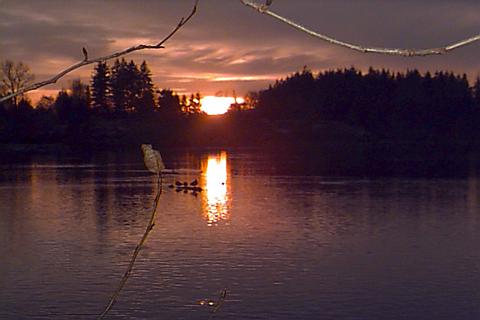
At story's end, it is the death of the baby which becomes the dominant symbol, a bitter symbol of forgotten hope, sacrifice and communication (that soul from their soul), the dominant reality for Paul. For Ellen, whose future is so pledged to the will of her husband, this event is, ironically, fortunate, for her husband is finally with her, holding the baby and soon her as well, but she, it seems, is gone: "Her eyes were still wide in an immobile stare, but with her lips she smiled at him" (33). The baby is dead and cold, but Ellen does not realize it. The storm has died down, but a life has been lost. The heart and vision of family has been surrendered, unwittingly, by Paul in his relentless battle with nature to grow crops for his family. The setting at the end of the story is calm and idyllic:
It was evening now. Across the fields a few spent clouds of
dust still shook and fled. Beyond, as if through smoke, the
sunset smouldered like a distant fire. (33)
Ross, while using the setting to symbolize the conflict between Paul and Ellen, ends by using the
dead child to symbolize the same, suggesting that using nature or even symbol in order to find
peace is a doomed vision in the Romantic mode, storm or no, if we forget that nature, while a
source of symbol, symbolizes but cannot ever replace the living symbol of the human condition,
the human body, and specifically the imagination and love of man and woman, the human soul.
Without a shared body of sacrifice and love, there can be no shared symbol or vision of the
future, a conclusion which resounds through both this story and history, suggesting that, for Ross,
the dead child is also a symbol for what humanity has sacrificed through war and struggle - a sort
of Romantic Christian Humanism which speaks, in my opinion, for the added value of the "body"
of Canadian literature. Whether we, as humanity are Paul with his confident vision or Ellen with
her sympathetic weakness (more likely both), it is necessary to tend the fire, so to speak. For,
while nature may be the source of all symbol (as William Butler Yeats espoused), the human
body is the source of all value (as history and literature attest). Sinclair Ross's theme resounds
through both literary and historical conceit and seeks to renew both, for the light around which
we first shared stories appears "beyond, as if through smoke" (33).
Work Cited
Ross, Sinclair. "The Lamp at Noon". The New Oxford Book of Canadian Short Stories. Eds.
Atwood, Weaver. New York. Toronto. Oxford University Press, 1997. 26-33.