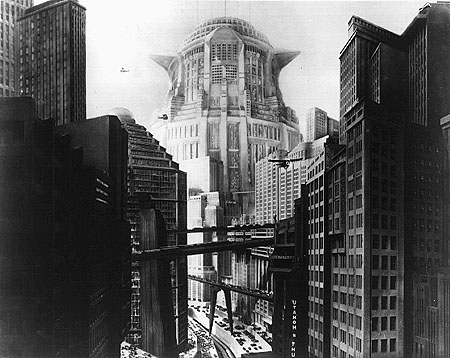
Set Design from Fritz Lang's Metropolis
Landon Sealey (Feb 10, 2001)
Modern Film from
Fritz Lang's
"M"
Do you believe then that the sciences would ever have arisen and become great if there had
not beforehand been magicians alchemists, astrologers and wizards, who thirsted and
hungered after obscondite and forbidden powers?
Friedrich Nietzsche
I have felt the wing of madness pass over me.
Rimbaud
The logical extension of the ego is God
Jim Morrison
They only who build on ideas, build for eternity.
Ralph Waldo Emerson
The duality of the classical romantic unit, that of reality and fantasy, can only be resolved if
culture and nature, body and architecture, are one in the same entity/person - the source, even, of
personhood. If we could only glimpse the grandeur of such a design that would afford infinite
variations of this most basic of communications or dialogues between human and cosmos, then
we would have glimpsed the mystery of culture, the word of God so to speak - we would dare to
look into the star-filled blue abyss that lies behind the masks humans wear. In writing this paper
on the relevance of film to the everyday world, I wish not to derive my arguments from the
metaphysics of historical idealism (Marxism, Communism, Enlightenment) but from the logical
extensions of secular humanism(having revitalized neoplatonism once again for the masses) or
the aesthetics of polity. My arguments, if need be, might be classified under headings such as
bohemianism, hedonism or even neo-paganism. Although I see them as simply neoclassical in
their derivation. It is our privilege, even, as scholars in the postmodern world, to see our ideas put
to the test amidst the predominance of democratic capitalism and first stages of globalization. In
on others, if it seems right there is bound to be a truthfulness to it, which is the most we can
expect on that volatile border where our personal fictions meet the fictions of the world at large,
mass culture. This is particularly relevant at the start if, in deed, the polity of the human body
does prefigure the effects of global culture upon whole nations. Or, as Jim Morrison once said,
"the logical extension of being an American is being the president."
Hence, we look herein for some loving salve for our perpetual concupiscence, a toast perhaps to
our IggyPopish "lust for life" and our priestlike homage to or even lust for self-knowledge:
"Know thyself, Oedipus" says one aged sage to another (Sophocles), and then there was light,
and bombs dropping down and champagne breakfasts and fast food and whole nations of elegiac
cityscapes drawing masses to the alter of Apollo, the theater - but even more specifically, the
individual the nexus of culture created spontaneously every instant when the world without
collides with the world within in patterns that will echo through all time because time itself is
one and every such echo of the gods who created us and who we forever create in the image of
Aphrodite, the spirit of life and love...
Ralph Waldo Emerson:
Introductory Lecture ....Read at the Masonic Temple in Boston, Thursday Evening, Dec 2, 1841:
"The Times, as we say- or the present aspects of our social state, the Laws, Divinity, Natural Science, Agriculture, Art, Trade, Letters, have their root in an invisible spiritual reality. To appear in these aspects, they must first exist, or have some necessary foundation. Beside all the small reasons we assign, there is a great reason for the existence of every extant fact; a reason which lies grand and immovable, often unsuspected behind it in silence. The Times are the masquerade of the eternities: trivial to the dull, tokens of noble and majestic agents to the wise; the receptacle in which the Past leaves its history; the quarry out of which the genius of to-day is building up the Future. The Times - the nations, manners, institutions, opinions, votes, are to be studied as omens, as sacred leaves, whereon a weighty sense is inscribed, if we have the wit and the love to search it out. Nature itself seems to propound to us this topic, and to invite us to explore the meaning of the conspicuous facts of the day. Everything that is popular, it has been said, deserves the attention of the philosopher: and this for the obvious reason, that although it may not be of any worth in itself, yet it characterizes the people.
.....What is the reason to be given for this extreme attraction on which persons have for us, but
that they are the Age? they are the results of the Past; they are the heralds of the Future. They
indicate, - these witty, suffering, blushing, intimidating figures of the only race in which there are
individuals or changes, how far on the Fate has gone, and what it drives at. As trees make
scenery, and constitute the whole hospitality of the landscape, so persons are the world to
persons. A cunning mystery by which the Great Desalt of thoughts and of planets takes this
engaging form, to bring, as it would seem, its meanings nearer to the mind. Thoughts walk and
speak, and look with eyes at me, and transport me into new and magnificent scenes. These are the
pungent instructors who thrill the heart of each of us, and make all other teaching formal and
cold. How I follow them with aching heart, with pining desire!
...And so why not draw for these times a portrait gallery? Let us paint the painters. ...let us set up
our Camera also, and let the sun paint the people. Let us paint thee agitator, and the man of the
old school, and the member of Congress, and the college-professor, the formidable editor, the
priest, and reformer, the contemplative girl, and the fair aspirant for fashion and opportunities,
the woman of the world who has tried and knows; - let us examine how well she knows."
...But the subject of the Times is not a abstract question. We talk of the world, but we mean a few
men and women. If you speak of the age, you mean your own platoon of people, as Milton and
Dante painted in colossal their platoons, and called them Heaven and Hell. In our idea of
progress, we do not go out of this personal picture. We do not think the sky will be bluer, or
honey sweeter, or our climate more temperate, but only that our relation to our fellows will be
simpler and happier. "
Martius: Dost know what 't is to die?
Sophocles: Thou dost not, Martius,
And, therefore, not what 't is to live; to die
Is to begin to live. It is to end
An old, stale, weary work and to commence
A newer and a better. 'T is to leave
Deceitful knaves for the society
Of gods and goodness.
-Bonduca, a play by Fletcher
("Our valours are our best gods")
Such a regenerate paradigm, what cultural historian William Irwin Thompson heralds as a return
of the age of myth and what I like to think of as the cultural Androgyne, thus allows for optimum
freedom of its own essential duality or romantic nature, which, then is also ours. In fact, I would
argue that cinema is structurally a story about what is ours of the transformation (or
metamorphosis) of ancestry, blood and myth - it is mythological.
The heavens and all below them,
Earth and her creatures,
All change,
And we, part of creation,
Also must suffer change.
OVID - "Metamorphoses"
Man has no body distinct from his Soul: for that called Body is a portion of Soul discern'd by the five senses, the chief inlets of Soul in this age.
William Blake
We must assume our existence as broadly as we in any way can; everything, even the unheard-of, must be possible in it. This is at bottom the only courage that is demanded of us: to have courage for the most strange, the most inexplicable.
Rainer Maria Rilke
"M", by German director Fritz Lang, marks for me a milestone in the exploration of the human
soul. If indeed, all human desire results in architecture of some form, the tyranny of the body
beautiful (or Miltonic Satanism) can only be romanced through a deeply honest understanding of
the universe though history and outside of time, through the imagination (cultural history could
be called the history of the imagination or the Soul's Body). It is for just such a "reason" that
ancient cultures such as our own, have sought to practice shamanism (artscience) through the
unification of myth and ritual - to understand both ourselves and our future through the shadows
we cast in the architecture of civilization - Again, this beckons a universal mythological dialectic
or, at the very least, an appreciation for the mytho-heroic ancestry of both our persons and our
language systems or technologies.
The subtle difference between the image of structure and the structure of image, consciousness and form, is only discernable by a god (merely a hieroglyphic redefinition of the human form), a culturally defined and confined entity (such as Osiris) which is highly localized (ie we can only know who we are if we know where and when we are, a complex and rewarding task that can take thousands if not millions of years if it has any end at all, more likely many ends or as Fiction Fantasy writer Robert Jordan writes "The wheel of time turns, and ages come and go..."
"...And it shall come to pass, as before in ages long gone to dust, that in a time of the Light's greatest bounty, shall the Shadow lift up its countenance upon the world. Unto the Free Peoples shall be delivered the full hatred and wrath of the Dark One, come upon the backs of His minions. As a black tide shall they pour forth from the North, killing and destroying with impunity. And the Free Peoples shall rise up and offer war upon the Shadow, buying with their lives their freedom. As it was once, so shall it be again, world without end. World and Time without end."
.....Anonymous )
A god, then, or a God-man, or even more specifically, an animal-god, the divine minus the
hydrophobia. We are talking, then , not of men and women of the audience but of "persons", the
logical extension of theater in the modern world; we are talking of androgynes, gods, the dancers
and the dance. It is as though a spiral return to our animistic ancestry would bring about the
fruition of individualism. For, where in deed is a person when he or she is watching a movie?
Are we "circling in a blue sky" as Pink Floyd would say?
That is, if architecture of any variety, of any sufficiently rhythmic organization of form/energy (e.g. Culture, matter, infrastructure, music, speech, physiology...) is a metaphor for subjective reality (a reality in which each and all is most intimately involved) then a sufficiently localized character (repetition of nature) on the silver screen should become a god (an isomorphic representation of being or self - an ironic metaphorm*), one whose very being is forever stored in the immutable laws of rhythm, the architecture of cosmic memory. This being the case, we have a paradigm with which to demolish the iron wall between personality and consciousness, between light and shadow (dilemma for which all civilization is already the response, much like each and every self) - ie it is essentially, like drama or culture, liturgical. What is? Well, everything and you and me and him and her and them and us. Who, then is the character and who is the chorus? What is the self and what is the entertainment technology? Again, what is the structure and what is the image of structure? What is the government and what is the citizen? What is the art and what is the audience? Is our entertainment technology as interested in us as we are with it because we, like nature, are structured like language, like culture, like technology? Ironically or not, this would not be a difficult question for ancient cultures to answer if they could understand the need for the question, for they would be accustomed to treating the whole physical world as a person or consciousness (at once localized and forever nonlocal). It would not be such a wonder to them that our most advanced forms of shamanism (those of physics and information technology) mirror such a cultural symmetry: the universe reproduces itself, it is at once sexual and asexual down to the very fabric of space time and consciousness. And why not, such characteristics allow for maximum creativity, unlimited creativity, for motion and stillness, for lust and love, for sympathy and passion, for understanding and mystery. We are and it is astro-logical, mythical beast, Human, Hero.
The key to our understanding here is in sufficiently localizing or describing a character's place in space , time and consciousness (which also has a geography and pattern). Such an endeavor is thus reducible to Pattern, which within the outlined paradigm becomes synonymous with archetype, structure, logic, and language. I don't need to mention that all human knowledge of art and science is already oriented in this manner through history, polity, and art - Body, equal parts imagination and form, dream and reality. I find that poetic, not to mention our and nature's ability to give roughly six billion animal-gods something to do with their time *laugh.
It is as simple a task as describing the movement of day into night, deciphering the relevance of
film. But in course of doing so, we alter who we are and, simultaneously, where we are. This,
however, is the indisputable purpose of art and culture.
"Feels like Heaven's coming down..."
The Tea Party
If the radiance of a thousand suns Were to burst at once into the sky, That would be like the splendor of the Mighty One... I am become Death, The shatterer of Worlds.
The Bhagavad-Gita
(Also quoted aloud by R. Oppenheimer after first nuclear test on US soil)
"Trinity"
Names supposedly given by US nuclear scientist, Robert Oppenheimer to first US nuclear
test, in reference to the Hindu trinity (Creator, Preserver, Destroyer).
"I am pursued by ghosts of women and dead little girls," says Peter Lorre ("M") in Fritz Lang's film by the same name. I have collaged these quotes together because I believe they hi-light how often human wisdom courts horror in art and life. In deed, throughout the course of cultural evolution the story of how humans might come to terms with the responsibility commiserate with reflexive consciousness is one fraught with existential dilemmas of ontological as well as historical proportions - this is a mytho-heroic story within many if not most modes of human discourse. Often are the times I will come back the Classical Tragedy of Oedipus Rex simply because the horror genre has never been done better, which is a good thing because then we can see exactly how it works. To start with, Oedipus Rex shows us that we would never know anything about ourselves if we were perfect. This is a facile statement, but a fact that we often take for granted when viewing great films like Lang's "M".
Perhaps another way to put the same statement would be to say it is almost impossible to know ourselves perfectly. Without waxing too philosophical, we as an audience are thus always fascinated by the portrayal of events beyond our control, a double entendre in this case because this film gives us a serial murderer within the historical context of the second world war. Just what do we make of such horror?
For starters, Fritz Lang's portrayal of the human figure through exquisite use of light and shadow is reminiscent of theatrical masks. The look of the film is so consistent that it becomes easier to hear Lang's characterization of humanity and not just one child murderer. The lighting further lends a dreamy quality in the romantic sense that humanity's ultimate identity is caught up is its creations, a point underlined by the shot of a child's balloon caught in overhead power lines. This is especially noteworthy in terms of film as whole because here we have one of the first glimpses at humanity starting to look at itself through a supremely literal medium other than Newtonian mechanizations. As I believe you mentioned in class, the "language" of film images is on par with all other language systems. We have, in the power lines, a "sign" and yet it signifies something wholly alien to everyday mundane life. Like the ancient sacrament of drama, there feels to be something horrific in the very process of such a sublime association between societal infrastructure and our mortality. Hence, the content of the film reveals the import, in part, of the structure of the medium, lending credence to the notion that civilization in all its forms is, like language, structured like the unconscious. What we "see" in the look of M becomes what we "hear" in the modern soundtrack. Like the magic of music's effect on human consciousness the effect of film is to remind us that we are, at once more and less in control of life than we have yet imagined and there is something almost sexually thrilling about this intuitive fact. Beyond even this, is the vague archetypal memory that we have come this way before not so much as persons but as a species. That we have again harnessed the power and potential of the sun and thus must contend with the sheer madness and lust for life that occupies our collective if not individual being. How much, then, of what we call our body is the same as what we call our person? And how much then is our understanding of self dependent upon how humanity views itself? Is the underlying and overarching creative authority music or mayhem? The answers may only come if we are each, like collective culture, structured mytho heroically.
Like many people perhaps, I am more an enthusiast of film than any kind of expert. I am
therefore content to draw film's relevance to me from an intuitive compilation of disciplines
which boil down to my own subject sense of the world combined with however much formal
understanding anyone can possible beat into me. I do, however, understand enough about my
culture to know that such a response to the world or film is not unique - it is an orientation to not
so much to what is right or wrong but what looks good and what sounds good and feels good - it
is, admittedly, a sensual response but not for sensation's sake (at least, not entirely); in a world
where we are being asked to be experts on culture whether or not we know anything about
culture in the usual sense of the word, it is simply, as always, a matter of survival (the same
reason we have reason in the first place), mental, psychic and sexual.
Epilogue:
There are instances when any given art form transcends its own architectural (temporal, spacial, technological) context. When it does this, it becomes boldly archetypal (of or relating to Pattern) in the sense that it not only satisfies the universal desire to grow but creates also a vantage point (much like a new building) from which many may participate in the act of vision and sacrament that invokes and informs all civilized forms and discourses. It is, at such times/instances, as though the processes of motion and stillness unity, when matter and energy unite, when metaphor and sign become as water and light because water and light are simply different states of each other.
There is a simple action that is characterized by stopping and looking at water cast upon by the light of day or night wherein one no longer knows one thing or another but that one is forever oriented towards the center (of what it does not matter because everything and one ting are united like two eternal lovers) - it is in such times, times of divinity, that one realized that the universe is such an art form, that it is built to allow us to participate in being ourselves ever and always more human, and its best known totem/icon becomes human architectural space, for then we know we are perfectly human and more perfectly so for our ineffable drive to build much more to stop and look and listen to ourselves, for we are all we have and that beauty is almost more than we can bear without the grand illusion of time which contracts to skin and warmth and breath and sweat in the equally simple act of human love.
To conclude, film, in large part, needs rise to such an art of civilization or re-art/metaphorm, for it in forms in the grand patterns of its display the grand patterns of movement of human economy and politics (social and sensual), much like the universe itself. Hence, the movie "M" and many others don't just give us great drama but a grand theater in which to view the divine beauty of all human movement and its essential mytho-heroic pattern (our world today, our age, our person). It is astro-logical in the most basic sense of the word, it is a Ptolemaic sound of spheres, of us, the logic and music of the still movement of the heavens above and below. It is rock n' roll. It, like all human life, is our ode to joy from the muse of respect.
Such a romantic paradigm is not intrinsically doomed but is a success dependant on a faith in
human character. Hence, when it is doomed, it is doomed to look for a context greater than itself,
it is doomed to a humble submission the tranquility of the human soul which always see
inspiration where some might see ignorance. We are Muse. The Nature of the Romantic (and
even Mythical) quest is not intrinsically doomed although it, historically, courts doom at every
conceivable turn.
*The Irony that language, body, and soul all mean the same thing but that language, body and
soul would rather proceed form one thing or another than be one thing or anther, like the
relationship between ego and body, personality and person, consciousness and matter, the "spirit
of...". If this were not so, we wouldn't be writing about or "of" it, and it wouldn't be writing about
or "of" us. Hence, metaphor is the closest we can ever come to an absolute science of reality
because reality is forever relative or, on other words, it is as in awe of us as we are of it for many
of the same reasons. The universe, as are we, is mysterious to itself. In the words of Sarah
McLaughlin, we are "building a mystery", an ironic phrase since buildings are, by nature,
concrete - as concrete, it seems as mystery. Therefore, I love cinema. If I wanted to fully share
my personal mythology (or metaphorical paradigm) with you I would have to indoctrinate you
into my mythology, and I would have to convince you that it is real. However, eventually, what I
felt was mine would corrupt as that mythology revealed its ancestry in what is essentially you and
me and, broadly, us. If I chose, for some reason, not to honour this humanistic ancestry, I might
defer to some form of authoritarianism, a force or entity who I myself did not understand but
firmly believed everyone should direct their desire to share personal mythology towards, an
authoritative personality which, while symbolic of the romantic unity of the cosmos in
justification of any and all forms of hostility, lacked any real relatedness to everyday
human/societal evolution, at least in the ways, such as speech, love, passion, that people relate.
Do you see where I am going with this? Such an entity is the very definition of technology, which
is totemic of Blake's "Natural Religion"; it is a literal and figurative and mythical polity which
draws from and gives back to the ultimate authority of human interpersonal culture. That is, if
nature built us to relate to itself, we built technology to relate to nature and each other. The is
poetry of grand proportions, and the state that it governs is the state of the human or
anthroposcosmic imagination enacted by all human ritual but primarily if only metaphorically
localized in the realm (literal and figurative) of cinema. Primal humanity looked at the universe
and saw gods. We look at the screen and see the same. So who are we, then? And how aren't
these implications embedded deeply in every nuance of cultures everywhere? When we look at
that screen, how are we not kissing on the cheek all that we love in life? Technology is like
authority; we need it and we don't. A few twists and turns to one side, all is light and water:
All in all is who we are
The very sweetest
Touch the Water constantly
And there come one with lips as bold
As eyes with but Old
For what light has cast
Upon his withered cheek
Dare drown that vision in
The pleasure of not finding
For if in vain that search
The Water rushes to
Glistening in the Sun
Sounds sweeter Still
*****
"The Rainbow comes and goes,
And lovely is the Rose,
The Moon doth with delight
Look round her when the heavens are bare
Waters on a starry night (10-14)
Intimations of Immortality
by William Wordsworth
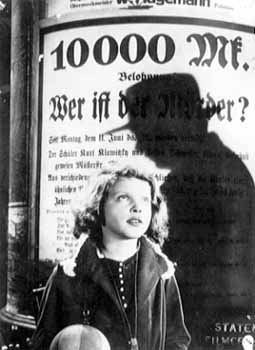
Peter Lorre and Little girl from "M"