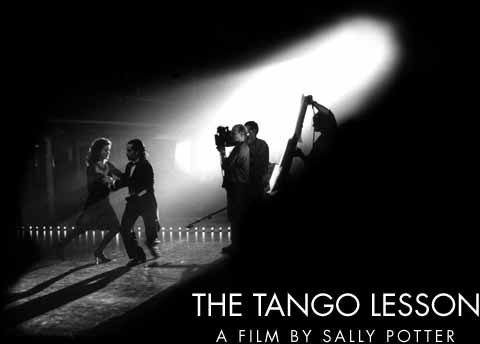
Pic from Sony.com
Human Limitation in
"The Tango Lesson"
By
Landon Sealey
Sally Potter's The Tango Lesson is a study in human limitation, both the limits we set for ourselves and limits placed upon us by others. In this essay, I hope to use the relationship between the characters of Sally Potter and her love interest, Pablo Veron, to show that the director is trying to blend reality and expectation (or fantasy) into a socially relevant commentary upon how our personal sense of limitation can be acted out in art and life; I believe Sally Potter is saying something about societal perceptions of love and art, since both of these areas tend to heighten or focus our personal ontologies (or bring into focus the fundamental ways and reasons we assign value to things, experiences, events, persons or life and culture in general). Granted, this is a poetic venture. However, this is not necessarily a limitation.
To narrow my focus, I will choose the concept of work or vocation to concentrate on. More specifically, then, I am asking, "is it possible to blend one's professional and personal life when both are stirred by the same essential passion" as is the case, it seems, with Pablo Veron. When Pablo, the Tango teacher, neglects to show up for a New Year's date with Sally, he shows up late at here apartment. Sally says to him, "I think we should set some new limits to our relationship". Pablo agrees and states that he has had trouble in the past when he tried to combine his "personal and professional life". Pablo is giving Sally tango lessons at her request. In fact, at first acquaintance, Sally has made it quite clear that she is in awe of how Pablo moves on the stage, "like an actor". Whether she is as taken with the man as the dancer is not made as clear until later in the film.
Before I continue with their relationship, I must say that since this is a "socially realistic" film, we are one of the characters. Hence, it is novelistic in the sense that the author of the film, Sally Potter, is inviting us to roam with her through the landscape of her life and inviting us to see the landscape of our life; it is what cultural historian, William Irwin Thompson, has called "metafiction" in the sense that this film is designed to reveal the design of the archetypal "story" - the essential design of our becoming, our actualization.. Hence, the making of the film, is, along with the romance, a subject of the film and likewise the maker of the film is a subject of the film. I would thus call her the Poet. This film is poetry.
And what the romantic poetry of past and present has to lend us is the beauty or quest of seeing one's self in another. The final song and dance sequence of the film makes this quite clear as it chimes "I am you, and you are me" as Sally and Pablo dance into one enchanted evening punctuated with a dramatic kiss. The Poet knows that life isn't always one enchanted evening, and the film has made clear by this point that passion is fraught with the potential for bad endings, but what else is there to do? The moment of passion as with the moment of poetry is not so much a collision of opposites such as reality and fantasy but a tenuous balance (as on the verge of collapse or birth) of elements more closely related there ever imagined outside the realm of romance, elements such as reality and fantasy, story and architecture, art and life, work and play, love and hate, freedom and limitation - passion.
As an example, we witness the growth of the Poet's art form, in this case film. In the beginning of The Tango Lesson, Sally Potter is working on a script for violent film noir called Rage. And there could not be a clearer metaphor being made than that of her life's work being compared to her life's story when her home literally falls apart around her as she is writing. This is "horrific" in the sense of stagnancy and decay and also the physical limitations of matter ie rotting wood. However, the decaying home could also be a metaphor for her past limitations falling away. In deed the Poet is just beginning her first tango lesson. And it should be no wonder at this point that the tango is a metaphor for dealing with human limitations.
So, the Poet and the filmmaker is being asked at the outset, even challenged, to build a new home, to be an architect. She can no longer portray just the contour of sociopolitical architecture through the medium of film; she must also inject her very own breathe and soul into it; this is a mythoheroic journey she is undertaking for she must sacrifice her previous creative limitations for new ones. In deed, while looking in a mirror with Pablo, he asks her ingenuously, "you are making a film right now aren't you. You aren't really here with me." "Yes," Sally says, that is what I do. I use my eye." This is an important moment in the film because Sally must confront what she wants and gets out of making films versus what she wants and can get from Pablo professionally and personally (he is to be the star of her newly developing film - not surprisingly, the one we are watching). Pablo, the tango god, is on a very similar journey. In other words, Pablo Veron is the dancer and Sally Potter is the master of the dance. In the film, as I hope in the essay thus far, it is evident that these are not opposing forces so much as intermingling poetic entities from which we may draw relevance outside the context of a theatrical play of desires and wills. Hence, we the audience must confront our own will and desire to "watch a film about romance," about the passion almost totemically symbolized by the tango. As if this wasn't ambitious enough already, the Poet throws God into the mix; she is becoming more, and she wants us to see more in film art.
Sally Potter's value system as a Poet or Director concedes to her value system as a mortal being when Pablo (who, along with his colleagues has transformed her into an adept dancer) asks her if she believes in God. Sally replies, "I believe in chance and that our destiny is what we make of it." "With what?" asks Pablo. The Poet replies, "with our will." "But," she says, "I am a Jew." So is Pablo. And as a tear rolls down their cheeks, the Poet has isocognitively shaken us up one step further, for the entire film is replete with a sense of cultural displacement. Pablo reveals more of himself stating, "I don't know who I am." The film moves over the territory of Britain, France and Buenos Aires and both main characters alternate speaking French, English, and Spanish. This film is quite the regeneration of the limitations we put on the language of architecture and film in the Renaissance Mannerist tradition. That is, the play of forms both in society and nature are isocognitive with the play of human emotion and ontology; we inextricably engaged in the drama of seeing both nature and society (and especially, their architecture or language) through the human component. Again, this is a very romantic film in the classical sense.
One wrestles with one's self to see one's self in another for confronting another in romantic love requires that one take complete creative responsibility for one's world even though one can't entirely control it. For this reason, The Tango Lesson is a morality play about love in contemporary society. Much like light and shadow play in nature, the same play in our souls. We may not be able to totally understand it, but it helps to know where the story is taking place and that is taking place at all. In any case, it helps to be reminded of it. In conclusion, Sally Potter has dared to satisfy our Jungian religious instinct. She has dared to normalize the cultural playing field while giving us the freedom to take what we want and honour the relative importance we grant foreign art and culture. She it a once, spiritual, romantic, political, self effacing, honest, and extraordinarily relevant to the dilemmas still facing modern man and woman. Make of it as you will. So spoke the Poet.