
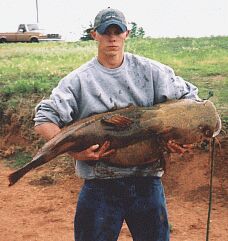
the most elusive of all catfish, even the most knowledgeable
catfisherman can go days, or even weeks without a fish.
It takes extreme patience and determination to successfully
pursue these whiskered giants. I'm going to try and explain
some of the information required to attempt to track and catch
these elusive catfish. There are many variables to factor in
when tracking flatheads but i'm going to start with the basic
information about the flathead.
The Flathead Catfish, unlike other catfish, is a predator,
therefore it prefers its food to be alive. Flathead feeding
activity peaks at night. They have well-defined territories,
and relate heavily to cover. If you remember nothing else in this
article, those four rules should put you on a flathead or
two. But, understanding the seasonal patterns can make those
encounters a little more frequent. When Flatheads emerge from
their winter haunts in early spring they have two things on
their mind, eating and spawning. This is one of the best times to
catch a Trophy Flathead, after winter they eat very heavily
regaining their energy and feeding up for the spawn, reaching
their biggest size of the year right before spawn. The water
is very cool at this time so fishing can be good day or night,
although flathead activity usually peaks at night, cool water
coupled with Spring weather such as heavy winds and rain can make
for some excellent day fishing opportunities for those willing
to get a little wet and cold. Flatheads don't generally come very
shallow this time of year (unless a good rain has caused some
creek or river swelling) nor do they hang out in the deepest
water available, opting instead for mid-depth areas with good
cover. This feeding frenzy will continue until spawn, although
just before the spawn flatheads will start searching for a
spawning area with the biggest and baddest flats taking the
best available areas. This is a great time to start fishing
the Rip-rap and the Dams. Practically every flatty in the lake
will visit the rip-rap and the dam while searching for their
spawning sites. When spawning begins when the water temperature
reaches approx. 72-78 degrees I always get a sharp decrease in
the catch rate, flatheads don't eat while their spawning, this
is why they feed so heavily before hand. After Spawning, the male
will drive the female from the nest and tend to eggs until they
hatch and maybe until they disperse. The female will eat after being
driven off by the male, this and the fact that not all flatheads
spawn at the exact same time mean you can still catch flatheads
during the spawn, just not usually quit as many. After the spawn
the water is getting pretty warm and summer is setting in, this
means hotter days, less wind, less rain, and less cloud cover,
which makes the flathead almost exclusively Nocturnal. Summer
Flatheads are very hard to catch during the day (or at least I
haven't figured out how to do it yet) so I would have to
recommend fishing only at night with live-bait. Fall is
another great time to catch some Hefty Flatheads, the
water temp starts to continually decrease and the fall
feeding begins. Flatheads have to feed up before winter
just as they did before the spawn, the patterns are also
fairly similar to spring in reverse without the spawning
stuff. Winter is almost impossible, most flathead anglers
take the winter off, flatheads don't fare well in cold water.
Some studies claim they burrow partially in the mud where
the sediment can be five degrees warmer than the water,
although some have success jigging soft plastics in early
and late winter. The information just posted can give
you a basic idea of what the flatheads are doing at any
given time, but understanding Weathers affects on flatheads
can increase your success a little more. Weather plays an
important role in flathead activity, heavy winds, overcast
skies and rain? You might as well set some milk out cause
its time for the kitties to eat! Flatheads are predators,
therefore, their favorite time to eat is any time they have
a credible predatory advantage. By this I mean they take
advantage of their strengths against their preys weakness.
For example: its a well know fact that flathead feeding
activity usually peaks at night, why? Flatheads have extremely
good vision at night, their prey does not, thus giving them
an extra advantage over its prey. Same goes for heavy winds,
heavy winds can cause turbulence in the water, disorienting
baitfish such as perch and shad making the flatheads job a
little easier. But its when the flathead has a mixture of
different advantages on its side that can really put them
into a feeding frenzy. Heavy winds, combined with overcast
skies and rain can make an excellent opportunity for a catfisherman
to cross a few eyes. I told you there where a lot of variables
to factor in. I just have to cover one more cause I don't know
how much I can put in this one post. Finally we will talk about
forage, an important part of locating flatheads is locating its
prey. Shad, Perch, and Crappie are some favorite foods of the Flathead, when they spawn it makes for an easy target for flatheads.
While flathead fishing may be slow and tedious at times it can be
fast and furious when everything comes together. Don't give up,
I caught my first flathead 42# on accident, it took me 6 months
to catch another one on purpose. I never gave up and have had some
unbelievable days on the water. I would also like to mention my
dad Ron "BareFoot" Cantrell, the Master Catman who took the time
to teach me everything I Know about flatheads. Catfishing has made
a greater bond between my dad and me, so I'll always love him and this
great sport!!!!!