| Hey, How about that picture? Pretty snazzy, ah? I was on one of my many journeys when I came across this fantastic picture. So being the good Indian that I am, I counted coup against this poor fellow and swiped his picture. He didn't even see me coming. No, I'm kidding, I know I'm a Pastor and would never steal...much. The picture is actually from www.reesetipis.com |
| The First Nation Bible Study is my newest creation in the ongoing effort to take over the world. Oh, I mean win the world to Christ. The First Nation Bible Study is an examination of Christianity from a First Nations perspective. I intend to update this section every week, of course we all know what road is paved with good intentions. The Bible Study is something I am doing at the church and it seemed like it would be a good idea to incorporate it here. |
| Symbolism |
 |
| First Nations Bible Study |
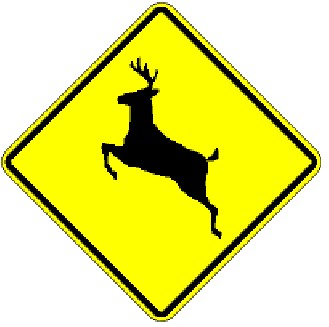 |
| And I, Dave, when I was soaring along the plains of Saskatchewan, saw in the distance a sign suspended in the heavens upon a white pole rising from the earth. I saw the image of a diamond, a diamond of two colors,the yellow of the noon-day sun being trimmed with an outline of darkness, black as night. On the diamond was a male stag, black in color. It appeared to be leaping, as though it were in flight. Upon it's head was an antler and around about the antler it had points, four in number. I beheld it's majestic beauty and wondered what could it mean. |
| I think most of us have probably seen this sign somewhere in our travels. If you think about, this sign is the government's unique attempt at prophecy. The highway department puts this sign up in an effort to warn the motorist that a deer or a deer-like animal may cross the road at any moment. It's pretty obvious that a deer is not going to cross at the exact location where the sign has been placed, and it's even more obvious that when a deer does cross the road it's not going to be black male deer. The sign is symbolic, it represents some other reality. The yellow indicates a warning and the black deer indicates that it is possible that a deer could cross the road at any moment. So be alert. In Christianity, we use all kinds of symbols to express and aid our faith. The cross represents to many of us, Jesus and our salvation. We use the dove or fire to represent the Holy Spirit. We have all kinds of postures that we use during prayer. We stand, we kneel, we lay on the floor, we put our hands together. We do this to humble ourselves or show our humility before God, it's a symbol of what we feel in our hearts. At least I hope it is, some people just do things for religious reasons. I think we need that symbolism. It gives us a physical representation of a spiritual reality. It's when you start worshipping the symbol, or making the symbol a giver of power that you are in trouble. Because now the symbol has become God or God-like. Idolatry is basically symbolism taken to an extreme. In First nations society there alot of symbols, pictures, and images that represent and speak to the First Nations person. The teepee, peace pipes, feathers, dancing, buffaloes, eagles, starblankets, etc., etc., etc., are great symbols of the First Nation people and they instantly speak to the First Nation person. A first nation person can look at these symbols, given the right context, and instantly feel some kind of a connection. I think the body of Christ can use these symbols, in the right context, to reach and speak to the First Nation person. The church has for many years struggled to grow in First Nation society. I think it's because alot of the evangelical church does not know how to speak to the Indian man or woman. The church does not know the language of the First Nation person, and the First Nation person person does not understand "churchanese", so there is alot of misunderstanding amongst the two groups. I think that the incorporation of First Nation symbolism into the body of Christ would go along way to bridging the language barrier between the two people groups. If the church could do that I think First Nation people would feel that instant connection and thus be receptive to Jesus Christ, who is "for" the First Nation people and not against us. And isn't that what it's all about? Bringing the gospel to a people that need it. Ekosi. Pastor Dave Bird |