In OTL, the Reconstruction issue was going even before the Union won the war. While I have an accelerated Union win, that doesn't change. Not much.
On August 12, 1863, President Lincoln institutes by executive order a policy for reintegrating the rebellious states. Intended to enhance the power of Southern Unionists, his Proclamation of Amnesty and Reconstruction is pretty much his OTL policy. When 10% of the people in a state eligible to vote in 1860 swear an oath of loyalty to the Union, then that group of loyal voters shall be entitled to form a new civilian state government which is to be considered legitimate. The Union controlled parts of Louisiana and Arkansas (basically the whole states) fulfill these conditions relatively quickly, and Lincoln issues a new Order on Oct. 5. When the representatives of those states arrive in Washington, the Radical Republicans in Congress refuse to admit them. The Congress then passes the Wade-Davis Bill, which like OTL, requires an oath of loyalty from the majority of each state's 1860 voters, a new constitutional convention per state, and adds legal safeguards for freedmen. Lincoln vetoes the bill as soon as he gets it. While the Senate overrides the veto, the House, being badly divided, fails to do so as the House democrats vote unanimously against it (joined by a few more moderate GOP members). The deadlock is not resolved; there is no compromise as in OTL. While the winners of the Congressional elections in the two states are legitimate (Lincoln's order remains in force), they are not allowed to participate in sessions. Congress further refuses to recognize the state governments.
In April and May 1864, Gen. George B. McClellan has a series of very interesting meetings with August Belmont, chairman of the Democratic National Committee. At the Democratic convention that year, he is easily nominated for President, and Andrew Johnson of Tennessee is selected as his running mate.(1) The Copperheads are insignificant here, and Vallandigham's peace platform is never introduced.(2) (Vallandigham was still arrested, convicted by a military court in Ohio, and exiled to Canada in 1863. He did sneak back like in OTL but was never nominated for governor by Ohio Democrats.) Lincoln and Hamlin are renominated at the GOP convention.
McClellan, though he hates Vallandigham, holds him up as a poster boy for how the GOP brooks no dissent, pointing to similar arrests. Deliberately confusing the Radicals and Lincoln, he goes on to say that Lincoln "cares more for the civil rights of Negroes that those of fine upstanding white men." This is one of many instances where the Democrats play to Northern racism (just like OTL). The key difference is that with McClellan being a bigger hero, they have a more credible messenger. (The message itself is just as repugnant.)
McClellan is in this TL not a cashiered, disgraced general, but the general who won the war. (At least that's how the nation sees it.) That alone helps his chances. But the fact he isn't running on a peace platform helps, as in OTL it undercut his pro-war message. Many soldiers not only favor, but openly promote him.(3)
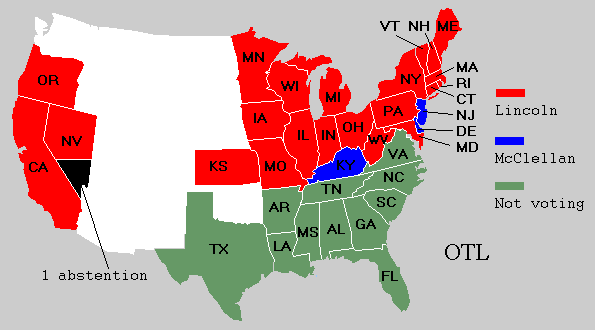
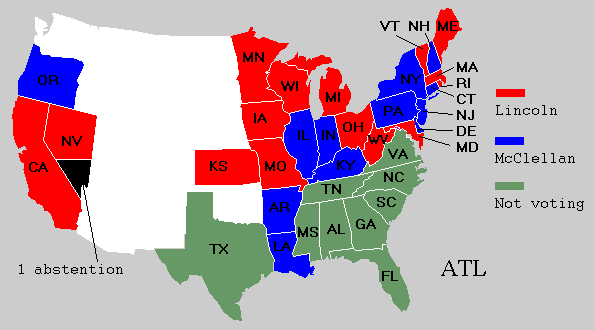
When Nov. 8, 1864, is over the votes are being counted. McClellan takes New Jersey, Delaware and Kentucky, just like he really did. But he also captures Illinois, Indiana, New York, New Hampshire, Pennsylvania, Oregon and Connecticut, as well as the reconstructed states of Arkansas and Louisiana for a 135-110 win, with one abstention in Nevada (admitted to the Union on Oct. 31, 1864, just like OTL). (4)
To be continued...
1. With the war wing of the Democrats more firmly controlling theparty, not nearly as many War Democrats jump to the GOP, which doesn't rename itself the Union party. Also, with the Copperheads losing power, there is no cause for Pendleton as VP nominee.
2. Even though the war is over now, making the issue moot, the platform would never stand a chance in this TL.
3. In OTL large numbers of soldiers voted for Lincoln even though McClellan was extremely popular with them. The general opinion was disgust with his choice of political allies (Copperheads).
4. The abstention in Nevada really happened in OTL. While the GOP won in a massacre (212-21) electorally, the popular vote is another story. Lincoln's margin of victory was 400,000 votes, just over 10%. In the states he lost in ATL but not OTL, his margin was under 10% in each. His margin was only 1% in NY, the state with the most electoral votes (33). Abe loses only about 180,000 votes compared to OTL, so he still comes out on top in the popular count. (His margin is actually a little wider in a couple solidly Republican states.)
Part 11: Caesar Salad With Lame DuckThe 13th Amendment, like the rest of Reconstruction, was set in motion before the war even ended. In October of 1863, the Senate passed an addition to the Constitution reading a lot like our 13th Amendment. The House only achieved a simple majority (2/3 majority was required) as the Democrats united with a few moderate Republicans to kill the proposal.
When George B. McClellan is elected President in 1864 by a slim margin, losing the popular vote, those who claim he is overrated are as vocal as those calling for his election. But the Democrats are not just happy with the White House. They make substantial gains in the Senate and recapture the House. The new Congress looks like this:
House: 102 Democrat, 87 Republican, 2 Other
Senate: 32 Republican, 20 Democrat
Feb. 13, 1865
1:00PM
Abraham Lincoln stood outside the White House facing the people who had voted him out of office. He knew he'd gotten unpopular over the course of the war, but took some solace in the fact that a majority of the country had voted for him. As he made his speech, he wound down to a mixed smattering of applause and boos. One voice called out: "Mr. President!"
"Yes, what is it?"
"Avoid the theater tonight, sir." Lincoln thought that odd; how could this man know he would be going to Ford's Theater tonight for a play?
"Avoid the theater tonight, you say?" he answered. He found himself intrigued and nervous.(1)
"Yes, sir. Death waits for you there. I study the signs in the stars, and the Moon is not in a good position for you. Do not go out tonight, Mr. President. It is bound to take your life. There is a bad moon on the rise."
The chief executive whispered to an aide, "What's that man talking about? A bathroom on the right? It makes no sense."
"Must be a madman, Mr. President."
Lincoln made some soothing words to humor the astrologer, but felt better about going to Ford's; there was nothing to this warning.
A Washington boarding house
2:15 PM
John Wilkes Booth checked the Derringer for the third time that day. His plans were perfect. Being voted out was not enough for Lincoln, he had to be removed permanently as punishment. Nothing could stop him. (2)
Ford's Theater
8:23 PM
The audience was riveted by the play when a cloaked person made his way to the President's box and opened the door. Booth thought it strange that there was no one guarding the door, and decided it was a sign from God. He fired once at the back of Lincoln's seat and ran from the box. "Sic semper tyrannis!" the assassin's voice called out. Three men chased after him as he fled the building, but he hopped on a horse and rode off speedily, eluding all capture.
Abraham Lincoln was not killed right away, it was only a mild wound at first. He was easily able to go on about the business of his office. But it grew infected, and he got physically weaker. The outgoing President refused to let Hannibal Hamlin take over, however. His mind was as strong as ever. The inauguration of McClellan was a somber affair, and the 17th President prayed with everyone publicly for Lincoln's recovery. Alas, it was not to be and Lincoln died on March 15, 1865.
It was widely known Lincoln had been in favor of the 13th Amendment, though. Support for it grows and the House passes it on March 30, with a bipartisan backing. Then it is sent to the states and formally declared ratified when Michigan passes it on August 1. 6 out of 11 ex-Confederate states are among those that pass it.
Lincoln's killer is never caught or identified. Many theories will be put forth as to who did it, and the question is hotly debated on the Internet decades later. The idea that John Wilkes Booth killed Lincoln is first proposed in 1932, but never is well received. The most popular theory is that a local doctor was responsible. But the doctor's descendants point to accounts of some eyewitnesses who thought they saw a one-armed man flee the theater. The mystery is left for the ages.
1. Lincoln supposedly had psychic visions, including a dream predicting his own death. IMHO he'd be predisposed to believe a warning.
2. Here Booth is not part of any plot, but is acting alone. Even his OTL co-conspirators have decided he is a loon; he is decidedly more unbalanced than OTL due to the South getting so thoroughly defeated. He is not going after McClellan because Lincoln's policies were known to have angered him in OTL, while McClellan favored a much more moderate Reconstruction that would be easy on the South.
Part 12: Building Bridges
Mar. 3, 1865
Washington, D.C.
President-elect George B. McClellan was worried over his inaugural speech. He was going to blast the GOP for being the party of the iron fist, for policies which could only anger the South into another rebellion down the road. His campaign had said as much, often with vitriol. He'd even asked voters in speeches whether they wanted their children fighting another war between the states in 20 years, and promised to keep the next generation safe. But he couldn't very well attack the Republicans so heavily now, not with so much sympathy for a dying Lincoln being the national mood. Lincoln's current main problem seemed to be not admitting he was doomed. And there was still the Senate to worry about, he needed the Republicans there to accomplish his Reconciliation program. Meantime, he could not forget how slim his win in November had been. Why, 13 votes was a small enough margin that if Lincoln had taken one more state, he'd win! (1) He had to get some more Democratic votes from somewhere in four years. But where?
Excerpt from the inaugural address of the 17th US President, George B. McClellan:Pres. McClellan's first act was to recognize the state governments formed under Lincoln's Reconstruction policy, still in force because the Radical Congress never was able to put anything else in place. There are now five such governments, all dominated by Southern Unionists. They are in Louisiana, Arkansas, Tennessee, North Carolina, and South Carolina. In the meantime, the first act of the new Democratic House is to recognize these same state governments and admit their duly elected Representatives, something the Radicals never did. The Senate, however, still refuses to admit Senators elected under this policy."We have now the time not just for Reconstruction, but also for Reconciliation. The recent war we have been through tore this great nation asunder. Brother was commonly fighting against brother, and friend against friend. It is time to put our differences aside and look toward the future as one. Now is the time of the olive branch."
The 14th Amendment
In May 1865, a new addition to the Constitution is debated in the Senate. The Radicals controlling that house don't feel the Lincoln policy combined with the 13th Amendment to be sufficient. And so a new amendment is proposed, the 14th, which is identical to the 14th in OTL, except it comes earlier, and the order of the sections is not the same. (Section 1, repudiating the Confederate debt, came 4th and last in OTL.) The Senate concludes debate and votes on the matter May 31. The vote is 28-22 in favor of the 14th Amendment, with 2 abstentions, but 35 votes are needed for a 2/3 majority.
McClellan is intrigued by the possibilities here, though. On June 2 he contacts GOP Senate officers with a possible compromise. If they would be willing to modify the proposed amendment by eliminating Sections 3 and 4 (2), he would be willing to sign into law a bill they should pass which would disenfranchise ex-Rebel leaders. In essence, he would back as statutory law one provision in exchange for the watering down of the amendment. McClellan has no sympathy for the rebellion, and would be quite happy to see its leaders barred from office. But the rank-and-file of the CSA army and government are potential voters, and the South is likely to go Democrat. He has decided the South must be Reconciled by 1868, and it must be done on terms acceptable to the South (for which, he assumes, the South will thank him at the polls). McClellan is doing this partly because he genuinely believes in a moderate reconstruction, but mainly because McClellan believes in McClellan.(3) Debate within the Radical camp is heated over whether to accept the proposal. But finally they figure it is the best they can do if they want the 14th passed. Counting the law the President agrees to sign, they are getting 3/4 of what they want, and the Democrats and moderate Republicans are more likely to vote for this. (McClellan explains to the Democrats who are against any disenfranchisement that the law would be likely to be struck down as unconstitutional if the Supreme Court reviewed it. Thus, there is no harm done if they vote for it, and everything to gain if it swings the South in their favor.)
The revised version of the 14th Amendment is voted on by the Senate June 15. This time the vote is 39-13, with all members voting. The proposal goes on to the House, where it is also passed, this time by a vote of 130-58. From there it goes to the states, and it is declared ratified on Nov. 26, 1866 after passage by Illinois. McClellan does make good on his promise. (More on that later.)
1. Several of McClellan's states were more than 13 electoral votes. See part 10. Most of the closest states in OTL's election were also most worth having.
2. Sections 2 and 3 OTL, which disenfranchised former Confederates who served the Rebellion after having sworn public oaths to the US or to their own states pre-war, and which reduced the representation in the House of any state which denied voting rights to any of its citizens.
3. All my research on the man has indicated he was overwhelmingly full of himself. For example, the close win at Antietam when he dithered away his advantage in OTL, he crowed about having dealt the South a crushing blow. Far from it except in his own mind.