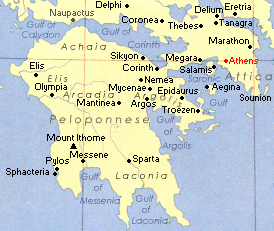
We flew into Athens and began our sightseeing there (Pictures 01 to 14).
We flew into Athens and began our sightseeing there (Pictures 01 to 14).
Picture 01: The Acropolis
from a distance.
Picture 02: Lance in front of the
Parthenon.
Picture 03: Lance (lower left) being dwarfed by the East face of the Parthenon.
Picture 04: Another shot of the Parthenon's East side.
Picture 05: The Erechtheion.
Picture 06: Behind and to the right of Tanya is
Hadrian’s Arch
and the Acropolis is farther in the distance.
Pictures 07 and 08: The Theater of Dionysos South of the Acropolis.
Picture 09: The
Ancient Agora and the Acropolis are behind Lance and Tanya.
Picture 10: The
Temple of Hephaestus (Thisio)
Picture 11: A bronze Spartan shield from the Agora Museum.
Picture 12: The
Temple of Olympian Zeus.
Pictures 13 and 14: The Tower of the Winds in the
Roman Agora.
This tower from the 1st Century BC was originally a weather vane, sundial and water clock.
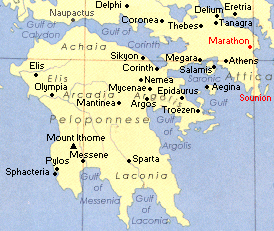
The Attica Region (Pictures 15 to 17)
Picture 15: a Tomb (Tumulus) at Marathon.
Pictures 16 and 17: The Temple of Poseidon at Sounion, probably commissioned by Pericles and built around 440BC.
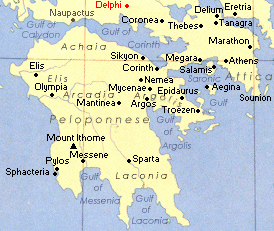
Delphi (Pictures 18 to 23)
Picture 18: A statue of a Sphinx from the
Delphi museum.
Picture 19: The remaining statue of a chariot driver (the full statue had the chariot and horses).
Pictures 20 and 21: The
Temple of Apollo.
Picture 22: A treasury in the foreground with the Athena Pronaea and ancient gymnasium farther down the
mountain in the background.
Picture 23: The
Ancient Stadium.
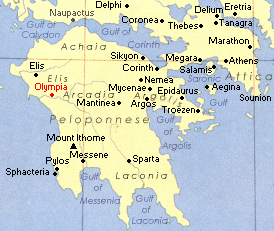
Olympia (Pictures 24 to 33)
Picture 24: The Palaestra,
a square building used for athletic practice.
Pictures 25 and 26: The Leonidaion,
a hostel for distinguished visitors.
Picture 27: The Temple of Hera.
Picture 28: The one remaining standing column of the
Temple of Zeus.
Pictures 29-32 are from the Olympia Museum, depicting
an impressive collection of Bronze Age helmets (and shields).
Picture 33: These are bronze tripods that were used as offerings to the
Gods (for people who couldn't afford the full-size tripods).
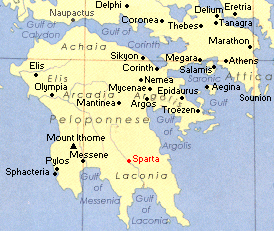
Pylos and Sparta (Pictures 34 to 40)
Picture 34: An ancient washbasin in
Nestor's Palace, which is near Pylos on the map.
Picture 35: The palace's throne room and its circular hearth.
Picture 36 and 37 are of Mystras,
a Byzantine city founded in the 13th century A.D. and one of the few sites we visited that wasn’t ancient (Bronze Age).
Mystras is between Messene and Sparta on the map.
Picture 36: a shot of the Upper City (Ano Chora).
Picture 37: The Ayios Demetrios (cathedral) and the museum to its left with modern Sparta in the background.
Picture 38: The remains of a Roman Theater in
Ancient Sparta. Most of the Spartan ruins are from Roman reconstruction.
Picture 39: The Spartan Acropolis.
Picture 40: The Sanctuary of Artemis Orthea, where young Spartan men had to endure public floggings as a
rite of passage.
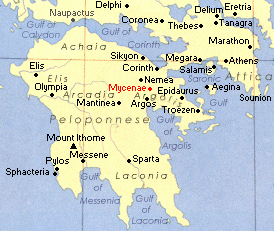
The Mycenaen Region (Pictures 41 to 51)
Pictures 41 to 43 are of Tiryns,
which is near Argos on the map. Picture 41 is the entranceway, Picture 42 is of the courtyard, and Picture 43 is of a
corbelled arch which was possibly a stable.
Next are pictures from Mycenae
and its museum.
Picture 44: The Lion’s Gate that is the entrance to Mycenae.
Picture 45: Looking down from the Great Ramp onto a Grave Circle.
Picture 46: Tanya and Lance taking pictures of each other in the dark
subterranean cistern.
Picture 47: An entrance to a Mycenaean tholos tomb (shaped like a beehive on the inside).
Picture 48: Lance standing in the larger entrance to the
Treasury of Atreus.
Picture 49: A representation of a figure eight shield at the Mycenae museum.
This type of shield was probably made of bull hide stretched across a frame with some of the hair still intact.
Picture 50: Various burial artifacts (swords and a gold mask).
Picture 51: Bronze tripods and axe heads.
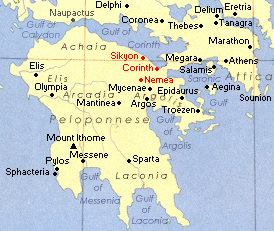
The Corinth Region (Pictures 52 to 58)
Picture 52 through 54 are from Nemea, a site at which Tanya used to excavate.
Picture 52: The Temple of Zeus undergoing modern reconstruction.
Picture 53: The
Stadium of Nemea.
Picture 54: Facing the starting line of the Stadium.
Picture 55 and 56 are of Corinth.
Picture 56: The Temple of Apollo with the fortress of Acrocorinth atop the mountain in the background.
Picture 57 and 58 are of Sikyon.
Tanya is participating in a survey of the valley around this site.
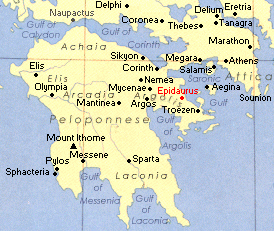
Epidaurus (Pictures 59 to 63)
Pictures 59 and 60: The
Theater of Epidaurus, the best preserved Greek theater and home to a modern summer theater festival.
Picture 61: The Stadium of Epidaurus.
Picture 62: The
Sanctuary of Asklepios. Epidaurus was an ancient healing center.
Picture 63: Behind the ruins in foreground lies the remains of a Roman bath house.