WEAPONS

This is the area dealing with weapons. The first section deals with Marine issue, and the second section deals with Starfleet issue.
MARINE ISSUE
M-75 MARINE TYPE 4A MEDIUM PHASER RIFLE
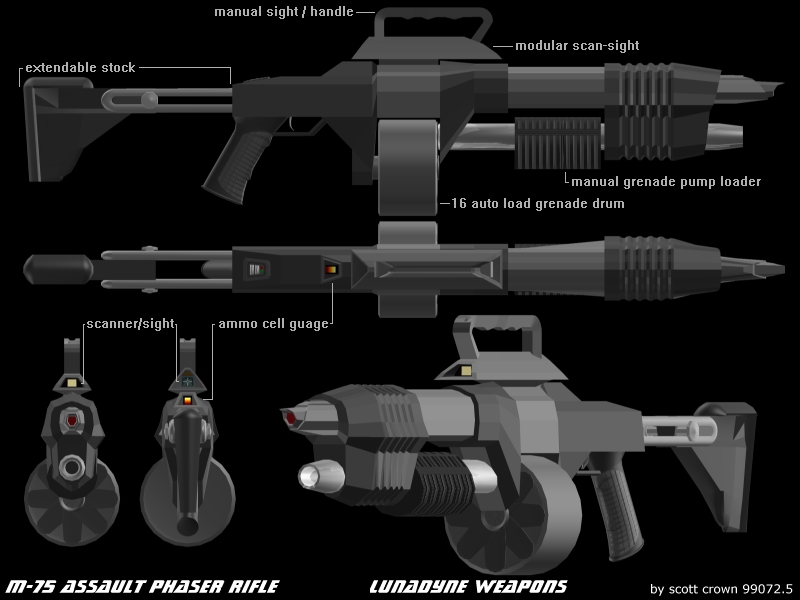
The Type4a Medium Phaser Weapon is an offshoot of the standard Type4. Slightly larger than the Type4, the 4a has many improvements detailed below. While not meant to replace the Type4, the 4a is added to the Shadow Operations arms compliment as an alternative for medium weapons fire.
Background: After interviewing many Federation Marine officers, it was determined that a more robust medium capability weapon design was necessary. The need for a multi-plane firing weapon (shoulder, mid-section, hip), with the ability to provide rudimentary target tracking was specified. The ability to activate key functions without taking a hand away from the weapon was also specified.
While thoroughly tested in-house, the Type4a is still in the experimental stage. Field tests where decided and bestowed upon the Marines. It is believed that with direct input from the Marines, the Type4a can be finalized and put into use for the Marine Corps and Starfleet special operations.
At the height of the Dominion War in early 2376, a shipment of M-75s were sent to Starfleet's Shadow Operations special forces unit for continued field testing. Each Shadow Ops vessel has been issued 12 of the M-75 weapons.
Key Functions:
- Stock: The Type4a includes a "swing-out" type stock that, when folded, is more completely out of the way for single-handed and non-shoulder use of the weapon. When extracted, the relatively tiny stock, made of tri-polymers for strength, fills the requirements for a shoulder-fired weapon.
- Ammunition Cell: The ammunition cell is loaded from the back of the weapon. The design of the cell is compact - for ease of carry - yet holds a yield equal to that of the larger variation. The cell itself also includes a trigger mechanism for use as a stand-alone explosive, detonation upon impact.
- Tactile Control Surface: The Tactile Control Surface (TCS) is a hybrid of that found on the standard Type2 phaser and that of a standard tricorder (see graphic for detail). Functions include weapon mode settings as well as a limited tricorder-type Range Finder (RF). Though limited, the RF is meant to augment the Marines' helmet-mounted tricorder functions (or with Shadow Ops, the NVVs). Showing only horizontal azimuth distance, the RF allows the user to track targets - in a limited fashion - in the event the helmet is non-operational or present. The RF displays targets in a sweep mode, showing only what it can detect in the direction the weapon is aimed. As with a tricorder, the RF can detect life signs through objects, however the function is limited. Susceptible to interference and jamming signals, the RF is not fool-proof nor meant to replace tricorder functions. Distance of the Range Finder is limited to one hundred meters and can be tuned down to display lower ranges by the user.
- Pop-up Imaging Sight: The Pop-up Imaging Sight (PIS) is linked directly to the TCS Range Finder, displaying horizontal and vertical azimuth images of detected targets. When looking through the PIS, targets are displayed as small red squares, the more distant the target, the lighter the hue of the square. Objects are also displayed in the PIS reticle, hue saturation displayed according to distance. The PIS is only activated by pressing and holding the PIS target tracking Tactile Thumb Pad on the weapon (see #5 below). This allows the user to activate the PIS functions only when needed. For example, in the event there are multiple targets saturating the area, activating the PIS might obscure the sight making it difficult for the user to aim the weapon. In that event, without pressing and holding the PIS Tactile Thumb Pad, the sight stays in its inert mode and functions as a standard weapon sight.
- Tactile Thumb Pads: The Tactile Thumb Pads are located on either side of the weapon housing, just out of "lazy" reach of the users' thumb. Having the pads placed in this manner requires the user to reach for them, thus negating any accidental activation. The four pads include the following functions: PIS target tracking, weapon mode toggle (single-beam/pulse), PIS activation toggle (up/down), and power cell eject.
- Replaceable Long Life Power Cell: The Replaceable Long Life Power Cell is the weapons main power source. Operating the TCS and PIS functions, the cell has a standard life of six months. In the event of no ammunition, the cells' power can be rerouted to ammunition with an extremely limited capacity. The Replaceable Long Life Power Cell can be set to overload as a means of last resort. In the event the Replaceable Long Life Power Cell becomes depleted, power can be rerouted from the ammunition cell to provide power to the TCS and PIS. Doing so, however, seriously diminishes the life capacity of the ammunition cell.
- Optional Grenade Launcher: The Optional Grenade Launcher can quickly and easily be fitted to the Type4a providing single-load and shot capability of the standard Type7 Marine grenade. Loaded from the rear of the launcher, the grenade is placed in the launcher housing. A single cock of the launcher readies the grenade for launch. A press of the launcher firing pad, located on either side of the launcher, releases the grenade. The launcher is a point-and-shoot weapon only, with a maximum distance of 0ne hundred meters. The grenades themselves are equipped with a trigger mechanism for use as a stand-alone explosive, detonation upon impact.
PR-209 MARINE AUTOMATIC PULSE RIFLE
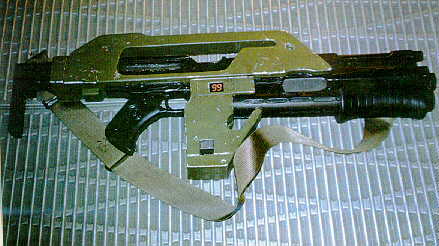
The 209 is a Phased Energy Reticulated Pulse Rifle with an effective range of five hundred meters, designed to discharge rounds that alternate between tightly packed balls of charged particles and a phased energy mix. The primary reason for this is to be more effective against targets with energy shielding because, theoretically, the energy charge weakens the sheild, and as it is recoiling from the energy impact, the matter charge has a better chance of penetrating the shield. It therefore fires a energy bundle followed closely by a particle bundle. This pair is referred to as a single shot.
The weapon is powered by a rectagular energy cell that fits into the bottom of the weapon just in front of trigger and pistol-grip. Due to the extensive energy required to charge the particles, the standard energy cell can power a maximum of 100 shots.
On the right side of the cell sleeve, there is a digital display expressing the number of shots remaining in the cell. As soon as a dry cell is replaced with a fresh one, the weapon automaticaly charges it's first shot, and therefore, the counter can only show a maximum of ninety-nine.
Under the barrel mounts a thirty millimeter pump-operated grenade launcher with a range of one hundred meters. The 209 can contain three grenades in it's holding chamber.
The weapon has four firing rates: single, triplets, auto, and full cyclic. Single shot will fire only one energy-particle pair each time the trigger is depressed. Triplets fires three spaced shots each time the trigger is pressed. Auto will continue to fire spaced shots until either the trigger is released or the energy cell runs dry. Full cyclic is similar to Auto, but the shots come at three times that speed. If the weapon is fired on full cyclic for more than three seconds, the build-up of heat will begin to cause damage to the weapon, which may lead to an internal ammo explosion. It is recomended to use short, one-second bursts when toggled to full cyclic.
M30 30mm GRENADES
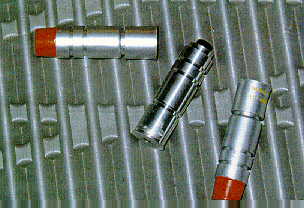
M30 grenades are the most commonly used grenades in the Marine Corps. Both the M-75 and the PR-209 are chambered to accept M30's.
The M30's come in several variations, and are all powered by a small discharge of concentrated gas triggered by the launcher mounted on the weapon firing it. M30's are also capable of being triggered by time-delay charges with a minimum of five seconds and a maximum of twenty minutes.
M30 Variations
- Hi Ex: High-explosive M30's cause an explosion with a 50 meter radius and 25 T force. These are designated by a red tip.
- Flamer: Flamer M30's splatter a radius of 30 meters with a substance that burns in contact with oxygen and continues to burn until all of the oxygen is depleted. These are signified with orange tips.
- Fragmentation: Frag grens do not create heat or fire, but instead send shards of duranium in all directions at close to the speed of sound. Effective damage radius is twenty five meters. Frag grens are designated by brown tips.
- Implode: Implode grens cause the reversal of Hi-ex, sucking all matter within fifteen meters into itself with the force of a black hole, but the effect only lasts a few seconds. Signified by black tips.
- Nerve Gas: Nerve gas grens are the most dangerous to use, as they expel a cloud of gas that disables the autonomic nervous systems of those who enter the cloud. As the cloud does not have a maximum range, it is dangerous to use in close quarters as it must disperse to become non-lethal. These are labeled with a yellow tip.
- Para Gas: Para gas grenades are similar to Nerve gas grenades with the difference of instead of toxic and lethal gas, the gas in Para grens merely cause paralysis in those effected for several minutes. These are designated by purple tips.
- Stun: Stun grens explode with a bright flash and extreme sound, but do not cause any more damage. They are primarily used to distract and blind targets. Commonly refered to as 'flash-bangs'. These have green tips.
- Dampen: Dampen grens explode without visible light or heat, and little sound, but the effect is to disprupt forms of energy transmission. They can hamper transporter activity, communication, electronic serveilance and active sensor probes for several minutes before they disperse. These are designated by white tips.
- Tazer: Tazer grenades explode with a massive electrical discharge, causing injury to people within the blast radius and damaging all electrical equipment. Useful to disable machinery. These have blue tips.

STARFLEET ISSUE
PHASERS
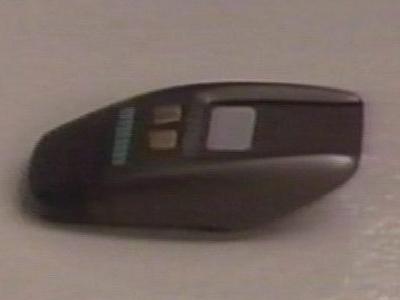
- Type I: Palm Phaser -- Small pocket version of the phaser sidearm. Settings available from 1-8. Starfleet handheld energy weapon in use since circa 2266. The Phaser Type I was commonly used when a show of force was not appropriate, such as in first contact and other off-ship missions involving diplomacy. The Type I is also referred to as a palm phaser. Early in their use, the Type I of the 2260s through 2290s could be attached to a pistol grip for added range and stability for aiming.
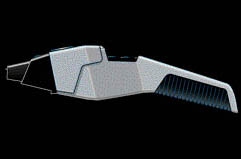
- Type II: Personal Phaser -- Larger sidearm version. Capable of settings 1-16. Larger handheld energy weapon used by Starfleet personnel since 2266. More powerful that the Type 1 variety.
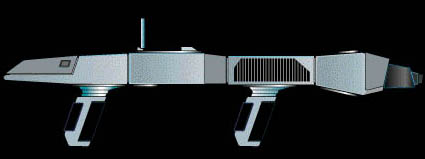
- Type III: Phaser Rifle -- Rifle version with settings 1-16. Has 50% more power available and greater accuracy. These are commonly stored in a ship or starbase armory.
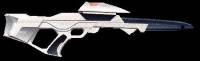
- Type IV: Compression Rifle -- Capable of automatic fire and higher settings.
- Type V: Sniping Rifle -- The Type V sniper rifle is a varient of the Type IV rifle that has recently gone into service among Starfleet. It provides an increased range and accuracy, but is much larger. An external power pack also provides increased power settings. It is fitted with energy dampeners, to mask the huge energy output typical of directed energy weapons.
PHASER SETTINGS
- Setting 1: Light Stun
- Setting 2: Medium Stun
- Setting 3: Heavy Stun
- Setting 4: Thermal Effects (some epidermal damage)
- Setting 5: Thermal Effects (severe burns to flesh)
- Setting 6: Disruption Effects (skin and structual materials penetrated/disrupted)
- Setting 7: Disruption Effects (death)
- Setting 8: Disruption Effects (vaporization)
- Setting 9: Disruption Effects (beginning of light structural vaporization)
- Setting 10: Disruption Effects (heavy alloy vaporization)
- Setting 11: Explosive/Disruption Effects (metal vaporized, light geologic displacement)
- Setting 12: Explosive/Disruption Effects (medium geologic displacement)
- Setting 13: Explosive/Disruption Effects (medium geologic displacement)
- Setting 14: Explosive/Disruption Effects (heavy geologic displacement)
- Setting 15: Explosive/Disruption Effects (heavy geologic displacement)
- Setting 16: Explosive/Disruption Effects (heavy geologic displacement)
TR-116 SNIPING RIFLE
Created by Starfleet R&D for use in situations where energy weapon fire is inhibited by dampening fields, the TR-116 is a rifle designed to fire a 10mm tritanium projectile. Attached to the barrel of the weapon is a micro-transporter device which allows the user to transport the bullet into another room at up to a 100 meter radius. User must be able to "see" the target, however, using an exo-graphic targeting sensor worn as a headset unit with eye reticle. This device allows the user to see through walls, doors, bulkheads, etc. so targets within 100 meters can be acquired. Once a target is acquired and the weapon is fired, the projectile is transported into the room or area occupied by the target, where it continues its path on to the victim. Production of the weapon did not occur, but the schematics were acquired by Starfleet's Shadow Operation division recently for possible use. Shadow Ops has modified the weapon to accept a seven round magazine .
TR-120 SUBRIFLE
A modified rifle based on the TR116. This 'subrifle' is essentially equivalent to the TR116, except in size, range, and the lack of the micro-transporter and exo-graphic sensor. This particular model has a built in muzzle suppressor to reduce the muzzle flash and eliminate the sound of the firing round. The unique multi-rollback chambers enable the smooth and noiseless loading of multiple rounds at a time, allowing them to be fired consecutively from already locked chambers. This gives the subrifle almost no recoil (only 0.05 point) which allows the user the accuracy on every shot that can mean the difference between life or death. The rifle has only one trigger group: semi, three round burst, and full auto. (rifle designed for Shadow Operations usage only)
- Calibre: 4mm
- Weight: 6 lbs.
- Length: 30.75 inches stock extracted, 24 inches retracted
- Effective range: 70 meters
- Rate of fire: 400 rounds per minute
- Feed: 60 round magazine
- Muzzle velocity: 283mps (928 fps)