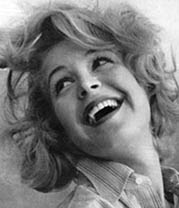
 HER SWINGIN' '60s CREDENTIALS: This sweet-looking teen, for awhile America's
perfect prom date, starred in numerous hit movies at the cusp between the '50s and '60s,
then she married one of the era's swinginest swingers for most of the decade.
HER SWINGIN' '60s CREDENTIALS: This sweet-looking teen, for awhile America's
perfect prom date, starred in numerous hit movies at the cusp between the '50s and '60s,
then she married one of the era's swinginest swingers for most of the decade.
CATEGORIES OF SWINGIN' CHICK: Movie Star and Girlfriend/Wife
BIRTH: She was born on April 23, 1942, making her a sweet seventeen as the '60s started. Some bios make her younger, saying she was born in '44, but '42 is the year Sandra herself gave in a 16 Magazine interview in '63. And some bios say that her mother perpetuated a story that Sandy was born in '42 instead of her "real" birthyear of '44 so that she would seem older and thus better able to get jobs early in her career; '42 is the year shown on her birth certificate, so we're stickin' with it. Her birthday is one day before Shirley Maclaine's, though Shirley was born in '34. Her exotic birthplace: Bayonne, New Jersey. Her moniker at birth: Alexandria Zuck, when her divorced mother remarried a realtor thirty years her elder, Sandra took her step-father's last name and became Sandra Douvan when she began modeling at eight years old. The studios renamed her Sandra Dee when her movie career got started in the late '50s.
IMPACT ON THE '60s: At a time when Elvis was putting the sex into rock 'n' roll and Marlon Brando and Marilyn Monroe were steaming up the movie screen, Sandra Dee emerged as a sweet, old-fashioned, virginal throwback to more conservative values. She was aware of the kind of roles she usually played -- "I was a junior Doris Day for years," she once told an interviewer, a quote which defined her status on most cast lists as nearly always somebody's young daughter, and also the all-American, wholesome motives of the characters she played. Her major impact on the '60s came right at the beginning when she was riding the crest of her popular Gidget/A Summer Place movies and took over the role of Tammy in the films Tammy, Tell Me True in '61 and Tammy and the Doctor in '63, both of which were sequels to the '57 hit romancer Tammy and the Bachelor with Debbie Reynolds, Leslie Nielsen, and Fay Wray. Sandra was the teen parents wanted their own kids to be like, plus she was the girl other girls wanted to know and the girl that boys wanted to date (by the way, also in Tammy Tell Me True with Sandra was another Swingin' Chick of the '60s, Stefanie Powers, while Tammy and the Doctor co-starred two '60s giants, Peter Fonda and Adam West).
CAREER IN THE '60s: Though she was at her peak at the beginning of the '60s, Sandra managed to keep her career going for much of the decade. In addition to the two Tammy movies mentioned above, she starred in Come September with Gina Lollobrigida in '61, If a Man Answers with Stefanie Powers in '62, and That Funny Feeling with Donald O'Connor in '65, all three of them comedies that paired Sandra opposite singer Bobby Darin. Other roles included the young step-daughter in the 1960 Lana Turner drama Portrait in Black, the young daughter in Peter Ustinov's '61 Cold War comedy Romanoff and Juliet, the young daughter in the '63 Jimmy Stewart comedy Take Her, She's Mine '63, the granddaughter in the '64 Maurice Chevalier/Andy Williams/Robert Goulet comedy I'd Rather Be Rich, the '66 James Garner/Melina Mercouri comedy A Man Could Get Killed, the feeble George Hamilton comedy Doctor, You've Got to Be Kidding in '67, the underrated '68 Rosalind Russell comedy Rosie, and the little-seen crime story The Man Hunter which was never released because it was so bad. None of these were award-winning epics, of course, and her popularity seemed to be considerably diminished by mid-decade, when the frequency of her film appearances started to slow down. At the end of '68 she didn't renew her contract with Universal and thus became that studio's last-ever contract player.
CAREER OUTSIDE THE '60s: Dressed like a doll, Sandra competed in talent shows as a young child. A model at the age of nine, Sandra was working for a top New York City agency in the mid-'50s, going on her own to the photo shoots. Her first magazine cover came in April '55 with her appearance on American Girl. She then modeled for New York department stores and for the next year appeared on more magazine covers, including repeated appearances on American Girl. Before her movie career took off she also did some TV commercials in the late '50s, including her first commercial for Coke and a print ad for Coppertone. As one of America's top teen models, her income in '57 was around $40,000, some estimates say almost double that, either way not bad for a thirteen-fourteen year old. In '57 she signed a long-term contract with Universal-lnternational Pictures in Hollywood and was making a grand a week. In that '57 Parade article mentioned above, Sandra recalled how she was "discovered" by Hollywood:
"I was walking through the NBC building in New York. A television producer stopped me in the hall and took my name and address. A few weeks later I was on the Vaughan Monroe program. Between modeling and TV I made more than $80,000 in two years. Last year, Ross Hunter, a producer from Universal, came to New York to cast Teach Me How to Cry. He interviewed 400 girls for the part and chose me for a screen test. That's how I came to Hollywood." In that first role she was shown aging from twelve to eighteen. At fifteen she was supporting her mother by working as a full-time actress, usually in dramas that played on her budding sexuality. Her breakthrough role was Imitation of Life in '59 alongside Lana Turner; supposedly Natalie Wood was the preferred choice for Sandra's part, but as a veteran of twenty movies already, Natalie may have been too pricey at the time. For fifteen-year-old Sandy, two huge hits quickly followed: the classic romance A Summer Place with Troy Donahue, and the beachy-keen Gidget with James Darren and Cliff Robertson, the first and still the best of the Gidget movies. Both of those were in '59, but their influence carried over into the '60s, and in fact the Percy Faith song "Theme from A Summer Place" was one of the top hits of 1960. After the '60s, Sandra was in the scary The Dunwich Horror in '70, a decent version of the classic H.P. Lovecraft tale and her last feature film. Clearly no longer a teenager, and with audiences demanding grittier, more realistic films such as The French Connection and Midnight Cowboy instead of her sweet, homey romances, Sandra was soon left with only TV movies like Houston, We've Got a Problem in '74 and Fantasy Island in '77, with a couple of "Night Gallery" appearances early in the '70s. Depressingly, in the mid-'70s she lost all her savings in a real estate scheme, and in a turnabout Sandra's mother supported her. After her mom's death in '87 Sandra didn't leave the house for four months. She also had to learn how to do all the basic skills that most adults already knew, such as how to write a check. In '91 Sandra was on the cover of People for a story detailing the sexual abuse she'd endured as an eight-year-old child from her stepfather. The story was called "Look at me, I'm Sandra Dee: She was America's teen sweetheart of the '50s -- then she disappeared. For the first time, she now reveals the shocking details of her two lost decades." Sandra made several commercials in the '90s, appeared on talk shows to help promote her son's book about her and Bobby Darin, performed in the play Love Letters with John Saxon, and in '98 she told the National Inquirer about her deep depressions that had led her to anorexic and heavy drinking after the divorce from Bobby, though she added that "my goal in life is very simple right now, I'm going to try to stay happy." In '99 she suffered more health problems and was having dialysis treatments, but she supposedly has emerged healthier than ever.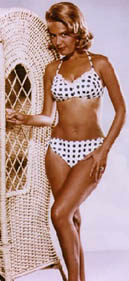 TALENT: While she was certainly earnest and enthusiastic,
she was never seen as a great actress, just a popular one. Sandra won the Most Promising
Newcomer award at the '59 Golden Globes; actually, she was a co-winner, along with Carolyn Jones (later of "The Addams
Family") and Diane Varsi (who played Allison Mackenzie in '57's Peyton Place,
which was the role Mia Farrow later played on
the '60s TV show).
TALENT: While she was certainly earnest and enthusiastic,
she was never seen as a great actress, just a popular one. Sandra won the Most Promising
Newcomer award at the '59 Golden Globes; actually, she was a co-winner, along with Carolyn Jones (later of "The Addams
Family") and Diane Varsi (who played Allison Mackenzie in '57's Peyton Place,
which was the role Mia Farrow later played on
the '60s TV show).
HER '60s LOOK: As America's favorite teenager, conveying both childlike innocence and perky energy, Sandra made the covers of dozens of magazines in the late '50s and early '60s. Her appealing looks came under scrutiny in the October '59 issue of Photoplay, which admired her youthful but carefully created beauty:
"Sandra has round, dark eyes (called the "blotter look") and a very dark brown eyebrow pencil furthers the effect. She completely outlines her eyes with dark blue -- the line narrows at the inside corner, wider at the outside corner. She uses a stormy blue shadow and black mascara. Just as she likes the effect of outlined eyes, Sandra likes her mouth rimmed in a bright color. For instance, she outlines her mouth with brilliant orange, then fills in with a lighter shade such as orange ice, or dark red with light pink. For a glossy look, add a dab of cold cream or Vaseline. Sandra's soft, tousled hair is just perfect for her andfor your own busy life. The secret to its always looking perfect is that Sandra doesn't part her hair, 'and the wind combs it,' says Sandra, 'helps give it that tousled look'."
While she was a popular movie star in the early '60s, Sandra's wholesome, healthy, cute looks brought her some TV commercials, including a spot for Lustre Creme shampoo alongside her mother. Still known as a young model to some people, she acknowledged her modeling beginnings when she was spotlighted in Teen Life magazine in the summer of '61 with an article called "Sandra Dee Tells How You Can Become A Teen Model." In her prime she was a size five, 5' 4" and 110 pounds, with an eighteen-inch waist (about four inches smaller than Twiggy's waist). But convinced that she had to stay thin, Sandra suffered through anorexia for years, with the weight on her 5' 5" frame dropping to only 86 pounds. She told the National Inquirer in '98:
"I was anorexic for many, many years -- even before people knew what it was. They didn't even have a name for it back then. I was a model in New York. And the reason I was anorexic is because I developed a bust when I was eight years old. I matured very early. And I didn't want any of it. Plus I have a very, very round face. I kept dieting and dieting. Throughout my life I never believed I could be too thin."
LIFESTYLE: A Parade magazine article in late '57 said this in a profile of Sandra:
"She lives with her mother in a hillside home equipped with a swimming pool. She drives a Buick, owns a mink stole, has two dogs. At the same time, she has no real friends of her own age. She has never dated a boy. She has never kissed except in line of duty. She has never gone to a dance. She diets constantly--example: no desserts."
No wonder she was so believable as a sweet, thoughtful, virginal teen in her '59 epics A Summer Place and Gidget. In that same article, Sandra predicted that by '66 she would settle down, marry, and quit the biz. Instead of doing that, she kept her career going, and in '61 married one of the coolest guys on the planet, singer/actor Bobby Darin. Darin, of course, was already a huge star, having sung such hit songs as the Grammy-winning "Mack the Knife" and "Splish Splash." He not only sang hits, he wrote them too, including "Splish Splash," "Dream Lover," "Queen of the Hop," "Eighteen Yellow Roses," "Things," and "You're the Reason I'm Living." His towering musical accomplishments got him elected into the Rock and Roll Hall of Fame in '90 and into the Songwriters Hall of Fame in '99. He was also nominated for a Best Supporting Actor Oscar in '64 for Captain Newman, M.D. According to the March '61 issue of Motion Picture magazine, here's what they said when they first met on the Italian set of Come September in '60:
"I've always enjoyed your pictures, Miss Weld," he told Sandra, his face straight, his voice earnest. Without blinking, she answered, "And I always buy your records, Fabian." " She's all right," Bobby thought. "This kid's all right!" In an interview she said she was attracted by his talent but then got to appreciate his intelligence and understanding. He said in a televised interview that "there couldn't be anything lovelier, she hated me, I loved her, and that was it." They were engaged after knowing each other only about two months, and then they eloped to get married on December 1, '60, bringing her independence from her stage mom and the chance to start her own family. Sadly, one month into the marriage she miscarried. Together Bobby and Sandra appeared in the three lightweight but high-grossing film comedies mentioned above. She got pregnant during the filming of Tammy Tell Me True in early '61 and their son Dodd Darin was born December 16, '61. Around this time Sandra started drinking. When she was in Tammy and the Doctor, Bobby got jealous of her co-star, Peter Fonda, plus he didn't like her drinking, so they separated in '63. Later she suffered a second miscarriage. Bobby and Sandra made That Funny Feeling toegether in '65 in an effort to save their marriage but he moved out in '66 and they finally divorced on March 7, '67. She said, "He just woke up one morning and didn't want to be married anymore." "It ended with a suddenness I still can't explain," she told People in '91. Sadly, after years of health problems, Darin died in '73 while having heart surgery. Son Dodd wrote a biography of his parents in '94 called Dream Lovers. EXTRAS: Her real
parents divorced when Sandra was five, and she never saw her dad again ... Sandra isn't to
be confused with another actress named Sandra Dee who starred in the '94 video Lesbian
Mystery Theatre: The Case of the Deadly Dyke alongside other actresses with names
like Sindee Coxx, Kiss, Kitty, and Saki St. Germain ... there's also an actress named
Sandra Deel, who was in Steve McQueen's Junior Bonner in '72 and several TV
movies in the '70s ... our Sandra Dee was memorialized in the Broadway musical Grease,
which featured the song "Look at Me, I'm Sandra Dee," as sung by Stockard
Channing in the movie ... lyrics include the lines "won't go to bed till I'm legally
wed," "as for you, Troy Donahue, I know what you want to do," and
"Elvis, Elvis, let me be, keep that pelvis away from me, just keep your cool, now
you're starting to drool" ... in a '62 16 Magazine interview Sandra said her
greatest extravagance was buying clothes and jewelry, and her favorite role was Gidg,
"the people on the set were all young, we worked outdoors, and I learned to
surf-board" ... other actresses who played the role of Gidget after Sandra include Deborah Walley in '61's Gidget Goes
Hawaiian, Cindy Carol in '63's Gidget Goes to Rome, Sally Field in the mid-'60s TV series
"Gidget," Karen Valentine in the '69 TV movie Gidget Grows Up, Monie
Ellis in the '72 TV movie Gidget Gets Married, Caryn Richman in the '85 TV movie Gidget's
Summer Reunion, and Richman again in the late-'80s TV series "The New
Gidget" ... another actress, Debbie Watson, played Sandra's Tammy character in a '65
TV series called "Tammy," and also in a '67 movie called Tammy and the
Millionaire ... Debbie Watson also played Marilyn Munster in the '66 Munster, Go
Home movie after Pat Priest had played
Marilyn on "The Munsters" TV show ... Tammy and the T-Rex was a
sci-fi/comedy in '94 starring Denise Richards, who later played Dr. Christmas Jones in the
'99 Bond flick, The World Is Not Enough ... in '98 columnist Liz Smith reported
that a movie about Sandra's life was in the works, with Drew Barrymore as the star and
Johnny Depp as Bobby Darin (this movie came out in 2004 as Beyond the Sea,
starring Kevin Spacey as Bobby and Kate Bosworth as Sandra) ... in July 2000 Oscar-winning
director Francis Ford Coppola started staging live productions of his new Gidget: The
Musical in L.A. to see if it were strong enough to become a movie ... the surf-style
pop songs were written by Coppola and one of the composers of Grease, and they
include: "When Will It Happen to Me" (Gidg wants to be a woman), "Man
Hunt" (Gidg chases boys and vice versa), "Beat Girl" (Gidget goes beatnik
in a coffeehouse), and "I Want to Belong to You" (Gidg and Moondoggie get
together) ... see our Minx Linx page for the
excellent Web sites devoted to Sandra, one of which, called "The Legendary Sandra
Dee," has all the magazine articles quoted above, plus lots more.
EXTRAS: Her real
parents divorced when Sandra was five, and she never saw her dad again ... Sandra isn't to
be confused with another actress named Sandra Dee who starred in the '94 video Lesbian
Mystery Theatre: The Case of the Deadly Dyke alongside other actresses with names
like Sindee Coxx, Kiss, Kitty, and Saki St. Germain ... there's also an actress named
Sandra Deel, who was in Steve McQueen's Junior Bonner in '72 and several TV
movies in the '70s ... our Sandra Dee was memorialized in the Broadway musical Grease,
which featured the song "Look at Me, I'm Sandra Dee," as sung by Stockard
Channing in the movie ... lyrics include the lines "won't go to bed till I'm legally
wed," "as for you, Troy Donahue, I know what you want to do," and
"Elvis, Elvis, let me be, keep that pelvis away from me, just keep your cool, now
you're starting to drool" ... in a '62 16 Magazine interview Sandra said her
greatest extravagance was buying clothes and jewelry, and her favorite role was Gidg,
"the people on the set were all young, we worked outdoors, and I learned to
surf-board" ... other actresses who played the role of Gidget after Sandra include Deborah Walley in '61's Gidget Goes
Hawaiian, Cindy Carol in '63's Gidget Goes to Rome, Sally Field in the mid-'60s TV series
"Gidget," Karen Valentine in the '69 TV movie Gidget Grows Up, Monie
Ellis in the '72 TV movie Gidget Gets Married, Caryn Richman in the '85 TV movie Gidget's
Summer Reunion, and Richman again in the late-'80s TV series "The New
Gidget" ... another actress, Debbie Watson, played Sandra's Tammy character in a '65
TV series called "Tammy," and also in a '67 movie called Tammy and the
Millionaire ... Debbie Watson also played Marilyn Munster in the '66 Munster, Go
Home movie after Pat Priest had played
Marilyn on "The Munsters" TV show ... Tammy and the T-Rex was a
sci-fi/comedy in '94 starring Denise Richards, who later played Dr. Christmas Jones in the
'99 Bond flick, The World Is Not Enough ... in '98 columnist Liz Smith reported
that a movie about Sandra's life was in the works, with Drew Barrymore as the star and
Johnny Depp as Bobby Darin (this movie came out in 2004 as Beyond the Sea,
starring Kevin Spacey as Bobby and Kate Bosworth as Sandra) ... in July 2000 Oscar-winning
director Francis Ford Coppola started staging live productions of his new Gidget: The
Musical in L.A. to see if it were strong enough to become a movie ... the surf-style
pop songs were written by Coppola and one of the composers of Grease, and they
include: "When Will It Happen to Me" (Gidg wants to be a woman), "Man
Hunt" (Gidg chases boys and vice versa), "Beat Girl" (Gidget goes beatnik
in a coffeehouse), and "I Want to Belong to You" (Gidg and Moondoggie get
together) ... see our Minx Linx page for the
excellent Web sites devoted to Sandra, one of which, called "The Legendary Sandra
Dee," has all the magazine articles quoted above, plus lots more.