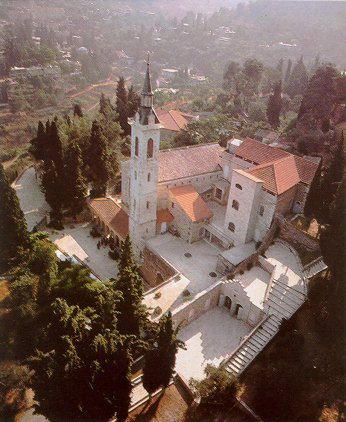
"It was late in the month of June, 8 B.C. , about three months after the marriage of Joseph and Mary, that Gabriel appeared to Elizabeth at noontide one day, just as he later made his presence known to Mary. Said Gabriel: "While your husband, Zacharias, stands before the altar in Jerusalem, and while the assembled people pray for the coming of a deliverer, I, Gabriel, have come to announce that you will shortly bear a son who shall be the forerunner of this divine teacher, and you shall call your son John. He will grow up dedicated to the Lord your God, and when he has come to full years, he will gladden your heart because he will turn many souls to God, and he will also proclaim the coming of the soul-healer of your people and the spirit-liberator of all mankind. Your kinswoman Mary shall be the mother of this child of promise, and I will also appear to her."[122:2.2]
"One evening about sundown, before Joseph had returned home, Gabriel appeared to Mary by the side of a low stone table and, after she had recovered her composure, said: "I come at the bidding of one who is my Master and whom you shall love and nurture. To you, Mary, I bring glad tidings when I announce that the conception within you is ordained by heaven, and that in due time you will become the mother of a son; you shall call him Joshua, and he shall inaugurate the kingdom of heaven on earth and among men. Speak not of this matter save to Joseph and to Elizabeth, your kinswoman, to whom I have also appeared, and who shall presently also bear a son, whose name shall be John, and who will prepare the way for the message of deliverance which your son shall proclaim to men with great power and deep conviction. And doubt not my word, Mary, for this home has been chosen as the mortal habitat of the child of destiny. My benediction rests upon you, the power of the Most Highs will strengthen you, and the Lord of all the earth shall overshadow you." [122:3.1]

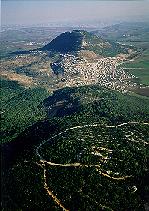
"In the latter part of June, Jesus, in company with his father, first climbed to the summit of Mount Tabor. It was a clear day and the view was superb. It seemed to this nine-year-old lad that he had really gazed upon the entire world excepting India, Africa, and Rome."[124:1.6]
"About the middle of May the lad accompanied his father on a business trip to Scythopolis, the chief Greek city of the Decapolis, the ancient Hebrew city of Beth-shean. On the way Joseph recounted much of the olden history of King Saul, the Philistines, and the subsequent events of Israel's turbulent history. Jesus was tremendously impressed with the clean appearance and well-ordered arrangement of this so-called heathen city. He marveled at the open-air theater and admired the beautiful marble temple dedicated to the worship of the "heathen" gods. Joseph was much perturbed by the lad's enthusiasm and sought to counteract these favorable impressions by extolling the beauty and grandeur of the Jewish temple at Jerusalem. Jesus had often gazed curiously upon this magnificent Greek city from the hill of Nazareth and had many times inquired about its extensive public works and ornate buildings, but his father had always sought to avoid answering these questions. Now they were face to face with the beauties of this gentile city, and Joseph could not gracefully ignore Jesus' inquiries. It so happened that just at this time the annual competitive games and public demonstrations of physical prowess between the Greek cities of the Decapolis were in progress at the Scythopolis amphitheater, and Jesus was insistent that his father take him to see the games, and he was so insistent that Joseph hesitated to deny him. The boy was thrilled with the games and entered most heartily into the spirit of the demonstrations of physical development and athletic skill."[124:3.6]

"Twelve years had passed since the first Herod had sought to destroy the babe of Bethlehem, and no one would now think of associating that affair with this obscure lad of Nazareth. Before reaching the Jezreel junction, and as they journeyed on, very soon, on the left, they passed the ancient village of Shunem, and Jesus heard again about the most beautiful maiden of all Israel who once lived there and also about the wonderful works Elisha performed there. In passing by Jezreel, Jesus' parents recounted the doings of Ahab and Jezebel and the exploits of Jehu." [124:6.2]

"Early in the month of March, A.D. 25, John journeyed around the western coast of the Dead Sea and up the river Jordan to opposite Jericho, the ancient ford over which Joshua and the children of Israel passed when they first entered the promised land; and crossing over to the other side of the river, he established himself near the entrance to the ford and began to preach to the people who passed by on their way back and forth across the river."[135:6.1]

145:2.15 The cooking and
the housework at the large Zebedee home, where Jesus and the twelve made
their headquarters, was for the most part done by Simon Peter's wife and
her mother. Peter's home was near that of Zebedee; and Jesus and his friends
stopped there on the way from the synagogue because Peter's wife's mother
had for several days been sick with chills and fever.
145:3.5 Soon after the
setting of the sun, as Jesus and the apostles still lingered about the
supper table, Peter's wife heard voices in the front yard and, on going
to the door, saw a large company of sick folks assembling, and that the
road from Capernaum was crowded by those who were on their way to seek
healing at Jesus' hands. On seeing this sight, she went at once and informed
her husband, who told Jesus.
145:3.6 When the Master
stepped out of the front entrance of Zebedee's house, his eyes met an array
of stricken and afflicted humanity. He gazed upon almost one thousand sick
and ailing human beings; at least that was the number of persons gathered
together before him. Not all present were afflicted; some had come assisting
their loved ones in this effort to secure healing.
145:3.7 The sight of these
afflicted mortals, men, women, and children, suffering in large measure
as a result of the mistakes and misdeeds of his own trusted Sons of universe
administration, peculiarly touched the human heart of Jesus and challenged
the divine mercy of this benevolent Creator Son.

The Greek Church, Capernaum -- A small fishing town on the shores of the Sea of Galilee at the beginning of the Christian era, Capernaum is believed by Christians to be the home of St. Peter, as well as the center of Jesus' activity in the region. In the Byzantine period, according to Christian tradition, a fisherman's house found in Capernaum was identified as St. Peter's home, and an octagonal church was built to protect its remains. Archeological excavations revealed the foundations of this church, now sheltered itself by a structure erected over it, as well as ancient docks and fishing equipment.
"That Sabbath was a great day in the earth life of Jesus, yes, in the life of a universe. To all local universe intents and purposes the little Jewish city of Capernaum was the real capital of Nebadon. The handful of Jews in the Capernaum synagogue were not the only beings to hear that momentous closing statement of Jesus' sermon: "Hate is the shadow of fear; revenge the mask of cowardice." Neither could his hearers forget his blessed words, declaring, "Man is the son of God, not a child of the devil." [145:3.4]

"The week following the Passover of this year a young man from Alexandria came down to Nazareth to arrange for a meeting, later in the year, between Jesus and a group of Alexandrian Jews at some point on the Palestinian coast. This conference was set for the middle of June, and Jesus went over to Caesarea to meet with five prominent Jews of Alexandria, who besought him to establish himself in their city as a religious teacher, offering as an inducement to begin with, the position of assistant to the chazan in their chief synagogue." [128:5.2]

"On the way to the Caspian Sea, Jesus had stopped several days for rest and recuperation at the old Persian city of Urmia on the western shores of Lake Urmia. On the largest of a group of islands situated a short distance offshore near Urmia was located a large building -- a lecture amphitheater -- dedicated to the "spirit of religion." This structure was really a temple of the philosophy of religions. This temple of religion had been built by a wealthy merchant citizen of Urmia and his three sons. This man was Cymboyton, and he numbered among his ancestors many diverse peoples." [134:3.1]
€Town of Urmia (Also birthplace
of Zoroaster)

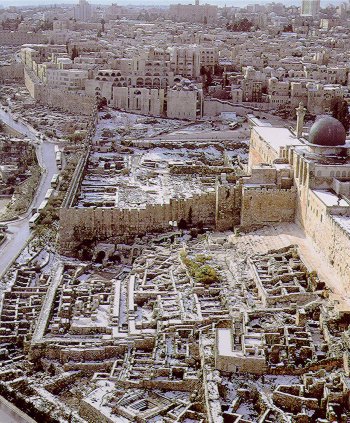
"One band remained at the temple to attend the morning sacrifices; another group marched down below Jerusalem to near Maza to cut the willow branches for the adornment of the sacrificial altar, while the third group formed a procession to march from the temple behind the water priest, who, to the sound of the silvery trumpets, bore the golden pitcher which was to contain the symbolic water, out through Ophel to near Siloam, where was located the fountain gate. ... On the evening of the next to the last day of the feast, when the scene was brilliantly illuminated by the lights of the candelabras and the torches, Jesus stood up in the midst of the assembled throng and said:
"I am the light of the world. He who follows me shall not walk in darkness but shall have the light of life." [162:4.4]
"The Adamsonites maintained a high culture for almost seven thousand years from the times of Adamson and Ratta. Later on they became admixed with the neighboring Nodites and Andonites and were also included among the "mighty men of old." And some of the advances of that age persisted to become a latent part of the cultural potential which later blossomed into European civilization. This center of civilization was situated in the region east of the southern end of the Caspian Sea, near the Kopet Dagh. A short way up in the foothills of Turkestan are the vestiges of what was onetime the Adamsonite headquarters of the violet race. In these highland sites, situated in a narrow and ancient fertile belt lying in the lower foothills of the Kopet range, there successively arose at various periods four diverse cultures respectively fostered by four different groups of Adamson's descendants. It was the second of these groups which migrated westward to Greece and the islands of the Mediterranean. [77:5.9]

"For almost one hundred years prior to Tabamantia's inspection, Van and his associates, from their highland headquarters of world ethics and culture, had been preaching the advent of a promised Son of God, a racial uplifter, a teacher of truth, and the worthy successor of the traitorous Caligastia." [73:2.1]
"Some of the early associates of Van subsequently
settled about the shores of the lake which still bears his name, and their
traditions grew up about this locality. Ararat became their sacred mountain,
having much the same meaning to later-day Vanites that Sinai had to the
Hebrews. Ten thousand years ago the Vanite ancestors of the Assyrians taught
that their moral law of seven commandments had been given to Van by the
Gods upon Mount Ararat. They firmly believed that Van and his associate
Amadon were taken alive from the planet while they were up on the mountain
engaged in worship.
Mount Ararat was the sacred mountain of northern
Mesopotamia, and since much of your tradition of these ancient times was
acquired in connection with the Babylonian story of the flood, it is not
surprising that Mount Ararat and its region were woven into the later Jewish
story of Noah and the universal flood." [77:4.11]
"Van and Amadon remained on earth until shortly after the arrival of Adam and Eve. Some years thereafter they were translated to Jerusem, where Van was reunited with his waiting Adjuster. Van now serves in behalf of Urantia while awaiting the order to go forward on the long, long trail to Paradise perfection and the unrevealed destiny of the assembling Corps of Mortal Finality." [67:6.8]
