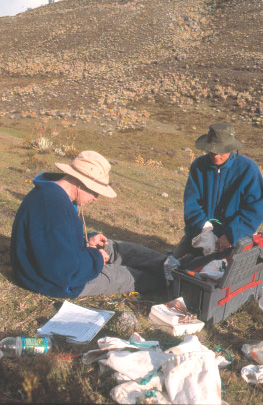
| systematic use of mist nets and a census are used to gather information on long-distance migrants and resident birds using the area. Data to be gathered for each bird captured included its species, age, sex, weight, fat, wing length and reproduction conditions (cloacal protuberance, brood patch, only on resident species). All birds captured are banded using aluminum bands (federal bands for migrants), Hummingbirds are banded using bands made with the McDonald equipment, this special equipment was provided by the Hummer Bird Study Group (Bob Sargent) Information gathered on each observation included species, habitat selection, direct (migrant-resident, migrant-migrant, resident-resident) interactions, and foraging strategy. |
| MONITORING OF NEOTROPICAL MIGRANT AND RESIDENT BIRDS IN THE VENEZUELAN ANDES |
| Carlos Rengifo G., Alirio Nava, Mario Zambrano & Salvador Gomez |
 |
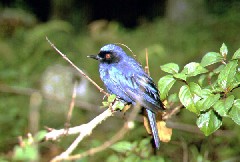 |
| Diglossa cyanea |
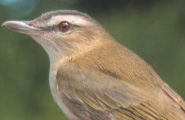 |
| Vireo olivaceus |
 |
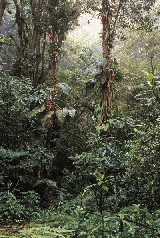
| La Mucuy |
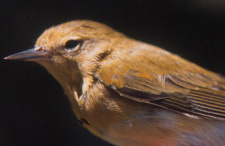
| Vermivora peregrina |
 |
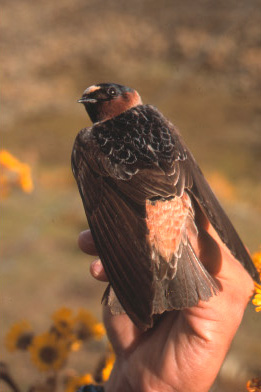 |
| Hirundo pyrrhonota |
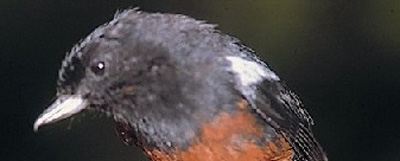
| The Venezuelan Andes are surrounded by large areas of cloud forest, which have been internationally recognized as environments which exhibit a great diversity of bird species. Many are endemic, and others are cataloged as endangered due to intervention by agricultural and timber industries. La Mucuy's cloud forest located in the Sierra Nevada National Park is an interesting example of an environment which exhibits high avian diversity. At the present time, the monitoring program conducted 2 days per week at this site have a total of 197 species of 36 families. Of the total individual captured 15 % represented Neotropical migratory species, this number is clearly higher than the 5 percent or less as reported by several authors. Some of the migratory bird species that are most frequently observed in "La Mucuy" cloud forests are: Blackburnian Warbler, Canada Warbler, Golden-winged Warbler, Tennessee Warbler, Black-and-white Warbler, and Rose-breasted Grosbeak. On the other hand, our program have revealed that of the 10 endemic bird species reported for the M�rida Andes, 8 inhabit this studying area, and are frequently observed within and on the edge of the forest. Some of these species include the M�rida Sunangel, White fronted Whitestart, Rose-Headed Parakeet, and M�rida Flower-piercer. |
 |
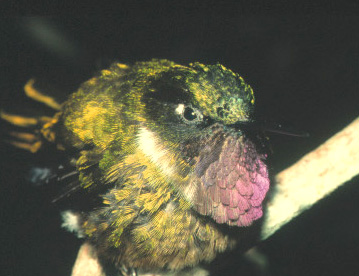 |
| Heliangelus spencei |
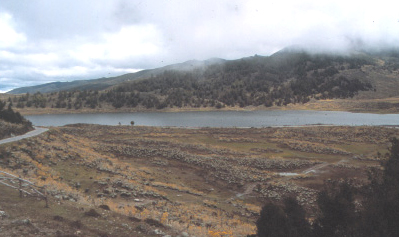
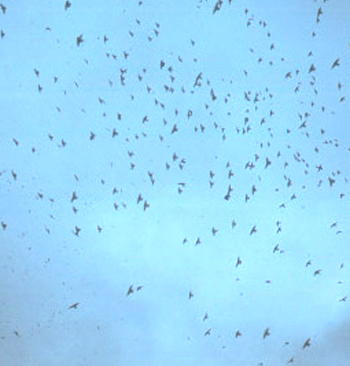
| For a period of two months (October and NOvember), activities are conducted at Mucubaji Lake (3200 m), located in the Sierra Nevada National Park, M�rida, Venezuela. A total of 30 migratory species have been registerd using the Mucubaji Pass, including Barn swallow, Bank Swallow, Cliff Swallow, Purple Martin, Gray-breasted Martin (South American migrant), Yellow-billed Cuckoo, Yellow Warbler, and Bay-breasted Warbler. Other species observed passing throw the area were: Canada Warbler, Black-throated Green Warbler, Lesser Yellow Leg, Spotted Sandpiper, Osprey, Merlin and thousands (2000+) of Turkey vultures migrating in mixed flocks with Swainson's and Broad-winged hawks. All the bird movement ware in a West to East direction, peaking in the early afternoon between 14:00 and 16:00 hours. The results obtained with this program allowed us to postulate the following conclusions: - Whether staying or continuing their migration to other areas in Venezuela or South America, the Mucubaji Pass is one of the most important migratory routes that Neotropical migrant birds use during their entrance to the M�rida Mountains. - The combination of the geographical conditions of the Mucubaji Pass, and the magnitude in numbers of individuals and species make it an ideal, and thus far, one of the best locations in Venezuela to establish a temporary bird observatory during the migration season. The above conclusions lead us to recommend the following: - At a local level, implementing educational and awareness programs targeting and involving the local communities and government agencies on the importance of protecting the Mucubaji Pass and surrounding areas for future generations. - As for the research aspects, we feel this should become a long term project in order to monitor migration patterns and changes, if any, in the years to come. |
| Mucubaji Lake |
 |
| Monitoring programs are an important part of responsible management. Only through knowledge of the status and trends of a species, and the habitats in which it occurs, can managers take appropriate actions. |
 |
| Diglossa gloriosa |
 |
 |