November 7th University at Carthage
Institut Supérieur des Langues de Tunis
Cité El Khadhra, Tunis
Of Memory And Maps
ISLT English Department Interdisciplinary Annual Conference
April, 8, 9, 10 2004
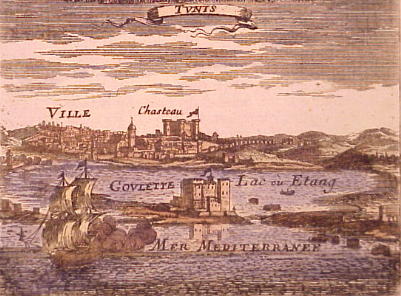
Cartographer: Mallet, "Tunis" 1683
Courtesy of Brian DiMambro Rare Books & International Book Sales, Inc
|
|
The Department of English at L’Institut Supérieur des Langues de Tunis announces its Annual Conference April, 8, 9, 10 2004 on the theme of "Of Memory and Maps." Paper Abstracts (200 words, max.) must be postmarked on or before 31 January 2004. The goal of the conference is to explore theories, representations, and performances of memory and its role in the production of "history," "culture" and "space." This conference will focus on the function of memory throughout the humanities, architecture, myths, arts, law, politics, as a source for human recollection, and for social or political influence. All disciplines, including sociology, historiography, linguistics, literature, anthropology, religious studies, theatre, film, psychology, gender studies, should feel free to contribute. We would like our participants to examine how power acts upon the production of memory and spatiality, and to consider as well how class, race, gender, and sexuality affect the construction of memory in theory and practice. What is memory? What is private memory? What is public memory, how and by whom is it constructed? What gets transmitted, filtered, passed down, and discarded? What roles do oral histories play in the preservation or passing on of memory? How does cultural memory get invented, remapped and terminated? What do Trans-Atlantic/Trans-Saharan literatures and histories tell us about the architecture of memory? What role do archives play in the construction of history and memory? How is memory theorized in psycho and socio-linguistics? What is the function of memory/myth for nomadic people or for those individuals or communities living in the diaspora? What does clash or dialogue of "cultures"/"civilizations" mean?
Paper abstracts examining memory in relation to the following themes are also welcome:
1. East of the West, West of the East: Myth in the Cultural Memory of the Maghreb.
2. Short Term vs. Long Term Memory.
3. Memory and the Politics of National and Ethnic Relocation.
4. The Structures and Narratives of National Identity Formation.
5. Remembering and Dismembering in Slave Narratives.
6. Genre Paintings/Music: Ideas of Nation, Class, Gender, Race, and Religion.
7. Anthropology, Power and Identity.
8. Race, Religion, Land, and Citizenship.
9. Imperialism, Postmodernism and Globalization.
10. Empire, Subjectivity and Political Theory.
11. Women and Children in War and Peace.
12. Humanism and Dehumanization.
13. Myths, Nations, and Narration.
14. Ethno-Spaces: Memory and Power.
15. Representations of the Muslim and the Jew in Literature and the Mass Media.
16. Auto/biography as Cultural Memory.
17. Border Crossings/Border Memories.
18. Power, Hegemony and the Production of History.
19. Childhood and War Memoirs.
And many other issues related to the theme of memory.
Please send all correspondence to ISLT conference conveners via email to:
Noureddine Fgaier at:
[email protected]Lamia Ben Youssef at:
[email protected]Or regular mail to:
Noureddine Fgaier, Chair/Lamia Ben Youssef, Conference Convener
L’Institut Supérieur des Langues de Tunis
14 Rue Ibn Maja
Cité El Khadra, Tunis 1003
Tunisia
Please indicate the title of your abstract, your full name, address, telephone, email address, research area (s), current status, and the name of the academic institution to which you are affiliated.
