 |
| GETTING STARTED |
| ROBOTICS INVENTION SYSTEM |
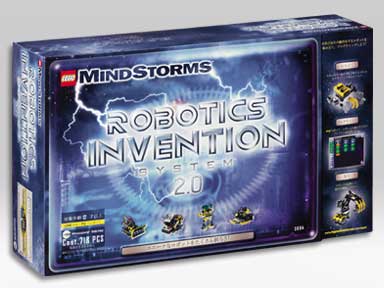
| The Robotics Invention System (RIS) in short is a complete Lego kit containing over 700 Lego pieces including two 9V electric motors, two touch sensors, one light sensor, and the RCX Microcomputer. Using these pieces, one can build robots capable of performing complex tasks, then program these robots via an infra-red link to your computer to "think" on their own or using input from the outside world. The kit has evolved through two upgrades since the release of the RIS 1.0. These kits are known as the RIS 1.5 and finally the RIS 2.0. However, all three versions are very similar and are compatible with each other. This set is what I would call "The ultimate Lego set". Click on picture to goto Lego information site. |
| FEATURES OF THE RIS |
| THE MOTORS |
| The kit includes two of the Lego Cat # 5225 9V Mini Motors. These are the same motors Lego offers separately for $17.50 or as a kit (Cat # 8735) that contains one motor, AA battery box, power cord, and extra gears and wheels. These items can be ordered from Lego Shop-At-Home catalogs. The motor runs of 9V DC using the electric plate in the top front of the casing. A planetary gear drive integrated into the design helps create a lot of torque while reducing weight. The RCX has outputs for three motors, while the kit contains only two, leaving the choice for the third up to you. There are two other motors available besides the 5225. The 9V motor (Cat # 5114) is available for $15.99, and the Micro Motor (Cat # 5119) is available for $11.00. All the motors run using 9V DC. The 9V motor is similar to the 9V Mini Motor, minus the integrated gear drive. The Micro Motor has the gear drive, but is more suitable for light duty applications such as a steering servo. It's advantage is it's size; about the same size as two 2 X 2 bricks stacked on each other. |
 |
| THE SENSORS |
| The sensors included in the RIS are two touch sensors and one light sensor. The touch sensors are basically 2 X 3 bricks, with an axle hole in one end, a pressure sensitive switch inside, and an opening with a pushrod like element protruding out the opposite end. The sensor has an electric 2 X 2 plate area on its top on the pusher end to connect a Lego wire to. The light sensor is the size of a 2 X 4 brick stacked on a 2 X 4 plate. It has a Lego wire permanantly attached on one end, and a LED/Phototransistor pair at the other. The LED emits a red light which is picked up by the phototransistor if reflected off of another object. The phototransistor also picks up light from outside sources (i.e. another lamp/LED, room lighting, etc). The sensors are connected through the appropriate wires to the input ports on the RCX. Then the RCX must be programmed accordingly to accecpt the sensors and know how to use them. The sensors can be used in a variety of modes depending on the software used to program the RCX. For example, the touch sensor can be used just as an on/off or touch/not touch device or can be used as a pressure sensitive device. Similar with the light sensor, it can be used as a dark/light device or can be used to precisely measure the amount of light detected. Other sensors available separately are the rotation sensor which measures axle rotation in steps and the temparature sensor. Home brewed, or homemade sensors are becoming popular for the experienced hobbiest. Another trick to using the sensors: The RCX has an infrared port on its front used to communicate with the computer interface and other RCX computers if available. The RCX can be programmed to send messages to other RCX's. Since the light sensor can detect infrared light, It can actually team up with the RCX to form a sort of radar. We'll see more of that later. |
| ACCESSORY KITS |
| There are a number of accessory packs available to compliment the RIS. These kits include additional sensors, motors, elements, and guided challenges to further enhance the robotics experience. While many of the parts contained in the kits are available separately, the kits provide a bundled package of sought after elements. These kits are available in most stores where the RIS is sold, and are more cost effective than buying the parts individually. Click on picture to goto Lego Information site. |
 |