 |
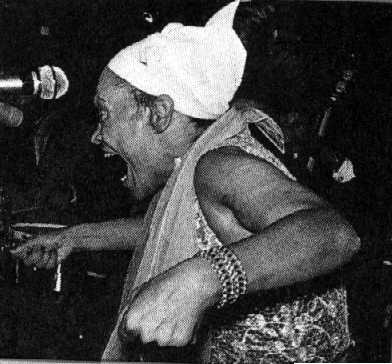
| LA LUPE BIOGRAPHY La Lupe, "the Queen of Latin Soul", was born Guadalupe Victoria Yoli on Dec. 23rd,1942 in San Pedrito, Oriente, Cuba. Her earliest influences came as a child listening to the music of Olga Guillot & Celia Cruz for hours on end. Her singing career began at age 12, after winning a local vocal contest. Having gotten a taste of show biz she left for Cuba to learn more. In Cuba she began her tutorage & 4 years later met and married her first husband Eulgio Reyes. She started working as a teacher & with her husband formed a trio Los Tropicuba & started performing. After the groups first performance her husband commented that he "thought she was having an epileptic fit," a stage style she would later be synonomous with. Before the year ended she was fired from the group, separated from her husband & started singing as a soloist. She landed a job at a local club, Cabaret La Red, where she started a controversy around town for her electrifying performances. At times she pulled her hair, screamed, bit herself, & even threw her shoes! Her performances at the Cabaret La Red were intolerable to the new Cuban regime experiencing its transition from revolution into socialism. Castro, even personally stopped her performances. In 1962 she left Cuba for New York. Immediately after arriving in New York she began singing at the Cuban cabaret club La Barraca in midtown Manhattan. There she was discovered by the legendary Mongo Santamaria, who went to see her after reading an article in a Cuban magazine, descrbing her as " a Cuban female vocalist who would get possessed by the devil while on stage". On Dec. 17th,1962 her debut album on Riverside Records, Mongo Introduces La Lupe, was released, with liner notes written by Dr. Elgio Valera. While promoting her new record, she fell in love with Puerto Rican vocalist Willie Garcia, becoming pregnant with his baby. She left Mongo's band in 1964 & joined Tito Puente's orchestra, debuting at the Bronx's Lowes Boulevard Theater. With Tito she recorded several successful albums on the Tico label owned by Morris Levy. One of her most well known songs Que Te Pedi, influenced heavily by flutist & bandleader Lou Perez's song Jugue y Perdi, emerged from those sessions. By 1967 Tito could no longer stand La Lupes unpredictable temper & "la tirana" side of her personality & fired her. The news came during La Lupe's recording of the infamous El Rey y Yo/The King & I record & on the coro of her classic Oriente, the news is well documented as she sings, "Ay yay yay Tito Puente me boto"! ("Tito Puente booted me!") In 1968 Tico label president Morris Levy crowned her with the title Reina De La Cancion Latina/The Queen of Latin Soul, releasing an album with the same name. On Nov. 16,1968 he had the great Machito orchestra backing her for a spectacular live show . She faded a little from the limelight she so enjoyed with Mongo & Tito's band in the '60's, but she recorded a string of strong albums in the '70's, some of which are considered her best work. In an interview with LOOK Magazine in 1971, she spoke of her performances: "I think people like me because I do what they like to, but can't get free enough." La Lupe continued & improved upon her inimitable vocal style while incorporating even more musical styles & pushing her boundaries. Some of these recordings including Stop I'm Free Again, Pero Como Va Ser & Unica En Su Clase, found her sound as "The Queen of Latin Soul" really coming together, mixing the perfect blend of Latin rhythms with Motown & soul influences. Her voice, a paradoxical blend of tough rasp & bell-like tone, is instantly recognizable. Most songs contain her trademark cries of "Ahi Na' ma'" and orgasmic vocal improvisations.Some insight into La Lupe's studio techniques was recently given through correspondence with Fred Weinberg. Fred was Lupe's favorite engineer, involved in many of her recordings & production: "As far as her method in the studio Lupe usually took one to three takes & did not like to overdub. 'Lo hacemos otra vez,' she would say. Lupe left the microphone choice to me, which was the Neuman U-47." When asked of any particularlly memorable moments, he replied, "There are many...each session was pretty much a 'happening' with Lupe. She loved the 'calefaccion up' (the 'heat up')in the studio and told musicians at times to remove their shirts if they complained that it was too caliente!" "By the way", he concluded, "contrary to rumours Lupe never drank, nor did she ever do drugs in all the years I worked with her!" Although another source reveals that she did indulge in a warm Coca-Cola before her performances. Also, during the 70's Lupe helped in the development of NY Salsa sound, which was being created as a marketing term around the same time.The sound identified the music that bridged the big band sound & the barrio "street" sound. A peak moment for her in the '70's happened on Jan. 30th,1977, when 4,000 La Lupe fans sold out Bronx's Puerto Rico Theater to catch an incredible set. Tito Puente reunited with "the queen" to play timbales on Oriente for the encore of that set! In the 1980's La Lupe moved abroad and lived in Spain for a while.Towards her later years she converted to Christianity & her last recordings like The Samaritana were spirtual & religious in style. La Lupe passed away quietly on Feb. 28th,1992, at the age of 53, allegedly of cardiac arrest. Thousands of mourners came to pay their homage at La Iglesia De Dios in the Bronx. Though she's no longer with us, La Lupe's presence & influence is still felt today, as strong as ever. In example, the song Puro Teatro was used as the closing number in the Almodovar film Women On The Verge Of A Nervous Breakdown.In 1999, Tico Records began the re-release of La Lupe's catalog on compact disc, to the delight of old & new fans alike! On Feb. 26th,1999 La India with Eddie Palmieri, Cheo Feliciano, Andy Montanez & Roberto Avellanet performed "Homenaje A La Lupe" at the Roberto Clemente Coliseum in Hato Rey. Latin Beat Magazine featured La Lupe on the cover of their May 2000 issue (Vol.10/No.4), with an in depth article by Max Salazar.Summer 2001 brought a resurgence of interest in La Lupe with a controversial stage production in New York about her life called "La Lupe, My Life, My Destiny," directed by Luis Caballero, continuing into 2002. A documentary by Ela Troyano, "La Lupe: A Mirror of the Times" is awaiting television release. Also, a street in the Bronx was re-named La Lupe Way! La Lupe: Trilogia is now available from Spain, a 3-CD set, containing many classic Lupe recordings. In February 2003, Mongo Santamaria, the man who first brought Lupe to the public's attention, passed away. If the news contains La Lupe, we'll keep you posted... HOME |