 |
| Planning your Herb Garden |
| Herbs have been used by humans since the beginning of time for medicinal purposes, for flavor and for fragrance. Whenever and wherever people have moved, herbs have gone too. Their "magical properties" are entwined in the lore of every culture, and their flavor and fragrance add a distinctive character to regional cooking. Herbs as Garden Plants The garden value of most herbs is derived from their form, foliage, texture and color, rather than their flowers. Herbs are best used in gardens that have structure, form and design. Choose herbs and space them to compliment the garden design. Take care in placing rank-growing herbs that can overpower and obscure other plants and the pattern of the garden. Designing an Herb Garden Choose a location that has full sun for all or most of the day. Choose an area where the formal pattern of the herb garden is appropriate. Locations separated from the rest of the landscape by walks, walls, fences, or an outbuilding work out well. The garden should fit the scale of the area, but also scale it to your time to take care of it. Many patterns can be used but simple designs are best. To be effective, make the boundaries between various parts of the garden clearly visible. Bricks are easy to work with, make excellent edging and blend well with the texture and colors of the herb foliage. Culture Most herbs are easy to grow. Plant in well-drained soil prepare as for any garden. Avoid too much fertilizer, manure and compost as most herbs are better in soil that is not too rich. Many herbs are annuals and the seed must be sown each year. In small gardens, it is best to sow the seed in trays and transplant the seedlings. When herbs are grown in rows in the vegetable garden, they can be seeded directly. Perennial kinds can be grown from seed, cuttings or divisions. Again, in the designed garden, it is best to use established plants rather than seeds. Annual herbs Sweet Basil (Ocimum basilicum) Height - 2' leaves-bright green to purple smooth or crinkled. Parsley (Petroselinum hortense) Height - 2' leaves-crinkled or smooth, but finely cut. Bushy, low-growing foliage makes it useful as an edging plant. Summer Savory (Satureia hortensis) Height - 18" leaves-small, light green, plant branches heavily from base. Borage (Borago officinalis) Height - 2' leaves-large, white-hairy, flowers are bright blue and quite ornamental. Dill (Anethum graveolens) Height - 3' Bluish-green stems, with finely divided yellow-green foliage. Will probably need staking. Fennel (Foeniculum vulgare) Height - 5' similar in foliage to dill; very graceful yellow flowers. Should be staked. Perennial Herbs Chives (Allium schoenoprasum) Height - 18" Onion-like foliage and attractive pink flowers, blooms early in the season. Wild Marjoram (Origanum vulgare) and Oregano (Origanum vulgare var. viride) Height - 12" a low, mint-like plant. The Mints (Mentha spicata and others) Different sorts are flavored like spearmint, peppermint, orange or citrus, apple and many others. Mainly coarse and rank-growing perennials. Sage (Salvia officinalis) Height 2' - 3' a gray-foliage and highly pungent; some excellent ornamental dwarf forms. Thyme (Thymus vulgaris and others) Height 3" - 6" creeping plants with small leaves that come in many colors, habits, and flavors. Rosemary (Rosmarinus officinalis) Height 18" attractive rich green needle-like evergreen foliage. Plants are not winter-hardy so must be brought inside in winter. |
|
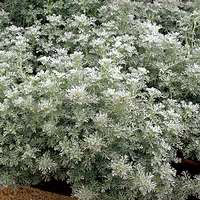
| French Tarragon |
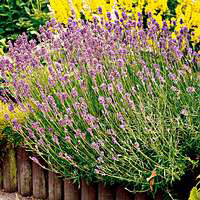 |
| Lavender |
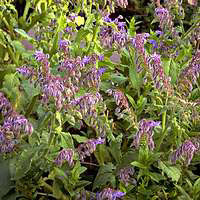 |
| Borage |
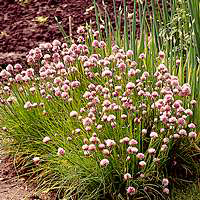 |
| Chives |
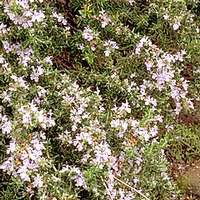 |
| Rosemary |
 |
| Home |
|
| Links |
|
| Garden Tips |
|
| Bulbs |