
|
|
Maintenance on and offshore is the key to preserving a healthy shoreline and lake. The goal of onshore landscaping is to prevent soil entering the lake through the process of erosion caused by rainfall. The first step in constructing a lakeshore that is environmentally safe is choosing the correct plants that will be able to thrive on your property. A good idea would be to explore neighboring shorelines in search of flourishing plant types that slow down erosion and water runoff. Often is the case that native plants are the most successful. The main advantage of planting native plants rather than lawn or traditional annual and perennial plants is a reduction in the time and effort needed for maintenance. Also, care is reduced to the control of invasive weeds. Erosion is caused by waves made by boaters crashing into the shoreline and loosening the soil as well. The planting of offshore vegetation (if it is not already present) is the best possible way to prevent erosion caused by recreational boaters. Plants installed within lake waters require very little maintenance and the only trick is anchoring the plants.
The key to achieving an environmentally successful shoreline and buffer zone is monthly walk-throughs and spring cleanings. The first season is the most important season when it comes to maintaining onshore plants. Once your plants are established, they will already have an advantage over weeds. Still, diligent weeding is very important but never fertilize, it encourages weeds. Also, you should water your plants but do it cautiously to avoid erosion. Following the first season, maintenance tasks begin to ease. The spring of the second season is your first chance to do some spring cleaning. First, cut back all dry, herbaceous vegetation from the previous year�s growth to within an inch of the ground. Next, thoroughly weed the entire area. Watering during the second season is reduced to only during drought periods. Maintenance during the third season and the seasons following consists of a spring cleanup and a monthly walk-through to scout for and pull or spray weeds and invasive nonnative plants. Expect your lakeshore planting to change over time. If your plants die or are washed away, replant as quickly as possible to avoid further erosion and repeat the process with your new plants. Maintaining a healthy lakeshore can be a vigorous and enjoyable task that should be utilized by anyone that lives on a lake shore.
Shoreline StabilizationThere are many techniques when it comes to stabilizing your shoreline both on and offshore. There are two main methods when it comes to offshore stabilization. The first is the hard-armor technique. The most common hard-armor technique is rip-rap which consists of large rocks placed in the water and up the slope along eroding shorelines. Rip-rap is used to control erosion along stream banks and lakeshores where vegetation is not sufficient to prevent erosion caused by high water or wave action. Unfortunately, rip-rap is overused, unattractive, and many of our lakes have lost their natural shorelines due to it. The soft-armor technique uses organic and inorganic materials combined with plants to create a living barrier of protection.
BioengineeringBioengineering, a soft-armor method, provides erosion control through the use of live vegetation and creates a more natural, environmentally friendly shoreline. So why bioengineering? Because bioengineering uses vegetation, it creates a wildlife habitat for birds, insects, and amphibians. It is useful for areas that are difficult to access with heavy equipment. It is self-repairing, for example, a willow branch may be broken in a storm but new branches will sprout. Most importantly, bioengineering is more environmentally friendly. Repairing an eroded shoreline with shrubs and herbaceous plants looks more natural than rocks and timbers. Repairing eroded shorelines will be costly no matter the technique but, in general, bioengineering is cheaper than hard-armor methods. Bioengineering methods vary greatly depending on the lake and shoreline.
Bioengineering can be used both below and above the normal water line. Below the water line, you will need to either install a temporary wave breaker or anchor the plants, unless your shoreline is in a quiet bay or protected area. 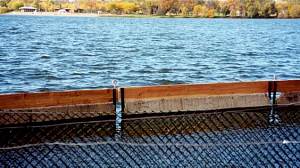 http://www.sustland.umn.edu/related/water5.html
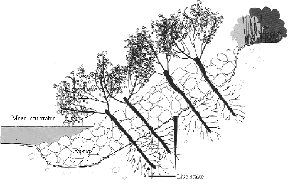
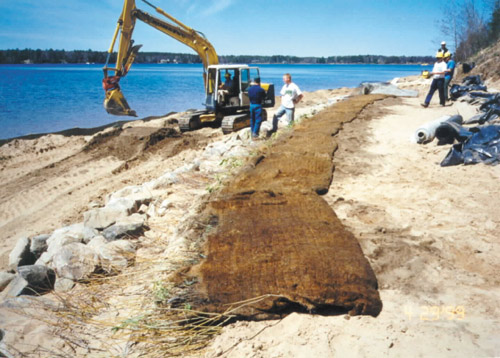
Temporary wave-breaking devices can be placed out in the water beyond the planted areas to protect the shoreline and vegetation from boat and wind-created waves. These can be constructed out of coconut-fiber logs, brush, rock within filter fabric, or double layers of plastic fence. There are many different materials that can be used to anchor plants on land as well as in the water. Coconut fiber, or coir, is a useful anchoring material due to its longevity. The fiber structure prevents scour (the abrasive movement of the water against the soil) and erosion, and provides protection until plants are established. There are many bioengineering methods for controlling erosion on upland slopes and near the water. Slope stabilization is very important and in cases where erosion has resulted in a very steep slope, some grading may be necessary to stabilize the slope that leads to the lake. Usually, the slope must be cut back rather than pushed out toward the water to meet permit requirements. Coir products are also used on uplands for holding the soil in place until plants establish from seed. Structural protection, such as rock, is needed at bottom of slope where velocities are high, bank soils are weak, or wave action is strong. Wattles, or live fascines, are bundles of branches that are used to protect banks from eroding. They root, sprout, and hold the soil in place and will also reduce water velocity, trap sediment, and hold the soil in place. Live Stakes stabilize slopes by creating a root system that holds soil and extracts moisture.
 http://www.reston.org/parks_rec/p_shoreline_stable.
Willow Posts create a deep root system to hold the bank in place while the willow�s branches keep erosive raindrops from hitting the soil directly. Brush Layers dig trenches and lay brush in trenches with tips coming out of ground; the tips will slow running water while the brush forms a root system. Brush Mattresses are useful for covering large, open soil areas. Brush approximately 6 feet long is layered vertically against the slope, butt ends down, within the staked area. The brush is covered with soil until about 80 % coverage is obtained. For all bioengineering methods, maintenance is extremely important. Soil should be kept moist while brush takes root, this takes approximately 6 weeks.
 http://www.landandwater.com/features/vol46no3/vol46no3_2.html
A limited number of species are appropriate for bioengineering. Ideal plants for stabilizing soil are fibrous-rooted woody species such as the willow and red-osier dogwood. The species you choose will depend a lot on availability; choose species that have the best ability to root from cuttings and will not grow too large for site conditions.
Ice ActionIce crashing against the shoreline can cause great damage to the lakeshore. Ice action will not destroy native vegetation, however. Many land shore property owners are tempted to remove this ridge of soil in the spring. It should be left in place if possible. The ridge can help filter runoff from the yard by capturing surface runoff against the ridge and allowing it to seep into the ground rather than flow directly into the lake. Removal of these ice ridges will expose the shoreline to erosion.
Back to Solutions