
Sackets Harbor Forts
Sackets Harbor Battlefield State Historic Site
Sackets Harbor Battlefield SHS official website
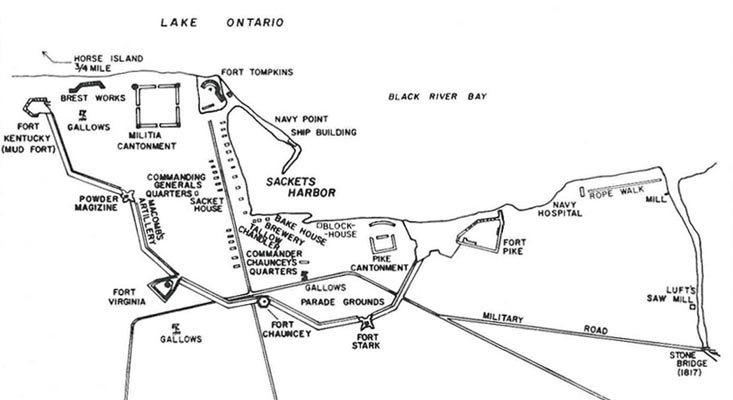
Sackets Harbor, a small, sleepy fishing village founded in 1804, soon became a major military and naval center on Lake Ontario during the War of 1812. A military presence was first established here in 1809 to enforce the 1808 Embargo Act directed against trade with Canada. The First Battle of Sackets Harbor occured in June 1812, when five British warships engaged the U.S. Brig Oneida and shore batteries manned by a company of U.S. Infantry. The British were repulsed. Soon after, a ring of defenses was erected to protect the town and the newly established U.S. Naval Shipyard on Navy Point. Fort Tompkins (blockhouse and earthworks with 20 guns) was the first built in 1812, located adjacent to the shipyard. The Smith (Basswood) Cantonment (palisaded complex with four blockhouses) was the garrison area for the troops. Officers were quartered in homes in the town. The blockhouse of Fort Virginia (16 guns) and the earthwork of Fort Volunteer were also constructed by 1813. The British attacked again in May 1813, landing troops on nearby Horse Island and marching east towards the town. The Americans sensed defeat and proceeded to burn all military and naval stores, then retreated to the fallback position of Fort Volunteer (site of the later Madison Barracks). However, the British could not overcome the entrenched Americans, and retreated in defeat. Soon afterwards, the town's defenses were strengthened again, with the addition of Fort Kentucky (palisaded earthworks), Fort Chauncey (stone tower), Fort Stark (earthworks), and a ring of earthworks connecting them with Forts Virginia and Volunteer. Fort Volunteer was rebuilt and renamed Fort Pike. The Pike Cantonment was built adjacent to Fort Pike as another garrison post for the troops. The town was not attacked again.
By war's end, eleven warships were built at the shipyard. Madison Barracks was constructed beginning in 1816 near Fort Pike to provide a permanent military presence on Lake Ontario (see seperate page). The shipyard was transformed into the U.S. Naval Station in 1848 after renewed tensions with Canada. After 1874, the shipyard was abandoned, and the naval station continued with minimal activity until 1954, being known as the New York State Naval Militia Training Center after 1915. Madison Barracks continued in operation until 1947, transferring all operations to Fort Drum near Watertown, established in 1908 as Pine Camp, later known as Camp Drum.
The Sackets Harbor Battlefield State Park encompases the Naval Station site, the Fort Tompkins site, the remnants of Fort Kentucky, and portions of the May 1813 battlefield. Traces of Fort Pike still remain at Madison Barracks. All other military works no longer exist. The site of the former Naval Shipyard on Navy Point is now a private marina.
courtesy of Sackets Harbor Historical Society
Map of Sackets Harbor Fortifications, 1814.
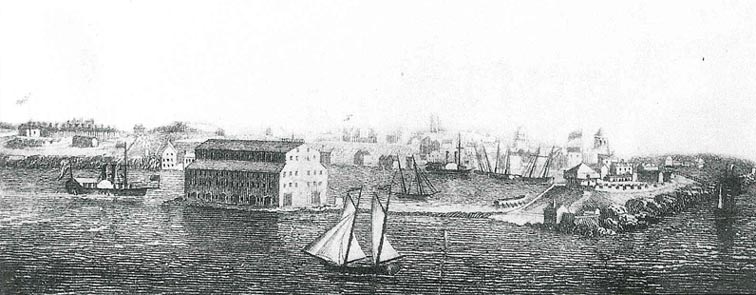
An 1835 drawing of Sackets Harbor, showing the Ship House at the Navy Yard (center).
Fort Tompkins is on the right, Fort Pike is on the left.
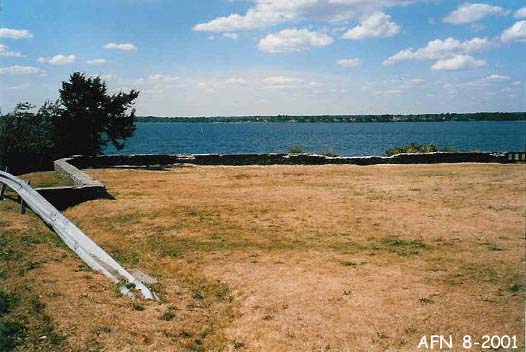
Site of Fort Tompkins (1812 - 1815), within the state park.
There are no trace remains of the fort, leveled by 1860.
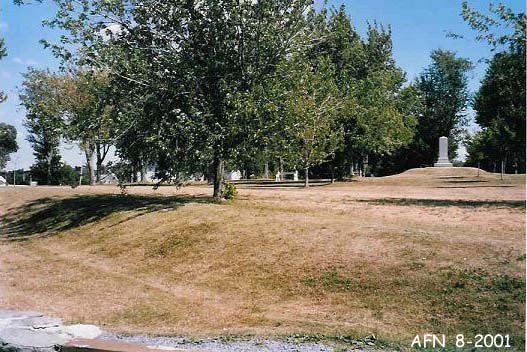
The War of 1812 Monument (1913) located within the site of Fort Tompkins.
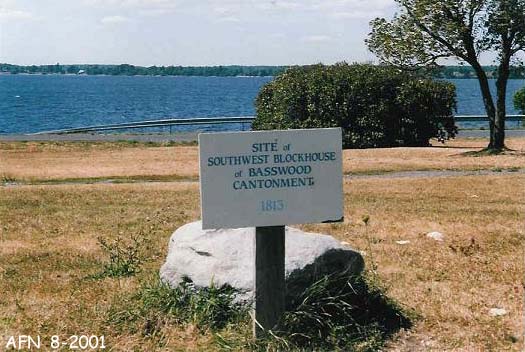
Marker for the southwest Basswood (Smith) Cantonment Blockhouse (1813 - 1815).
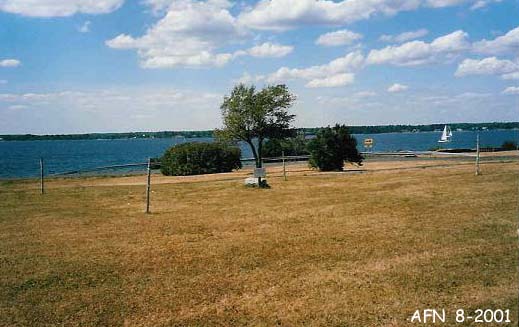
The Basswood site (wide view), adjacent to Fort Tompkins.
There were four blockhouses in a palisaded square barracks complex.
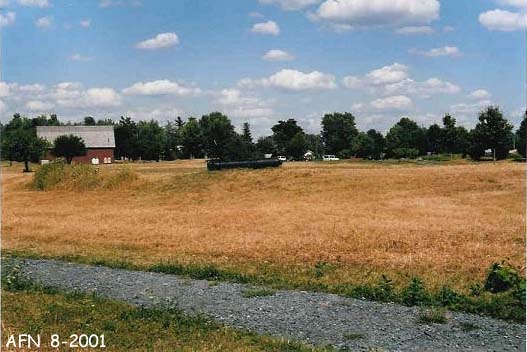
Earthwork remnants of Fort Kentucky (1813 - 1815), within the state park.
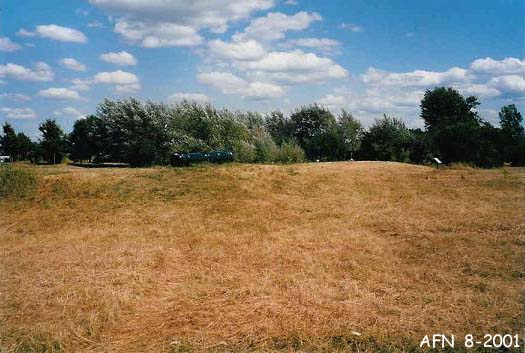
Fort Kentucky.
The cannon in photo is original, recovered in excavations.
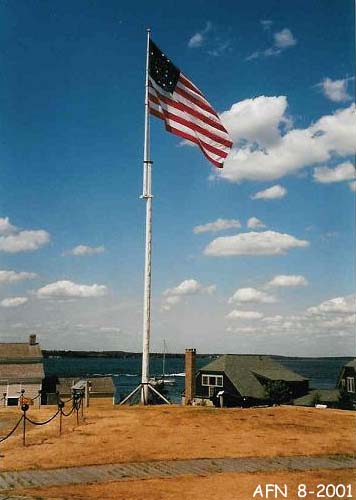
Flagpole at Sackets Harbor U.S. Naval Shipyard (1812 - 1874), within the state park.
A blockhouse was sited here in 1813, part of Fort Tompkins.
The Sail Loft and Icehouse (c. 1849) (left background) still remain on the site, with exhibits.
The houses on the right are part of the private Navy Point Marina complex.
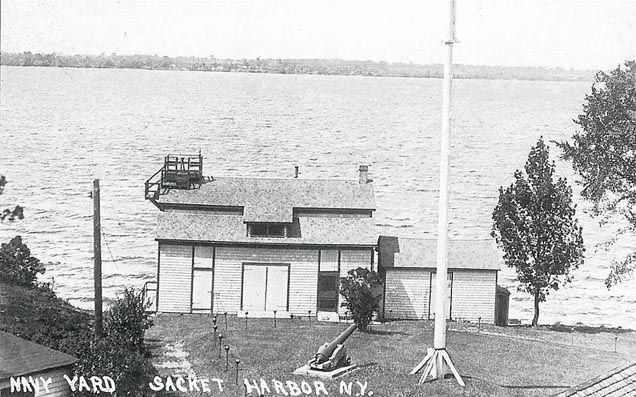
Sacket Harbor Navy Yard, circa 1915, depicting the Sail Loft.
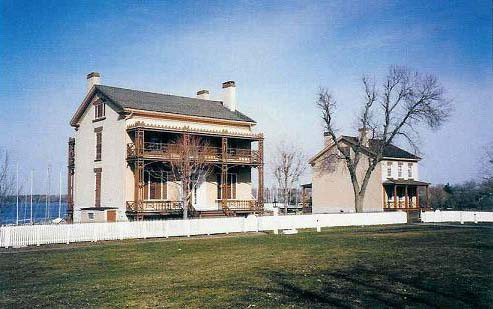
photo by Gary Ernest
Postcard of the Commandant's House (1848) (left), and the Lieutenant's House (1849) (right),
restored to the 1850's period with exhibits.
The U.S. Naval Station was established here 1848 - 1915.
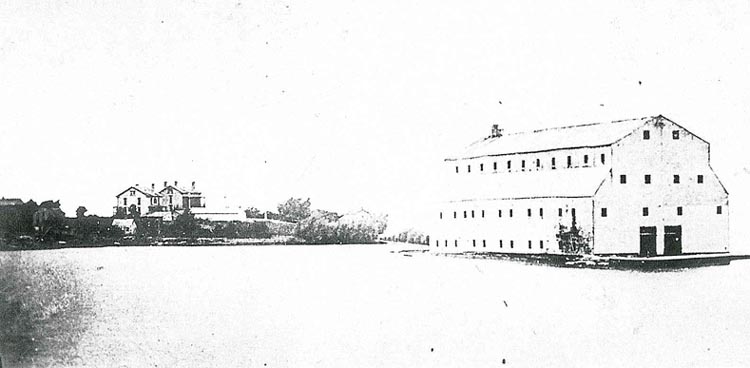
Sacket Harbor Navy Yard, depicting the Ship House on Navy Point.
The Commandant's House and Lieutenant's House on left.
The Ship House was built in 1815, demolished in 1884.
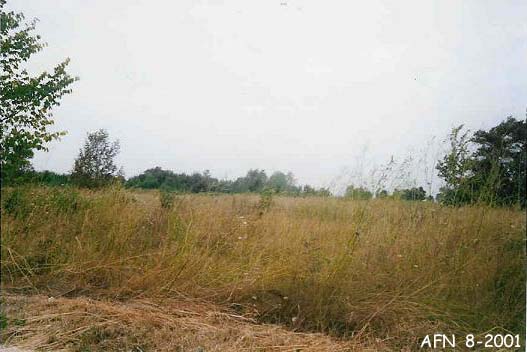
The general site of the powder magazine (1813 - 1815), between Forts Kentucky and Virginia.
No marker, no trace remains, on private land near Ray Street.
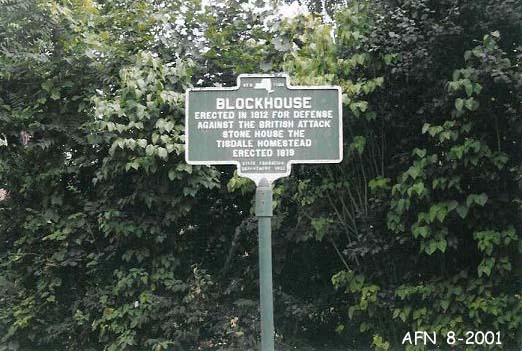
Marker for the Fort Virginia Blockhouse (1812 - 1815).
There are no trace remains, located at General Smith Drive and Washington Street.
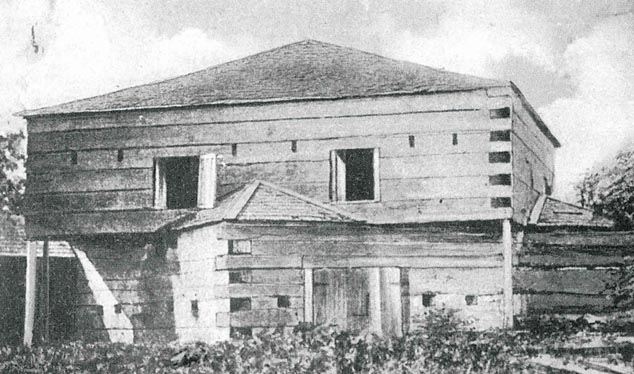
An image of the Fort Virginia Blockhouse taken many years after the war.
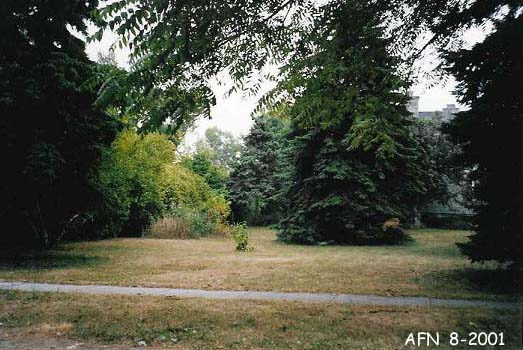
Site of Fort Virginia.
The blockhouse was surrounded by earthworks in 1813.
The house now here was built in 1817.
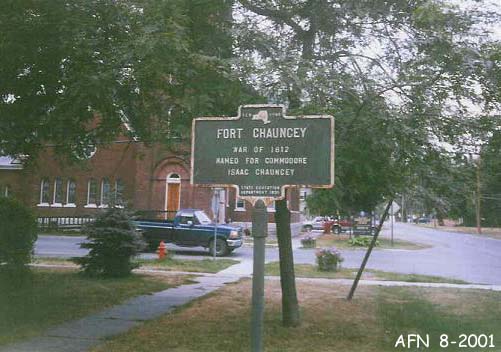
Marker for Fort Chauncey (1813 - 1815) on Broad Street.
There are no trace remains.
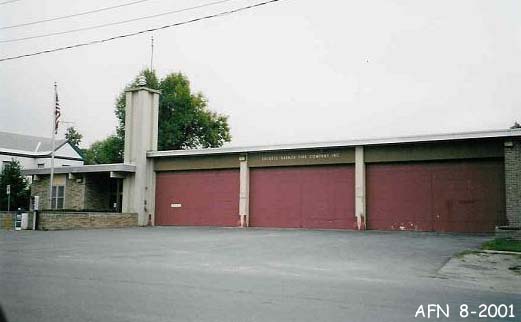
The site of Fort Chauncey is now the town's fire station.
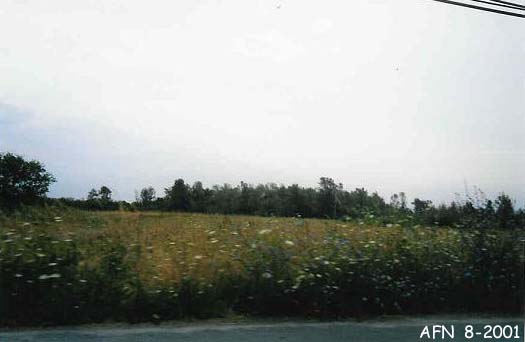
The general site of Fort Stark (1813 - 1815) on Monroe Street.
No marker, no trace remains, on private land.
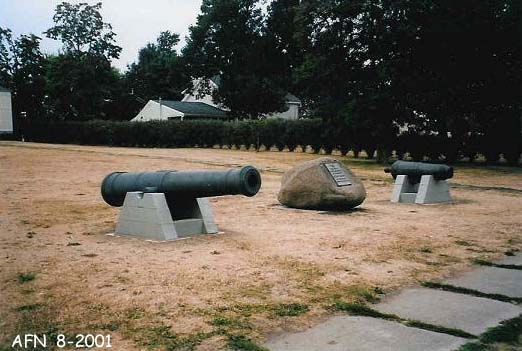
Old cannon and a stone marker located in front of the Sackets Harbor Visitor Center,
located at West Main and Bayard Streets.
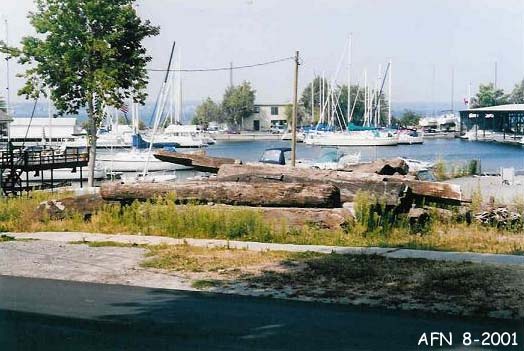
Old ship timbers located along the harbor in front of the Visitor Center.
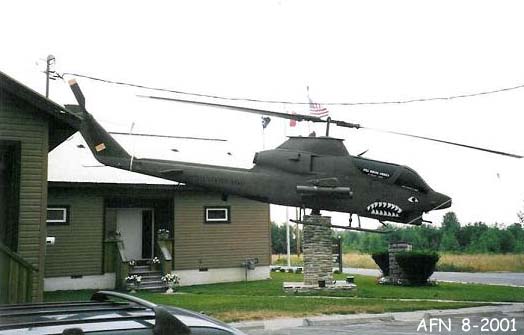
A US Army Cobra helicopter on display at the American Legion Post on Ambrose Street.
Evidently a cannon display wasn't good enough!
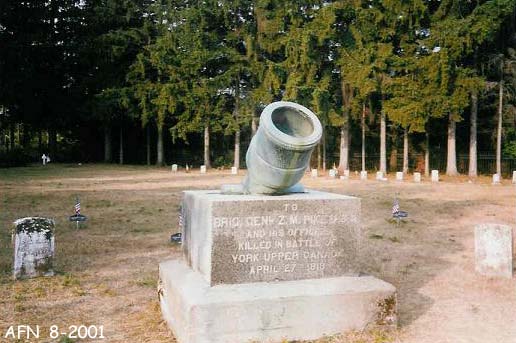
Sackets Harbor Military Cemetery on Dodge Avenue.
The tombstone monument for General Zebulon Pike (died 1813 at the Battle of York (Toronto)).
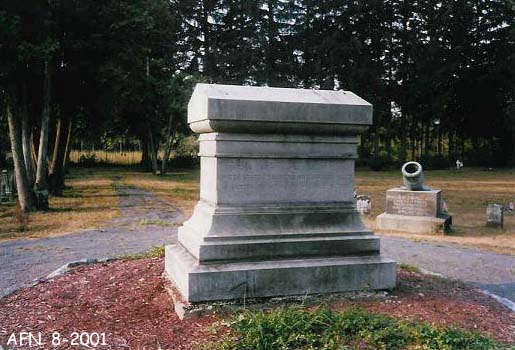
Tomb of the Unknown Soldiers, killed at the Battle of Sackets Harbor in 1813.
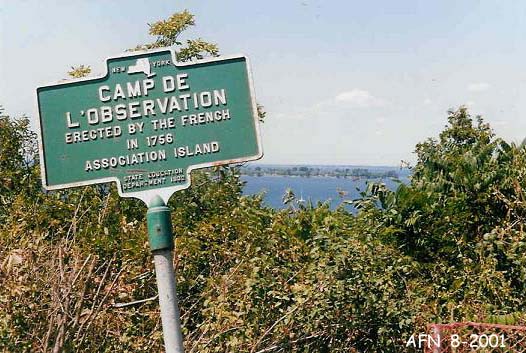
Marker for the French Camp of Observation (1756 - 1757) on Association Island.
The island is in the background, located in Henderson Harbor.
INDEX